Ornamental · Malvaceae
Hollyhock
Alcea rosea
Tall, old-fashioned spires of bloom that plant themselves once you let them go to seed.
Full sun
Every 5–7 days
USDA 3–9
5–8 ft · 1.5–2.4 m
Overview
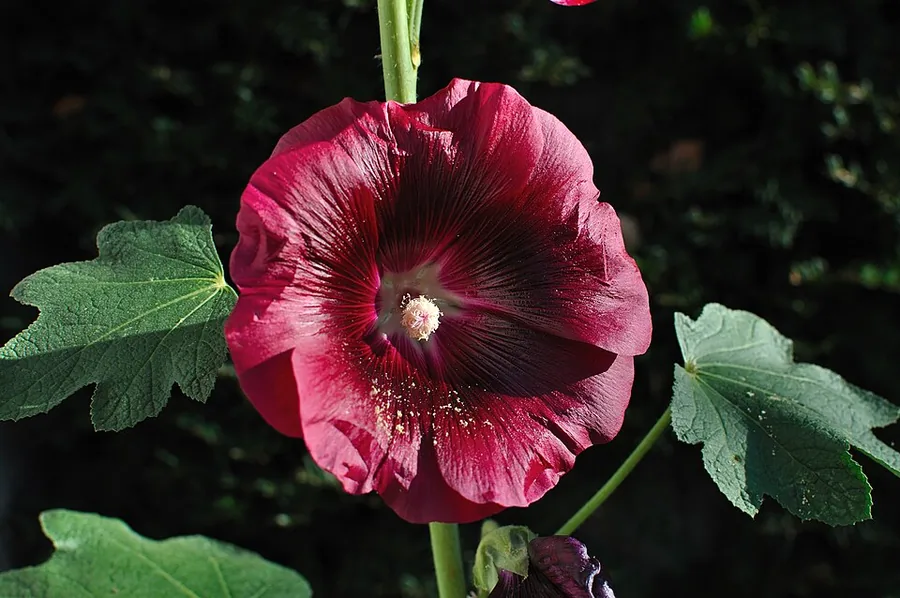
Hollyhock is the cottage-garden classic of the mallow family, valued for flower spikes that can exceed 8 feet (244 cm) and screen a fence or back wall through the summer. The saucer-shaped blooms are borne in succession up a single tall stalk from June through August, which accounts for both its long garden history and its vertical presence in a border.
The plant is undemanding despite that stature, and its life cycle explains the growing rhythm. Most forms are biennials, investing the first year in a low leaf rosette and flowering only in the second. The apparent slowness is offset by heavy self-seeding, so an established stand renews itself and reads as permanent even though individual plants are short-lived.
The defining management concern is rust, a foliar fungus that follows the plant almost everywhere it grows. The controls all trace back to the fungus's biology: full sun and open spacing keep the foliage drier and better ventilated, and watering at the roots rather than overhead denies the spores the leaf moisture they need to establish.
Care
The short version: site hollyhocks in full sun and rich, well-drained soil, hold even moisture by watering at the base, and space them so air moves and rust pressure stays low.
Light
Site hollyhocks in full sun, which supports the strongest flowering and keeps the tall stalks upright rather than lodging. They accept some partial shade, but reduced light drives the stems to stretch and lean, and flowering thins in proportion.
Water
Maintain average, even moisture and avoid letting the soil cycle between saturation and drought. Delivering water at the base with a soaker hose or drip line keeps the leaves dry, and because rust requires leaf wetness, that practice is among the most effective controls. The plant will not tolerate wet, waterlogged soil through winter.
Soil
Grow them in average, rich, well-drained loam amended with compost. They are indifferent to pH across the range 6.0 to 8.0, so drainage, not the exact reading, is the variable that governs performance.
Humidity
Ordinary outdoor humidity is adequate, so no target figure applies. The relevant factor is airflow, since stagnant, humid air around a crowded canopy is precisely the microclimate in which rust establishes.
Feeding
A single spring application meets the plant's needs. Incorporate compost or a balanced general-purpose fertilizer as growth resumes, and the plant sustains itself through the remainder of the season.
Pruning
Cutting the spent flower spikes tidies the plant and serves to limit self-seeding where spread is unwanted. Equally important, remove and destroy any rust-infected lower leaves and clear all debris in fall, since that tissue is where the fungus overwinters.
Size & spacing
These are tall plants, reaching 5 to 8 feet (152 to 244 cm) in height while remaining narrow at 12 to 24 inches (30 to 61 cm) in spread. Allotting each plant that full spread keeps air moving between them and reduces the rate at which rust advances.
When to plant
Hollyhock's schedule follows its biennial habit. Sow in late summer or start seed indoors in late winter, transplant after the last spring frost, and expect flowering from June through August of the subsequent year.
Northern hemisphere
Southern hemisphere
Typical months for a temperate climate: start earlier in warm zones, later where spring frosts linger.
- Sow: Late winter to early spring, about 8 to 10 weeks before the last frost.
- Plant: After the last spring frost once soil has warmed.
- Harvest: June through August.
Hardiness
USDA hardiness zones: 3–9
Temperature: down to -40°C
Troubleshooting
Nearly every hollyhock disorder registers on the foliage, and rust is the first most growers encounter. Identify the symptom below and intervene early, since these problems are far more readily prevented than reversed once they establish.
Chlorotic spots above, sporulating pustules below
This is hollyhock rust, driven by the fungus Puccinia malvacearum and the single disease that tracks the plant across its range. The yellow-orange spots on the upper surface mark infection sites, while the raised rusty pustules on the underside are where the fungus sporulates, which is why heavily colonized leaves eventually perforate and shrivel. Because the spores overwinter on plant tissue, removing infected leaves early, watering at the base to deny the fungus the leaf wetness it needs, and clearing all debris in fall each interrupts a stage of the cycle.
Fix:
- Remove and destroy symptomatic leaves early
- Clear all hollyhock debris in fall
- Water at the base to keep foliage dry
- Remove weedy mallows nearby
- Apply a labeled fungicide before symptoms appear if rust is recurrent
Foliage skeletonized to a lacy network
Two feeders produce this lacework. Japanese beetles aggregate and feed by day, consuming the softer tissue between the veins and leaving the venation as a skeleton, whereas slugs feed after dark and betray themselves with slime trails. Hand-picking beetles into soapy water in the early morning exploits their daytime activity, and because slugs move at night, baits or traps set where they travel are the more reliable control.
Fix:
- Hand-pick beetles into soapy water in early morning
- Reduce nearby turf grub habitat
- Use slug baits or traps where slugs are present
Diminished bloom with bored buds
The agent is the hollyhock weevil, Rhopalapion longirostre, a small black insect with tan legs and a long snout that congregates on buds and open flowers. It bores into buds and developing seeds, and that direct damage to the reproductive tissue is what reduces flowering. Since the larvae complete development in the seed heads, dislodging adults onto a sheet to destroy them and removing old seed heads both cut off the next generation.
Fix:
- Hand-pick or shake weevils onto a sheet and destroy them
- Remove and destroy old seed heads where larvae develop
Degraded lower canopy with dark lesions
Leaf spot and anthracnose fungi establish in the lower canopy where crowding, stress, and overhead watering keep the tissue wet and poorly ventilated, while the flowers remain unaffected. The damage is disfiguring but seldom threatens plant survival. Removing the worst leaves, widening spacing to raise the canopy's air movement, and watering at the base together remove both the inoculum and the moisture the fungi depend on.
Fix:
- Remove affected leaves
- Improve air circulation
- Water at the base rather than overhead
Toxicity
For households with pets, the record is reassuring: the ASPCA lists hollyhock as non-toxic to cats, dogs, and horses, and the flowers are edible enough that people consume them. The sole caveat is dermatological, since the bristly leaves and fibers can raise a mild skin rash in sensitive people, which is why gloves are advisable when handling or cutting the plants.
Safe for
People · Cats · Dogs · Horses · Rabbits · Livestock · Birds
Cats None
The ASPCA classifies hollyhock as non-toxic to cats, so ingestion carries no poisoning risk. Any plant eaten in volume can provoke a cat to regurgitate the fiber, but the tissue itself holds nothing toxic.
Dogs None
Dogs are equally unaffected. Hollyhock is non-toxic to dogs, and the most a leaf-chewing animal is likely to experience is transient, mild gastrointestinal upset from the roughage.
Horses None
Horses may graze in proximity to hollyhocks without concern, as the plant contains no toxic principles that would affect them.
Rabbits Safe
Rabbits may consume the leaves and flowers safely, since these Malvaceae plants contain nothing harmful to them.
Livestock Safe
Cattle, goats, and sheep incur no toxic risk from hollyhock when they browse a plant along a pasture or garden margin.
Birds Safe
Backyard birds and poultry may take the foliage and seeds without any harm.
People Safe
The plant is safe for people, and the flowers are in fact edible, commonly used as a garnish or steeped for tea. The one qualification is dermatological: the bristly leaves and fibers can produce a mild skin rash in sensitive individuals, so gloves are advisable when handling or cutting the plants.
Contact with the bristly foliage and plant fibers can cause skin irritation (contact dermatitis) in sensitive people; wear gloves when handling.
Varieties
The great majority of garden hollyhocks are the common Alcea rosea, but a few selections and related species merit attention for flower color or for their resistance to rust. These are the ones worth identifying.
Nigra
This selection carries deep maroon flowers pigmented so intensely that they read as nearly black against the green spike.
Russian hollyhock (Alcea rugosa)
A related species bearing soft yellow flowers, it shows markedly greater resistance to hollyhock rust than the common hollyhock.
Figleaf hollyhock (Alcea ficifolia)
Distinguished by its fig-shaped foliage, this species likewise tolerates rust better than Alcea rosea.
How to propagate
Hollyhocks propagate readily from seed, and once a stand is established it largely renews itself through self-sowing.
SeedEasy
Sow in late summer (August to September) for bloom the following year, or start indoors in late winter for transplanting after frost. · Germinates in about 1 to 2 weeks; plants form a rosette the first year and bloom the second year.
Seed is the standard and most reliable route to new hollyhocks. Sowing in late summer, roughly August to September, yields flowers the following year, while an indoor start in late winter allows transplanting once frost has passed. Germination follows in 1 to 2 weeks, after which the plant holds as a rosette through the first year and flowers in the second, consistent with its biennial habit. Left in place, the seed heads shed freely and reseed the stand, naturalizing it into a persistent colony.
Myths
Hollyhocks are poisonous and should be kept away from dogs and cats.
The ASPCA classifies hollyhock as non-toxic to dogs, cats, and horses, so incidental grazing in the garden warrants no concern. The flowers are edible enough that people consume them. The only genuine qualification is dermatological, since the bristly leaves can raise a mild rash on sensitive skin, so gloves are sensible when cutting the plants.
Hollyhocks are reliable, long-lived perennials.
Most hollyhocks are biennials by habit, producing a leafy rosette in the first year and reserving flowering for the second before the plant declines. Their apparent permanence is a product of prolific self-seeding, which repopulates the same ground with fresh plants season after season.