Vegetable · Malvaceae
Okra
Abelmoschus esculentus
Give it heat, full sun, and steady moisture, and okra keeps setting pods until frost.
Full sun
Every 5–7 days
68–95°F · 20–35°C
50–65 days
Overview
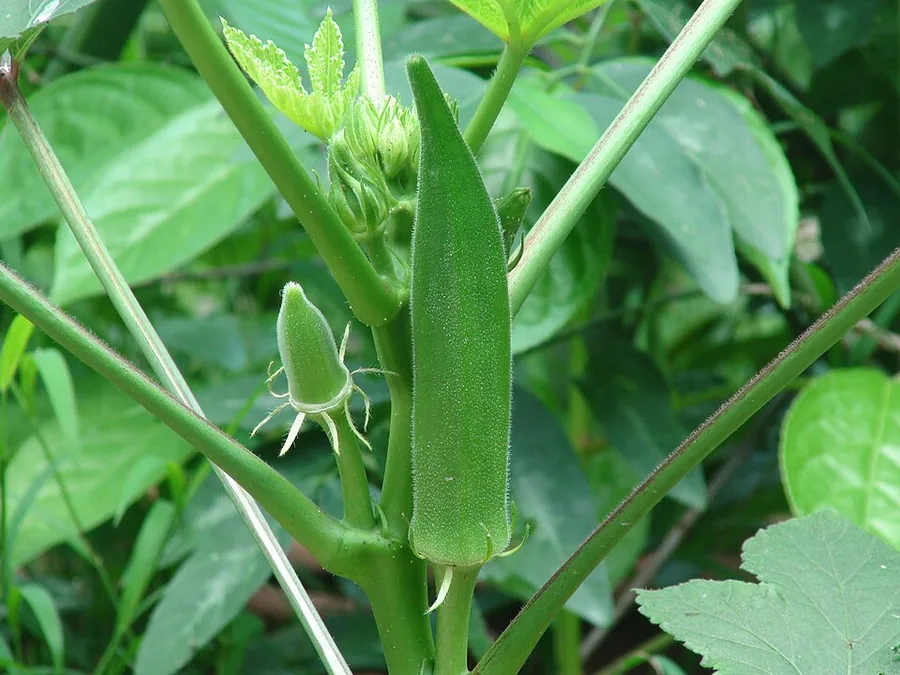
Okra is a warm-season vegetable in the mallow family, related to hibiscus and cotton, cultivated for its immature seed pods. The species originates in Africa and has anchored Southern, Caribbean, and South Asian cuisines, appearing in gumbo, curries, and pickles. Its habit is tall and upright and notably ornamental, with broad lobed leaves and pale hibiscus-like flowers that precede each developing pod.
Okra's defining trait is its thermophilic nature. It performs through heat that arrests many other crops, and it continues bearing as long as harvest keeps pace with pod set. A layer of fine bristly hairs covers most of the plant, from stems to pods, and can irritate exposed skin, which explains the preference among growers for spineless varieties.
As an easy crop, okra imposes one firm requirement: frequent harvest. Pods transition from tender to tough and woody within a day or two as their tissue lignifies, and a plant left unpicked slows pod production. Consistent picking keeps a short row yielding through the hottest part of the growing season.
Care
The short version: full sun and genuine warmth, freely draining soil, and about an inch of water a week, held steady once flowering and pod set begin.
Light
Okra requires full sun and responds to as much of it as possible. Site it in the brightest, warmest position available, because shade elongates the plants and sharply reduces pod production.
Water
Supply about 1 inch of water a week, held steady once flowers and pods form. Established plants tolerate short dry spells, yet consistent moisture through pod set maximizes yield, while waterlogged soil causes real damage.
Soil
Grow okra in deep, well-drained, fertile loam enriched with organic matter. A slightly acidic pH of 6.0 to 6.8 suits it, and loose ground allows the taproot to descend freely.
Temperature
This heat lover performs between 68°F and 95°F (20°C to 35°C). Cold soil and chilly nights suppress growth, so early planting confers no advantage.
Humidity
Okra accommodates ordinary outdoor humidity across 40% to 70% without difficulty. The figure is not a limiting factor here; warmth and sunlight govern the crop far more.
Feeding
Incorporate a balanced fertilizer at planting, then side-dress with modest nitrogen once pods begin forming. Keep nitrogen restrained, because excess drives vegetative growth at the expense of pod set.
Pruning
Okra needs no structural pruning, only frequent harvest every day or two to sustain productivity. Where plants grow very tall, topping or cutting back mid-season stimulates lateral branching and a second flush of pods.
Repotting
Not applicable; grown as a direct-sown annual in the garden
Size & spacing
Plants reach 3 to 6 feet (90 to 180 cm) in height and warrant adequate room. Space them about 18 to 35 inches (45 to 90 cm) apart to promote airflow and deliver light to the lower pods.
When to plant
Okra is governed by heat and has no tolerance for cold soil. In cool regions seeds can be started indoors a few weeks before the last frost, but the controlling condition is the same everywhere: delay planting until frost has passed and the soil has warmed to 65°F to 70°F (18°C to 21°C). Harvest then begins roughly two months after that.
Northern hemisphere
Southern hemisphere
Typical months for a temperate climate: start earlier in warm zones, later where spring frosts linger.
- Sow: 3-4 weeks before the last spring frost in cool regions to gain a head start
- Plant: After all danger of frost has passed and soil has warmed to 65-70°F (18-21°C)
- Harvest: Harvest pods young at 2-4 inches long, every 1-2 days, beginning about 2 months after sowing
Hardiness
USDA hardiness zones: 5–11
Temperature: down to -29°C
Troubleshooting
Most okra disorders register first on the pods, the flowers, or the leaves. Reading the early signs keeps a minor setback from progressing to crop loss. Identify the symptom below, then intervene while intervention still changes the outcome.
Stunted, chlorotic plants with galled roots
Swollen galls along the roots of a stunted plant identify root-knot nematodes feeding within the root tissue and disrupting water and nutrient uptake, which drives the yellowing and wilt above ground. No effective chemical rescue exists, so lifting and destroying the worst plants curbs population buildup. Rotation into non-host cover crops, generous organic matter, resistant varieties, and soil solarization together suppress the pest in recurring beds.
Fix:
- Remove and destroy heavily infested plants
- Rotate with non-host cover crops and add organic matter
Whole-plant wilt with browned vascular tissue
Wilt that irrigation does not relieve, together with brown streaking in a lengthwise-cut stem, indicates fusarium wilt, since the fungus colonizes and blocks the vascular tissue that moves water. The pathogen persists in soil and cannot be cured, so affected plants should be removed and discarded rather than composted. Long rotations, well-drained soil, and resistant cultivars form the practical defense against reinfection.
Fix:
- Remove and destroy affected plants; do not compost
Sticky foliage, curling leaves, and clustered insects
The ant-attended, soft-bodied colonies are aphids, and their honeydew becomes a substrate for black sooty mold, which is the sticky film you notice. A firm water jet dislodges them mechanically, insecticidal soap treats the heaviest foliage, and predators such as lady beetles and lacewings sustain control. Because aphids feed on soft, sappy tissue, restraining nitrogen limits the flush of tender growth that draws them.
Fix:
- Spray plants with a strong jet of water to dislodge aphids
- Apply insecticidal soap to affected foliage
- Encourage natural predators such as lady beetles and lacewings
Flowers abscising before pods set
Blossom drop reflects environmental stress rather than a disease, most often an intense heat wave, an unusually cool night, or drought coinciding with flowering. The plant resumes setting pods once conditions moderate, so the objective is buffering that stress while it passes. Even soil moisture supports pollination and pod set, and a mulch layer stabilizes soil temperature and conserves water through dry intervals.
Fix:
- Maintain consistent soil moisture during flowering
- Mulch to moderate soil temperature and conserve water
Pods turning tough, woody, and stringy
This is over-mature fruit rather than pathology. As a pod grows beyond roughly 4 inches its cell walls lignify and fill with fiber, which is why texture, not health, is the real variable. Harvest young at 2 to 4 inches every day or two, and clear the oversized pods so the plant redirects its energy into fresh pod set instead of maturing seed.
Fix:
- Harvest pods young at 2-4 inches, every 1-2 days
- Remove and discard over-mature pods to redirect energy to new pod production
Toxicity
For households with pets and children, the record is straightforward: okra is a non-toxic edible vegetable, safe for people and animals alike. The one consideration is the fine bristly hairs on the raw stems and pods, which can irritate sensitive skin at harvest, so gloves and long sleeves keep the work comfortable.
Safe for
People · Cats · Dogs · Horses · Rabbits · Livestock · Birds
Cats None
Okra carries no toxins for cats, so an investigative nibble of pod or leaf will not poison one. The spiculate hairs on the foliage may prompt licking or pawing at the mouth, but no systemic effect follows.
Dogs None
Okra presents no poisoning risk to dogs, and the cooked pods serve as a harmless treat. A dog that ingests a large volume of raw pods may show transient flatulence or loose stool, a purely mechanical response to the fiber load.
Horses None
Okra contains nothing toxic to horses, so a volunteer plant near the pasture warrants no concern. Most horses decline the bristly stems in any case.
Rabbits None
Rabbits browse okra leaves and pods without hazard, and many favor the tender young growth. Introduce it in measured portions alongside their standard hay rather than as a single large feeding.
Livestock None
Cattle, goats, and sheep can consume okra foliage with no risk of poisoning. In some regions the crop is cultivated deliberately for forage and seed.
Birds None
Okra is non-toxic to birds, and backyard chickens readily take the chopped pods and enclosed seeds. It supplies a wholesome, vitamin-rich feed item.
People None
Okra is a culinary staple eaten raw, fried, stewed, or pickled, with no poisoning risk. The single caveat is the fine bristly hairs on raw stems and pods, which can irritate sensitive skin during harvest.
The stems, leaves, and pods of most okra varieties are covered in fine bristly hairs (spicules) that can cause mild, transient skin itch or irritation in sensitive handlers; wearing long sleeves and gloves when harvesting helps. Spineless varieties such as 'Clemson Spineless' reduce this effect.
Varieties
Many okra varieties are available, but a small group recurs across gardens and seed catalogs. These are the selections worth knowing.
Clemson Spineless
This award-winning standard bears nearly spineless pods, which minimizes the skin irritation that harvest usually brings.
Annie Oakley II
A compact, early-maturing hybrid suited to gardeners constrained by a shorter growing season.
Burgundy
An ornamental-edible selection whose deep red stems and pods revert to green under cooking heat.
Emerald
A heirloom valued for smooth, round, dark-green pods that hold their tenderness at a larger size.
Cajun Delight
An early, prolific hybrid bred to yield reliably across both short and long growing seasons.
How to propagate
Okra is grown from seed and essentially nothing else, sown directly into its permanent position. The one technique that matters is preparing the hard seed coat before sowing.
SeedEasy
Direct-sow after the last frost once soil has warmed to 65-70°F (18-21°C) · 7-14 days to germinate; harvestable pods in about 50-65 days
Okra is propagated by direct-sown seed placed in its final position after frost, once soil temperature reaches 65°F to 70°F (18°C to 21°C). Because the seed coat is hard, an overnight soak or light scarification improves imbibition and germination; sow half an inch to an inch deep. Emergence follows in 7 to 14 days, with harvestable pods in roughly 50 to 65 days.
Myths
Okra is toxic because its leaves and pods are covered in irritating hairs.
Those spiculate hairs induce only a mechanical skin itch in some individuals, an effect resolved by rinsing or by wearing gloves. Okra is a non-toxic edible vegetable, and its pods are consumed worldwide.
Okra only grows well in hot southern climates.
Okra is heat-loving but not restricted to the South. Once soil reaches 65-70°F, pairing an early-maturing variety with the warm season lets you produce a sound crop as a warm-season annual well into cooler regions.