Shrub · Malvaceae
Rose of Sharon
Hibiscus syriacus
Because it flowers on current-season wood, this hardy mallow rewards a hard late-winter cut with color from June to October.
Full sun
Every 7–14 days
USDA 5–9
8–12 ft · 2.4–3.7 m
Overview
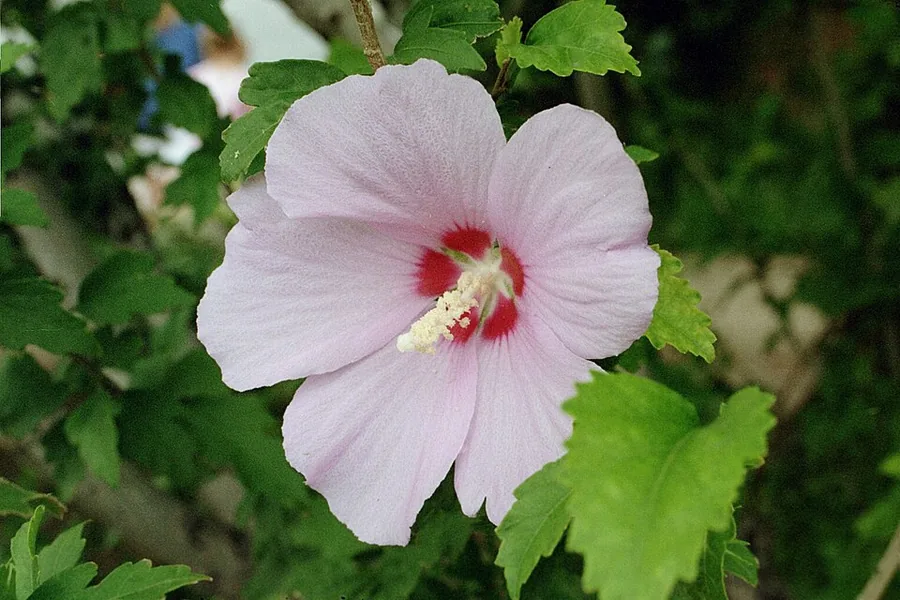
Rose of Sharon (Hibiscus syriacus) is an upright deciduous shrub in the mallow family, valued for extending the flowering season well past midsummer. It opens fresh, hibiscus-shaped flowers in succession from June into October, a habit tied to its bloom on current-season growth. Flower color spans white, pink, lavender, and an uncommon violet-blue, and most cultivars carry a contrasting eye at the throat.
Its reputation for toughness rests on broad environmental tolerance. Once the root system is established, the shrub withstands heat, humidity, drought, and poor soil, and its hardiness extends to roughly -20°F (-29°C). Growth is fast, and a mature height of 8 to 12 feet (2.4 to 3.7 m) makes it a practical informal screen or a structural anchor at the back of a border.
The trait that requires management is its prolific seed production. Under favorable conditions the species self-seeds heavily enough to be listed as invasive in several states, and its volunteer seedlings establish readily. Selecting a sterile triploid such as Diana, which sets almost no viable seed, removes that risk while preserving the long bloom period.
Care
The short version: site it in full sun on well-drained soil, irrigate through the first season or two to establish the root system, then prune hard in late winter so the current season's growth carries a strong flush of bloom.
Light
Flowering is driven by light, so full sun produces the heaviest bloom, though the shrub tolerates partial sun and light afternoon shade with a corresponding reduction in flowers. Siting it in an open, sunlit position maximizes bud set across the season.
Water
During establishment, regular deep irrigation encourages the root system to develop, which is the basis of the plant's later resilience. Once established, usually after a season or two, it becomes drought tolerant and performs on medium moisture and rainfall except in prolonged dry spells.
Soil
The species adapts to a wide pH range and tolerates poor sites, so fertility is rarely limiting. What it does require is sharp drainage, because saturated soil around the roots is one of the few conditions it will not withstand. Average, well-drained ground meets its needs.
Temperature
Cold hardiness and heat tolerance together span roughly -20°F to 100°F (-29°C to 38°C), which underlies its wide adaptability. It carries summer heat and humidity without stress and overwinters unprotected within its hardiness range.
Humidity
Ambient outdoor humidity is adequate, so no humidity management is warranted. The more relevant factor is air circulation: still, crowded air keeps foliage wet longer and favors the leaf spots and rusts this shrub can otherwise resist.
Feeding
In soils of average fertility the plant needs little supplemental nutrition, so a single application of balanced general-purpose fertilizer in spring suffices. Excess nitrogen is counterproductive, since it forces soft, succulent growth that aphids preferentially colonize.
Pruning
Because flowers form on new wood, pruning in late winter or early spring, before growth resumes, preserves the season's bloom and removes none of it. Cutting stems back hard, to 2 or 3 buds, redirects the plant's resources into fewer but substantially larger flowers while establishing framework.
Repotting
Container specimens are repotted infrequently. The indications for moving up are functional rather than scheduled: roots circling or emerging from the drainage holes, water passing straight through with little uptake, and stalled growth all signal that the root volume has been outgrown.
Size & spacing
This is a fast-growing shrub, maturing at 8 to 12 feet (2.4 to 3.7 m) tall with a spread of 6 to 10 feet (1.8 to 3 m). Spacing to that mature width is not merely aesthetic; it maintains air movement through the canopy, which keeps foliage dry and suppresses fungal disease.
When to plant
Rose of Sharon leafs out late and concentrates its display in the second half of the season, holding flowers from June into October. Establish new plants in spring after the last frost, or in early fall, and confine pruning to late winter, before bud break, so no flowering wood is removed.
Northern hemisphere
Southern hemisphere
Typical months for a temperate climate: start earlier in warm zones, later where spring frosts linger.
- Sow: late winter to early spring (8-10 weeks before last frost)
- Plant: spring after last frost, or early fall
- Harvest: June to October (mid to late summer)
Hardiness
USDA hardiness zones: 5–9
Temperature: down to -29°C
Troubleshooting
This is a durable shrub, and the problems that reach it are largely cosmetic and surface first on leaves and buds. Inspecting the foliage through summer catches pests and foliar disease early, when intervention is simplest and least disruptive to bloom.
Foliage skeletonized between the veins in summer
The lacework damage is caused by Japanese beetles, which aggregate on warm days and consume the leaf tissue between the veins while leaving the vein network intact. Hand-collecting them in the early morning, when they are sluggish, and dropping them into soapy water is effective. Pheromone traps are counterproductive, drawing in more beetles than they remove.
Fix:
- Hand-pick beetles in early morning and drop into soapy water
- Avoid pheromone traps that attract more beetles
- Treat heavy infestations with an appropriately labeled insecticide following directions
Deformed, honeydew-coated new growth
Distorted, sticky shoots indicate aphids, and sometimes whiteflies, feeding on the tender growth and excreting a honeydew that supports sooty mold. A forceful water spray dislodges the colonies physically, and insecticidal soap clears the remainder. Established populations of lady beetles and other predators usually suppress them without further intervention.
Fix:
- Dislodge aphids with a strong spray of water
- Apply insecticidal soap or horticultural oil to affected growth
- Encourage natural predators such as lady beetles
Buds abscising before they open
Yellowing buds that fall while still closed are bud drop, a physiological response to moisture stress rather than pathogen activity. The plant remains healthy but sheds buds when the root zone alternates between wet and dry during bud development. Maintaining even soil moisture through bud set and hot weather, reinforced with mulch, stabilizes the water supply and holds the buds.
Fix:
- Maintain even soil moisture, especially during bud set and hot weather
- Mulch to conserve moisture and buffer soil temperature
- Avoid letting the root zone dry out completely while flowering
Leaf spots, blotches, and occasional stem cankers
Discrete spots, blighted blotches, and rust pustules are the work of several fungal leaf spots, blights, and rusts, and canker fungi occasionally lesion the stems. All are favored by wet foliage and stagnant, crowded air. Removing affected leaves, excising cankered wood, and opening the canopy so foliage dries rapidly addresses both the symptoms and the conditions driving them.
Fix:
- Remove and dispose of affected leaves and prune out cankered stems
- Improve air circulation and avoid overhead watering
- Apply a labeled fungicide only if problems are severe
Toxicity
For households with pets or children, the toxicology is reassuring: Rose of Sharon is non-toxic across the board. The ASPCA records it as safe for cats, dogs, and horses, and the flowers are edible for people, so it can be sited without restriction.
Safe for
People · Cats · Dogs · Horses · Rabbits · Livestock · Birds
Cats None
Non-toxic to cats. Ingestion of a leaf or flower may produce brief gastric upset from the roughage alone, with no toxic effect.
Dogs None
Listed by the ASPCA as non-toxic to dogs, so incidental chewing carries no toxicological risk.
Horses None
Non-toxic to horses as well, so grazing on a small quantity of foliage poses no special hazard.
Rabbits Safe
Rabbits can browse the foliage without toxic effect, though any abrupt dietary change is best introduced gradually.
Livestock Safe
No compounds of concern to cattle, goats, or sheep that encounter a planting.
Birds Safe
Harmless to backyard and wild birds, many of which forage the flowers for nectar.
People Safe
Safe for people; the flowers are edible, consumed raw in salads or steeped as tea.
No special handling precautions for toxicity; as with any plant, ingestion of large amounts of plant material may cause mild, transient stomach upset.
Varieties
Selection and breeding have produced a broad spectrum of flower color and form in Hibiscus syriacus, ranging from clean singles to semi-double, anemone-form blooms. The cultivars below are among the most widely grown.
Diana
Diana bears pure white single flowers that remain open into the evening, and as a sterile triploid it produces almost no seed.
Blue Bird (Oiseau Bleu)
Blue Bird, listed as Oiseau Bleu, is distinguished by large single flowers of true violet-blue, each centered on a red eye.
Minerva
Minerva flowers in soft lavender-pink accented by a reddish-purple eye at the throat.
Aphrodite
Aphrodite carries dark pink single flowers organized around a deep red center.
Red Heart
Red Heart presents crisp white petals surrounding a prominent red center.
Lavender Chiffon
Lavender Chiffon produces lavender semi-double, anemone-form flowers with an added ruffle of inner petals.
How to propagate
The choice of method determines genetic fidelity to the parent. Vegetative approaches, cuttings and layering, reproduce the parent's exact flower color, whereas seed segregates and yields variable offspring.
Stem cuttingsEasy
Softwood cuttings in late spring to summer; hardwood cuttings in late fall to winter · Several weeks to root; transplantable the following season
Cuttings are the reliable route to a genetically identical plant, reproducing the parent's exact flower color. Softwood cuttings taken in late spring or summer, or hardwood cuttings from late fall into winter, root over several weeks. Grown on through a season, they are ready to transplant the following year.
SeedEasy
Sow late winter to early spring; the species also self-seeds outdoors · Germinates in a few weeks; flowers in 2-3 years
Seed is easily raised but genetically variable, so seedlings seldom reproduce the parent's flower color. Sown from late winter to early spring, seed germinates within a few weeks, but a resulting plant requires 2 to 3 years to reach flowering size. The species also self-seeds freely in the landscape, at times excessively.
LayeringEasy
Spring to summer · One growing season to root before separating
Layering exploits the shrub's capacity to root along a stem held against the soil. A low branch pinned to the ground in spring or summer forms its own roots over a single growing season, after which it is severed and lifted as an independent plant.
Myths
Rose of Sharon is toxic to dogs and cats.
The record does not support this. The ASPCA classifies Hibiscus syriacus as non-toxic to dogs, cats, and horses, so ingestion of a leaf or flower presents no toxicological hazard, and the flowers are in fact edible for people. Any effect is limited to transient gastrointestinal upset from the bulk of ingested plant material, as with most foliage.
Summer or fall pruning increases flowering.
The mechanism argues the reverse. Since the shrub blooms on new wood produced in the current season, cutting in summer or fall excises the very stems that would flower. Prune in late winter or early spring before growth begins, and reducing stems to 2 or 3 buds concentrates resources into fewer but larger blooms.