Shrub · Adoxaceae
Arrowwood Viburnum
Viburnum dentatum
A resilient native shrub delivering spring flowers, blue-black fruit, and strong fall color with minimal input.
Full sun
Every 5–10 days
USDA 2–8
5–10 ft · 1.5–3 m
Overview
Arrowwood viburnum ranks among the most adaptable shrubs available to the temperate garden. As a native of eastern North America, it withstands winter lows to -40°F (-40°C) and accepts a soil range that defeats less flexible species. Its common name records an ethnobotanical use, since Native peoples cut the straight young stems for arrow shafts.
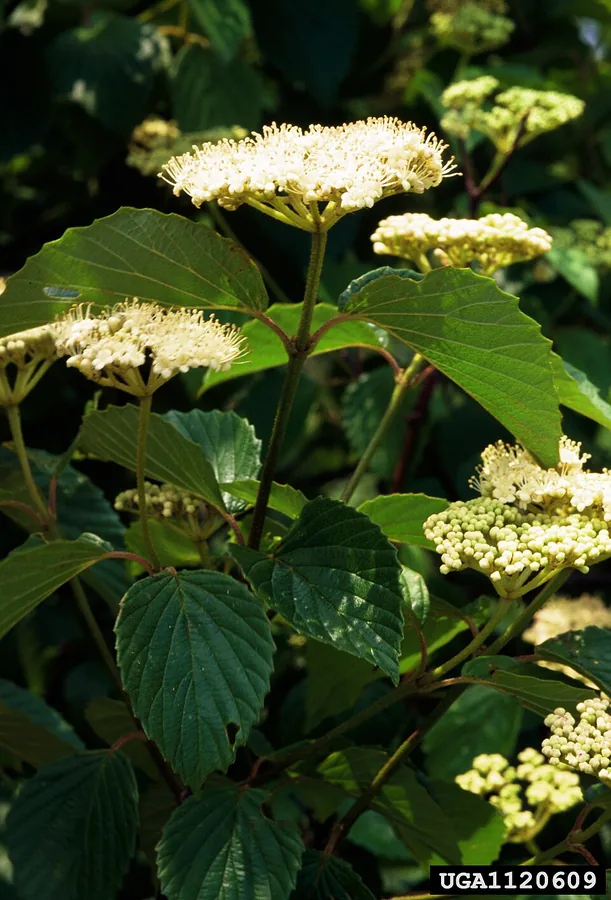
The species offers three distinct seasons of interest. Flat-topped creamy-white inflorescences open in late spring, blue-black drupes mature into fall, and the foliage colors in yellow, orange, and red before drop. As the fruit ripens, birds consume it readily, which gives the plant clear ecological as well as ornamental value.
Mature form is a rounded, multi-stemmed shrub of 5 to 10 feet (1.5 to 3 m) that suckers from the base and will form a thicket if unmanaged. The principal limitation is a specialist beetle, addressed below. Manage that single pressure and the species demands little further attention.
Care
The short version: site it in full sun to part shade in nearly any well-drained soil, irrigate through establishment, and inspect the twigs for viburnum leaf beetle eggs across winter.
Light
Arrowwood performs best in full sun to part shade. Full exposure maximizes flowering, fruit set, and autumn coloration, whereas a position with afternoon shade still yields a sound display and suits a woodland-edge planting.
Water
Maintain consistently moist soil, irrigating deeply through establishment and during drought. After the root system settles the plant tolerates intermittent dry periods, which in practice means watering every 5 to 10 days as governed by heat and soil type.
Soil
Soil adaptability is a defining trait of the species. It establishes in clay, loam, sand, or shallow rocky ground provided drainage is adequate, and it tolerates a broad pH from 5.5 to 8.0, spanning acidic to alkaline conditions.
Temperature
This cold-hardy native endures from -40°F to 100°F (-40°C to 38°C), corresponding to USDA zones 2 through 8. Winter low temperatures impose no constraint, so siting is open across most of the temperate range.
Humidity
Ambient humidity is immaterial for a landscape shrub of this kind. Air movement is the relevant factor, since open, ventilated growth keeps foliage dry and reduces pest establishment.
Feeding
Nutrient demand is low in reasonable ground. A balanced slow-release fertilizer or compost in early spring supplies what is needed, and an established shrub in fertile soil frequently requires no supplemental feeding.
Pruning
Prune immediately after flowering in late spring to shape or thin, and remove suckers to restrain spread. The critical operation is dormant-season scouting: excise and burn any twigs bearing viburnum leaf beetle eggs between October and spring.
Repotting
This is a landscape subject rather than a container plant, so repotting is rarely relevant. While held in a nursery pot, pot it on once the roots begin to circle or water passes through without being absorbed.
Size & spacing
Allow for a rounded shrub 5 to 10 feet (1.5 to 3 m) in height and comparable in width, with a spread of 6 to 10 feet (1.8 to 3 m). Provide that spacing, or more, where a companion plant is set nearby for cross-pollination.
When to plant
As a woody, fully hardy shrub, arrowwood involves no indoor seed-starting. Establish new plants in spring or fall, expect bloom in late spring, and allow the fruit to color from late summer into fall for foraging birds.
Northern hemisphere
Southern hemisphere
Typical months for a temperate climate: start earlier in warm zones, later where spring frosts linger.
- Plant: Spring or fall
- Harvest: Creamy-white flat-topped flower clusters in late spring (roughly March-May depending on region), followed by blue-black berries in late summer to fall
Hardiness
USDA hardiness zones: 2–8
Temperature: down to -46°C
Troubleshooting
Arrowwood is structurally tough, and most disorders register on the foliage. One pest accounts for the serious damage while a second is largely cosmetic. Identify the symptom below, then intervene before the leaf beetle in particular advances unchecked.
Foliage skeletonized to a lace of veins
Skeletonized foliage points to the viburnum leaf beetle, for which Viburnum dentatum is the most preferred host of any viburnum. Two feeding stages overlap, larvae in spring and adults afterward, so a heavy generation can defoliate the plant within a season. The control that matters most is sanitation: excise the egg-laden twigs through winter, dislodge larvae from small plants, and conserve lady beetles and lacewings as predators.
Fix:
- Prune out and destroy egg-infested twigs between October and spring before eggs hatch
- Hand-remove or knock larvae off small plants
- Encourage natural predators such as lady beetles, lacewings, assassin bugs, and spined soldier bugs
- Treat heavy larval infestations with an appropriate labeled insecticide if needed
Stippled, honeydew-coated leaves with white flies overhead
Stippling and sticky residue indicate a whitefly colony on the leaf undersides, whose excreted honeydew supports the black sooty mold that follows. Because the insects cling loosely, a forceful water spray strips most of the population, and insecticidal soap applied beneath the leaves reaches the survivors. The damage is largely aesthetic and seldom threatens the shrub.
Fix:
- Spray foliage with a strong stream of water to dislodge insects
- Apply insecticidal soap or horticultural oil to leaf undersides
- Encourage natural predators
Toxicity
For households with pets or children, the verdict is favorable: arrowwood viburnum is non-toxic in all its parts. The ASPCA lists it as safe for cats, dogs, and horses, and the fruit nourishes birds rather than harming them. Its tartness makes the raw berries unpalatable to people, but they present no toxic risk.
Safe for
People · Cats · Dogs · Horses · Rabbits · Livestock · Birds
Cats None
The ASPCA classifies viburnum as non-toxic to cats, so an investigative bite carries no toxic risk. The only plausible reaction is the transient gastric upset that excess plant material can provoke in any species.
Dogs None
The same ASPCA listing covers dogs, leaving leaves and berries free of toxic consequence. A large volume of ingested foliage may still trigger brief, self-limiting digestive upset through bulk alone.
Horses None
No toxin in viburnum is known to affect equines, so horses may graze in proximity to the shrub without risk.
Rabbits None
Rabbits browse arrowwood foliage in the wild with no toxic consequence. For a captive animal, any unfamiliar forage warrants gradual introduction to avoid disrupting hindgut fermentation.
Livestock None
Ruminants such as cattle, goats, and sheep tolerate the leaves and twigs without harm. As a native of pasture margins, the shrub carries no documented record of livestock poisoning.
Birds None
Beyond merely safe, the blue-black drupes are a sought fall food source that concentrates songbird activity as the fruit ripens.
People None
The plant presents no human toxicity, yet the raw fruit is markedly tart and astringent and offers little culinary value in quantity. The crop is best reserved for foraging birds.
No special handling required; as with any plant, ingesting large amounts of foliage or berries may cause mild stomach upset in pets.
Varieties
Most cultivated arrowwoods are named selections developed for more compact habit, heavier fruiting, or stronger autumn color. The following are the selections most often encountered in the trade.
Blue Muffin
A compact selection of 5 to 7 feet that yields abundant blue fruit, with set greatly improved by a genetically distinct arrowwood planted for cross-pollination.
Chicago Lustre
A vigorous upright cultivar carrying glossy dark green foliage and noted for dependable late-season flowering.
Autumn Jazz
A vase-shaped selection valued for autumn coloration, when the leaves develop strong tones of yellow, orange, and red.
Companions
Arrowwood fruits far better with a second, different arrowwood nearby to pollinate it, and pairs well with shade plants at its feet. Keep it away from other beetle-prone viburnums.
Plant near
A different arrowwood viburnum cultivar: Provides cross-pollination that dramatically improves berry set.
Native ferns and shade perennials: Fill the shaded base of the shrub and thrive in the same moist, well-drained soil.
Keep apart
Other highly VLB-susceptible viburnums (e.g. V. opulus): Clustering preferred hosts together can concentrate viburnum leaf beetle pressure.
How to propagate
You can multiply arrowwood three ways, from quick and easy to slow and stubborn. Cuttings and layering give you an exact copy of the parent; seed is a long project for the patient.
Stem cuttingsModerate
Early to mid summer · 6 to 10 weeks to root
Vegetative cuttings reproduce a named cultivar true to type. During early to mid summer, collect softwood cuttings from actively growing shoots, treat the basal cut with rooting hormone, and maintain high humidity to limit moisture loss while adventitious roots develop over 6 to 10 weeks.
SeedDemanding
Collect ripe fruit in fall · Several months to over a year (needs warm then cold stratification)
Seed propagation is slow and suited to the patient grower. Harvest ripe fruit in fall, then account for complex double dormancy that requires a warm period followed by a cold one, after which germination proceeds erratically across several months to more than a year.
LayeringEasy
Spring to summer · One growing season or more
Layering is the least demanding approach and partly a natural one. From spring through summer, peg a low branch into contact with the soil and allow it to root over a full growing season or longer. The shrub also throws natural suckers from the base, which can be lifted and divided as established plants.
Myths
The berries are poisonous to pets and people.
The premise contradicts the record: the ASPCA classifies viburnum as non-toxic to cats, dogs, and horses, so the blue-black drupes pose no threat to garden animals. The berries are valuable bird food, not a hazard, although their tartness limits their appeal for raw human consumption in quantity.
One arrowwood viburnum will always fruit heavily on its own.
An isolated specimen commonly sets only a sparse crop because the species fruits best when outcrossed. Cross-pollination from a second, genetically different arrowwood markedly raises fruit set, so siting two or more distinct cultivars or seedlings together produces the fullest display of berries.