Shrub · Caprifoliaceae
Beautybush
Kolkwitzia amabilis
A dependable, arching shrub whose old-wood branches carry pink, bell-shaped flowers each spring.
Full sun
Every 7–14 days
USDA 4–8
6–10 ft · 1.8–3 m
Overview
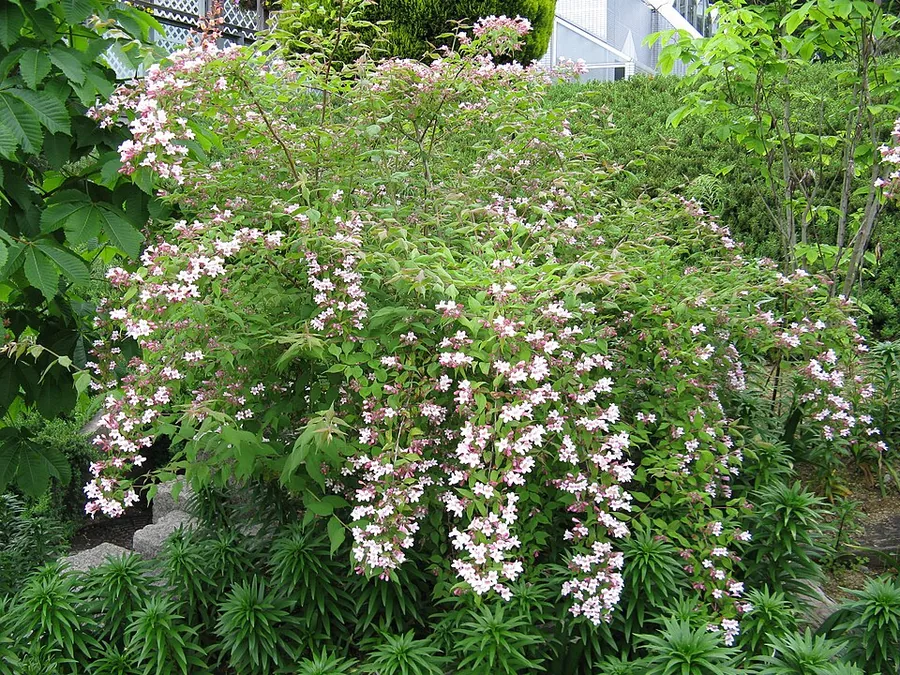
Beautybush declares itself in mid spring, when its arching, vase-shaped framework is hidden beneath hundreds of soft pink, bell-shaped flowers, each bearing a yellow throat. Outside that window it holds the garden together as a structural shrub, and its exfoliating bark sustains some interest through winter. A member of the honeysuckle family, the species originated in the wild in China before its introduction to Western cultivation.
Its reputation for resilience is well founded. The shrub tolerates clay and drought and withstands winter cold to -29°F (-34°C), and it carries no significant pest or disease problems. Deer typically avoid it, which recommends it for sites where browsing pressure is a constraint.
Mature dimensions warrant planning. At maturity the shrub attains 6 to 10 feet (1.8 to 3 m) in both height and spread, expanding in a fountaining habit rather than an upright one. Site it where that loose, open architecture can develop unrestricted, and it will require little beyond correctly timed pruning.
Care
The short version: full sun and average, well-drained soil suit it, watering through the establishment season builds a deep root system, and thereafter it needs little attention beyond pruning carried out directly after flowering.
Light
Beautybush flowers most freely in full sun, defined as six or more hours of direct light daily, because flower initiation responds to light intensity. It will grow in partial shade, but each hour of reduced light corresponds to a measurable loss of spring bloom.
Water
Water the shrub regularly through its first growing season to drive deep root development. Once established it is self-sufficient and tolerant of both drought and heavy clay, so during dry spells a thorough soaking every 7 to 14 days is sufficient.
Soil
The species asks only for average, well-drained ground. It accommodates clay, loam, or sand and a broad pH range from 5.5 to 8.0, spanning acidic through alkaline conditions, so most garden soils support it without amendment.
Temperature
Rated for USDA zones 4 to 8, beautybush endures winter minima to -29°F (-34°C) and summer maxima to 100°F (38°C) without injury.
Humidity
Ambient outdoor humidity has no bearing on this shrub, so no humidity management is required. It performs equally in humid and arid summers.
Feeding
A low-maintenance shrub, it has minimal nutrient demands. A balanced general-purpose fertilizer or a compost topdressing applied in spring meets its needs, and in many soils feeding can be omitted altogether.
Pruning
Pruning timing is decisive, since beautybush flowers on old wood. Prune immediately after the flowers fade, removing a portion of the oldest stems at the base to maintain an open form. Avoid late-winter or early-spring cuts, which excise that season's flower buds.
Repotting
As a landscape shrub it rarely needs repotting. A young specimen grown temporarily in a container should be potted up when roots circle the rootball or the medium dries unusually fast, and then planted into the ground.
Size & spacing
A mature beautybush reaches 6 to 10 feet (1.8 to 3 m) in both height and spread. Allow that allocation at planting so the arching branches can develop their characteristic fountaining form.
When to plant
Establish beautybush in spring or fall, when mild conditions allow the roots to develop before the onset of summer heat or severe winter cold. Flowering follows in mid to late spring, approximately April into May, as the pink flowers open along the previous season's wood.
Northern hemisphere
Southern hemisphere
Typical months for a temperate climate: start earlier in warm zones, later where spring frosts linger.
- Plant: Spring or fall
- Harvest: Mid to late spring (April to May)
Hardiness
USDA hardiness zones: 4–8
Temperature: down to -34°C
Troubleshooting
This shrub presents gardeners with few difficulties, and most of those that arise can be traced to pruning carried out at the wrong time. Identify the symptom below, and the correction is generally a matter of timing.
Few or no flowers in spring
Because beautybush carries its flower buds on old wood, the buds form during the previous season and overwinter on year-old stems. Cutting in late winter or early spring removes that wood and the dormant buds with it, which explains a bloomless spring. Insufficient light has a similar effect, since flower initiation depends on full sun, so the remedy is to ensure six or more hours of direct light and confine pruning to the period just after bloom.
Fix:
- Prune only immediately after flowering ends
- Relocate or thin surrounding plants to provide more direct sun
A dense, twiggy shrub that looks unkempt with age
Without intervention, beautybush accumulates aging stems and the interior closes into a crowded thicket where shaded wood flowers little. Renewal pruning corrects this: removing a share of the oldest canes at ground level just after bloom each year reopens the canopy. The cuts redirect the plant's resources from spent wood into vigorous new growth that will carry the next round of buds.
Fix:
- Remove a portion of the oldest stems at ground level after flowering
- Thin congested growth to open the form
Toxicity
Beautybush is a sound choice for gardens that include pets, livestock, or children. The species is absent from the ASPCA's toxic list and contains no recognized toxin in its leaves, stems, or fruit. Grown for ornament rather than consumption, it presents no toxicological concern.
Safe for
People · Cats · Dogs · Horses · Rabbits · Livestock · Birds
Cats Safe
The ASPCA toxic list does not include beautybush, so foliage investigated by a cat presents no toxic hazard. The only plausible response to a large mouthful is transient gastrointestinal upset from ingested plant matter, not poisoning.
Dogs Safe
A dog that contacts or chews the foliage faces no documented risk from this shrub. At most, a substantial nibble may produce mild, self-limiting digestive upset rather than any toxic reaction.
Horses Safe
No constituent of beautybush is known to be harmful to a grazing horse. Classed as an ornamental rather than forage, it tends to attract little grazing interest in any case.
Rabbits Safe
Rabbits, whether wild or domestic, can ingest the leaves without toxic consequence. In practice both deer and rabbits generally avoid the shrub, so browsing pressure stays low.
Livestock Safe
Cattle, goats, and sheep encounter no toxic principle in this shrub should they reach a stray branch along a fence line. Its standing as an ornamental, not a pasture species, limits the likelihood of significant intake.
Birds Safe
The shrub presents no hazard to birds, which frequently shelter within its arching, twiggy structure. Its dry, capsule-like fruit contains no known toxic compound.
People Safe
As a landscape shrub rather than a culinary plant, beautybush carries no recognized toxin and poses no concern for a gardener or a child. It is cultivated for ornament, not for consumption.
No special handling precautions noted; routine garden hygiene (wash hands after pruning) is sufficient.
Varieties
The species itself sets a high standard, yet a small number of named selections advance either the flowers or the foliage. The two below merit consideration.
Pink Cloud
A selection valued for clear pink flowers slightly larger than those of the wild type, produced in such density that the framework of the shrub is obscured at peak bloom.
Dream Catcher ('Maradco')
Selected for its seasonal foliage progression, emerging copper, passing through yellow and golden chartreuse, and concluding the year in orange and gold.
How to propagate
Beautybush can be increased by cuttings, by dividing an established clump, or from seed, and the chosen method largely determines the time required to reach an established plant.
Stem cuttingsModerate
Late spring to early summer using softwood cuttings · Several weeks to root; one or more seasons to establish
Softwood cuttings offer the most reliable means of increase. Collect them in late spring to early summer, while the current growth is still flexible and green and at its rooting peak. Rooting proceeds over several weeks, after which the young plant requires a season or more in the ground to establish.
DivisionModerate
Dormant season · One growing season
An established clump produces suckers and basal shoots that can be lifted and replanted as separate divisions. Carry out the work in the dormant season, when the plant is least disrupted by root disturbance. Each division needs roughly one growing season to establish.
SeedModerate
After collecting ripe capsules · Multiple years to reach flowering size
Seed is the slowest route to a flowering plant. Harvest the dry, capsule-like fruits at ripeness and sow them, allowing for the several years a seedling needs to reach flowering size. The protracted timeline is why most growers favor cuttings.
Myths
Beautybush should be cut back hard in late winter like many summer-blooming shrubs.
Hard late-winter pruning is appropriate for shrubs that flower on the current season's growth, but beautybush flowers on old wood and behaves in the reverse manner. A late-winter or early-spring cut therefore removes the year-old stems that hold the overwintered buds. Prune only once the flowers have faded.