Ornamental · Caprifoliaceae
Pincushion Flower
Scabiosa columbaria
Full sun and sharp drainage are what let the pincushion flower bloom from spring to frost.
Full sun
Every 5–10 days
90–120 days
USDA 5–9
Overview
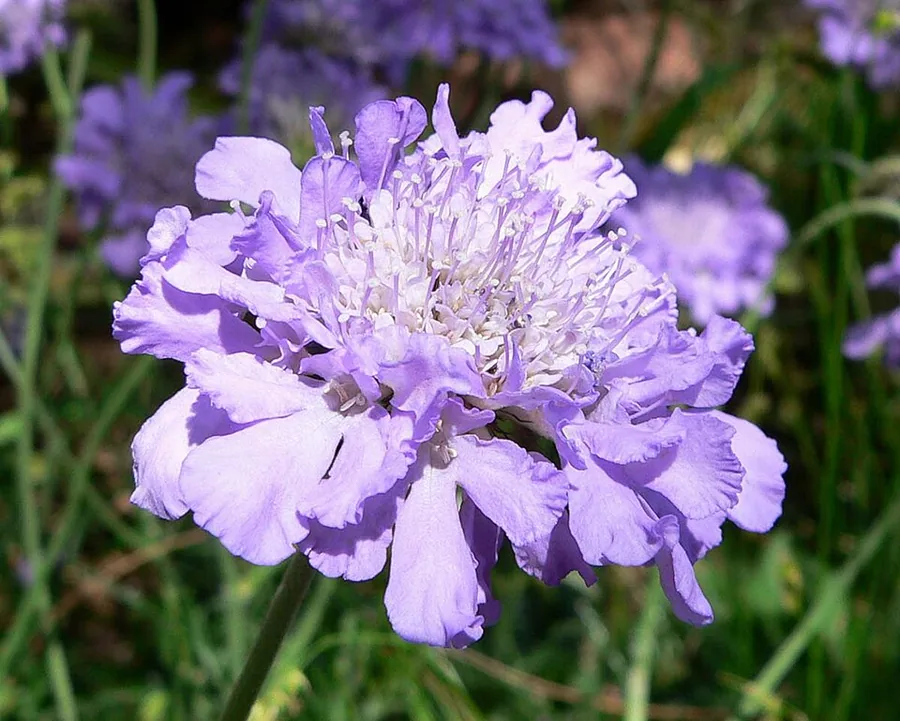
The common name describes the flower's structure with some precision. Each head forms a raised, domed receptacle studded with many small protruding stamens, so the whole bloom reads as a cushion full of pins. It is a perennial in the family Caprifoliaceae, compact enough for the front of a border, and it remains in flower across months rather than weeks.
The open, accessible flower heads draw bees and butterflies from late spring onward, which is why the plant earns a place in pollinator plantings and informal borders. Its lavender-blue and soft pink forms are the ones most often grown. Cutting the stems, much like deadheading, removes spent flowers before they set seed and prompts the plant to produce more bloom, so regular picking works with its habit rather than against it.
Its low maintenance follows from a few tolerances the record documents. It withstands drought once established, deer generally avoid it, and it contains no compound toxic to people or animals, so it is safe around pets and children. Its single real weakness is poor drainage, because roots left in saturated soil, above all through winter, are prone to rot.
Care
The short version: site it in full sun with fast-draining soil, and water only after the upper half of the soil dries. Deadhead through the season to sustain flowering, and divide the clump every few years to keep it vigorous.
Light
Flower production depends on light, so full sun yields the best bloom, with a little afternoon shade tolerated where summer heat is strong. In deeper shade the plant stretches and flops, spending its energy on stems rather than flowers.
Water
Allow the upper half of the soil to dry before watering, which usually falls around every 5 to 10 days. Once established the plant is drought tolerant, and because its roots are intolerant of saturation, a dry interval is far safer than wet feet, particularly over winter.
Soil
Drainage governs success with this species. Grow it in well-drained loam or sandy loam with good organic content, across a pH range from a mildly acidic 6.0 to an alkaline 8.5. Heavy, water-retentive soil holds moisture at the roots and is the usual cause of failure.
Temperature
Cold hardiness is broad, from -20°F to 90°F (-29°C to 32°C), which places it comfortably in zones 5 to 9. It survives hard winters and continues flowering through ordinary summer heat without stalling.
Humidity
Ambient outdoor humidity is adequate, so no target figure applies. The relevant factor is air movement around the foliage, since stagnant, humid air at the leaf surface is the condition that favors powdery mildew.
Feeding
Nutrient demand is low. A balanced all-purpose fertilizer or a light spring topdressing of compost meets it, and overfeeding only produces soft, weak stems at the expense of form.
Pruning
Deadheading spent blossoms removes the flowers before they set seed and prompts continued reblooming, which is what extends the season. Cutting tired stems back to the base encourages fresh basal growth from the crown.
Repotting
As a garden perennial it seldom needs moving, but the clump benefits from division every 3 to 4 years. Reduced flowering, a woody and crowded center, and a general loss of vigor are the record's indicators that the clump has outgrown itself and should be lifted and split.
Size & spacing
Mature plants stay compact at 12 to 18 inches (30 to 46 cm) tall and about 9 to 18 inches (23 to 46 cm) wide. Spacing to that mature width preserves the air movement around each plant that keeps mildew from establishing.
When to plant
As a cold-hardy perennial rated to zone 5, the pincushion flower runs on the temperate season. Sow seed indoors roughly a month or two before the last frost, transplant after the danger of frost passes, and the plant flowers from late spring until the first hard frost ends the display.
Northern hemisphere
Southern hemisphere
Typical months for a temperate climate: start earlier in warm zones, later where spring frosts linger.
- Sow: 4 to 8 weeks before the last spring frost
- Plant: After danger of frost has passed in spring
- Harvest: Blooms from late spring (April to May) until first frost
Hardiness
USDA hardiness zones: 5–9
Temperature: down to -29°C
Troubleshooting
Most problems on this species reduce to two causes the record repeats: excess soil moisture and poor air movement in a crowded stand. The earliest signs appear at the crown and on new growth, so inspect there first. Identify the disorder below and correct the underlying condition before it spreads through the clump.
Collapse with blackened stem bases and brown, mushy roots
Collapse accompanied by blackened stems and soft, brown roots indicates root rot, a condition that follows from soil holding water too long, most acutely over winter. Excavate around the crown to confirm dark, decayed roots in place of firm white ones. Correct the site by lifting the plant, incorporating grit or compost to improve drainage, and replanting only the sound divisions on ground that sheds water.
Fix:
- Improve drainage by amending soil with grit or organic matter
- Avoid overwatering and remove affected plants
- Replant healthy divisions in a well-drained site
Deformed shoot tips with a sticky secretion on leaves and buds
Curled, deformed tips and a sticky secretion signal aphids feeding on the soft new growth, occasionally with mites or whiteflies present. Confirm by examining leaf undersides and the growing points for colonies of small insects. A forceful jet of water dislodges most colonies, and insecticidal soap treats any residual population.
Fix:
- Spray off pests with a strong stream of water
- Apply insecticidal soap if needed
White, powdery colonies coating the leaf surfaces
A powdery white layer on the foliage is powdery mildew, a fungal problem favored by crowding and the still air that accompanies it. Increase spacing and thin the clump to restore air movement, and remove the most heavily colonized leaves. Full sun and watering at the soil rather than over the canopy remove the conditions it favors.
Fix:
- Improve air circulation by spacing and thinning
- Remove affected foliage
Toxicity
The horticultural record places the pincushion flower firmly in the non-toxic category. The genus does not appear on the ASPCA list of plants toxic to cats, dogs, or horses, and no part of it carries a compound that would harm a person handling it. It can be sited anywhere people and animals have access.
Safe for
People · Cats · Dogs · Horses · Rabbits · Livestock · Birds
Cats Safe
No toxic principle in the plant affects cats, so it can share their space without risk. Overconsumption of any foliage may cause transient vomiting, but that reflects indigestible bulk rather than a poison.
Dogs Safe
Dogs are equally unaffected. The species is not entered on the ASPCA toxic list, so incidental chewing of a leaf carries no consequence.
Horses Safe
Horses may graze in proximity to these borders without harm, as the plant contains nothing poisonous to them.
Rabbits Safe
Rabbits take no harm from browsing it. As with any unfamiliar forage, a gradual introduction lets a sensitive digestive system adjust.
Livestock Safe
Cattle, goats, and sheep are unaffected around the planting, since it holds no toxin capable of troubling grazing animals.
Birds Safe
Neither the flowers nor the seed heads present any hazard to birds, which in practice visit them to feed on nectar and seed.
People Safe
The plant is safe to handle and non-toxic to people. It is grown ornamentally rather than for consumption, and it offers no part intended to be eaten.
No special handling precautions required; generally safe around pets and children.
Varieties
Two named selections account for most plantings, and both are well documented. These are the two to know.
Butterfly Blue
Butterfly Blue, distinguished by its lavender-blue flowers, was designated the 2000 Perennial Plant of the Year and is recognized among the Missouri Botanical Garden's Plants of Merit.
Pink Mist
Pink Mist is a compact selection bearing frilly, soft pink pincushion flowers, and it performs best grouped with Butterfly Blue.
Companions
Pincushion flower pairs naturally with other sun-loving perennials that share its taste for well-drained ground and keep the pollinators coming all season.
Plant near
Scabiosa Pink Mist: Complementary pincushion blooms recommended for grouping in border fronts and rock gardens.
Other sun-loving border perennials: Shares full-sun, well-drained conditions and supports a continuous pollinator display.
How to propagate
The species propagates readily by two methods the record supports: seed and division of an established clump. Both are straightforward, and the choice depends mainly on whether you are starting from scratch or dividing a plant you already have.
SeedEasy
Start indoors 4 to 8 weeks before last spring frost · Germinates in about 2 to 3 weeks; flowers in roughly 12 to 16 weeks from seed
Sow indoors 4 to 8 weeks before the last spring frost. The seed requires light to germinate, so surface it and cover only lightly, then maintain the tray at 65°F to 70°F (18°C to 21°C), conditions under which germination occurs within two to three weeks. From sowing, the plant reaches its first flowers in roughly 12 to 16 weeks.
DivisionEasy
Early spring or fall when not in bloom · One growing season
Divide an established clump in early spring or fall while it is out of bloom. Repeating this at intervals of a few years prevents the crown from becoming woody and sustains flowering. Each division reestablishes over a single growing season.
Myths
Pincushion flower is toxic to cats and dogs.
The evidence does not support any toxicity in Scabiosa columbaria toward pets. It is cultivated as a pollinator border perennial, and the genus is absent from the ASPCA toxic plant list. The plant is safe to grow around cats and dogs.