Shrub · Caprifoliaceae
Honeyberry
Lonicera caerulea
Pair two cultivars for cross-pollination and harvest the earliest berry of the season, sweet-tart and frost-tough.
Full sun
Every 5–7 days
USDA 2–7
4–6 ft · 1.2–1.8 m
Overview
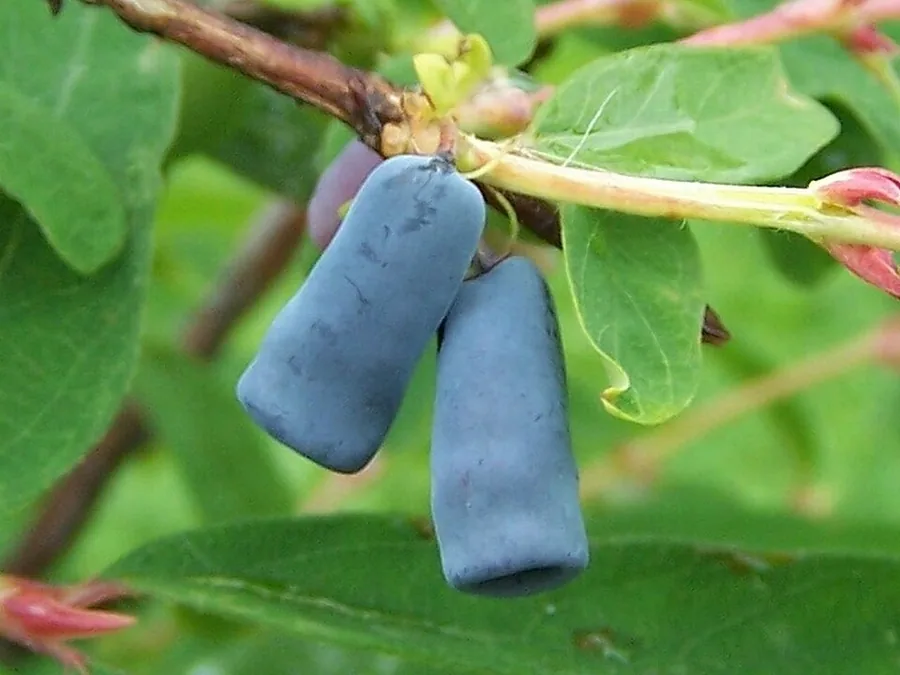
Honeyberry, known in the trade as haskap, is the edible-fruited member of the honeysuckle genus, and its elongated blue berries typically ripen earlier than any other garden fruit. In the wild it colonizes riverbanks and damp northern ground, which explains its preference for consistent soil moisture rather than dry sites. The fruit carries a flavor between blueberry and raspberry and holds up well eaten fresh or frozen.
The defining trait of this shrub is its extreme cold hardiness. Its wood withstands -45°C (-49°F), and the early flowers resist frost to about 19°F, so a late cold event seldom compromises the crop. It is likewise indifferent to soil reaction, succeeding across acidic through chalky, calcareous ground, which contrasts sharply with the exacting requirements of blueberry.
Its one real demand is a pollination partner. An isolated plant flowers heavily yet sets almost no fruit, because honeyberry is self-incompatible. Establish two unrelated cultivars that bloom concurrently, let insect pollinators do the transfer, and the result is dense clusters of berries by late spring.
Care
The short version: site it in full sun with steady soil moisture, establish a second compatible cultivar within pollination range, and net the bushes against birds as the early berries begin to color.
Light
Honeyberry fruits most heavily in full sun, though it tolerates partial sun and light shade. In hot-summer regions a measure of afternoon shade reduces the heat load, which the species does not handle well.
Water
The plant is not drought adapted. Given its origin on riverbanks and damp ground, it needs a deep soak every 5 to 7 days, and more frequently during heat, so that the root zone never dries. Drip irrigation delivers even moisture while keeping the foliage dry, which also limits fungal pressure.
Soil
Grow it in moist, well-drained loam. Its unusual adaptability spans a pH from 5.0 to 8.0, extending to chalky, calcareous soils that most berry crops reject, so soil amendment is rarely warranted.
Temperature
Cold hardiness here is exceptional. The wood endures from -45°C to 30°C (-49°F to 86°F), and the spring flowers resist frost to about 19°F, but sustained summer heat beyond zone 6 imposes physiological stress.
Humidity
Ambient outdoor humidity in the 40% to 70% band is entirely suitable. Air movement matters more than any specific value, because stagnant, crowded air is the condition that favors late-season powdery mildew.
Feeding
Apply a single early-spring dose of a balanced granular such as 16-16-16 at roughly a half cup per plant. Withhold late-season nitrogen, which stimulates soft growth that fails to harden off before winter.
Pruning
Restrict pruning of a young bush to dead or damaged wood through its first 3 to 4 years. From about year 6, remove up to 25 percent of the oldest branches each dormant season to maintain an open, productive canopy.
Repotting
As an in-ground shrub rather than a container subject, honeyberry seldom needs repotting. If started in a pot, transplant it to its permanent position once roots begin circling or water passes straight through.
Size & spacing
A mature specimen attains roughly 4 to 6 feet (120 to 180 cm) in height and a comparable spread. Match the spacing to that spread to ensure free air movement and to keep a pollination partner within effective foraging distance of bees.
When to plant
Honeyberry runs on a compressed early-season cycle. Establish new plants in early spring or early fall, expect cream-yellow flowers during the first warm spells, and harvest the ripe blue berries from late May into mid June, frequently ahead of the strawberry crop.
Northern hemisphere
Southern hemisphere
Typical months for a temperate climate: start earlier in warm zones, later where spring frosts linger.
- Plant: Early spring or early fall
- Harvest: Blooms very early spring with cream-yellow flowers that tolerate frost to about 19°F; berries ripen late May to mid June, often just before strawberries
Hardiness
USDA hardiness zones: 2–7
Temperature: down to -46°C
Troubleshooting
The great majority of honeyberry problems reduce to three causes: an absent pollination partner, bird predation on the early fruit, or excessive summer heat beyond the plant's climatic range. Diagnose against the symptoms below and the corrective action is generally direct. Intervening at the first signs usually preserves the season's yield.
Abundant flowering with negligible fruit set
Honeyberry is self-incompatible, meaning its own pollen cannot fertilize its own flowers, so an isolated bush blooms freely yet sets little to nothing. Fruit set depends on a second, unrelated cultivar flowering in the same window, for instance Tundra with Aurora or Honey Bee, sited within roughly 6 feet so foraging bees can shuttle pollen between the two. Early-spring companion flowers help because they recruit those pollinators into the planting while temperatures are still low.
Fix:
- Plant at least two unrelated cultivars that bloom together (for example Tundra with Aurora or Honey Bee)
- Site them within about 6 ft of each other to aid bee transfer
- Encourage early-spring bees with companion flowers
White fungal bloom on foliage after fruiting
The white coating is powdery mildew, which colonizes the leaf surface once warm, still, post-harvest air slows evaporation and favors the fungus. It seldom reduces the crop, but heavy infection can defoliate a bush ahead of schedule. Remove the most affected leaves, widen spacing to raise air movement, and rely on a resistant cultivar such as Tundra, since resistance is the most durable control.
Fix:
- Remove and dispose of badly affected foliage
- Improve spacing and airflow
- Choose mildew-resistant cultivars such as Tundra
Scorch and early defoliation under summer heat
Honeyberry evolved for cold climates, so heat stress becomes limiting beyond zone 6, and the effect is most pronounced in Russian-type cultivars. Excess heat scorches the leaf margins and triggers premature leaf drop. Buffer the plant with afternoon shade and consistent soil moisture, and select the Japanese or Kamchatka types, which are physiologically better adapted to warmth.
Fix:
- Provide afternoon shade and steady soil moisture
- Use Japanese or Kamchatka-type cultivars better suited to warmth
Fruit removed by birds during ripening
Birds target honeyberry before other crops because it colors up earliest in the season, when little else is available to them. Because the pressure is predictable, the control is straightforward: cover the bushes with bird netting before the fruit turns blue and keep it in place across late May and June until the harvest is complete.
Fix:
- Drape bird netting over plants before fruit ripens
- Net in late May through June
Toxicity
The verdict is reassuring: the entire honeyberry plant is safe. Its ripe blue fruit is a recognized food crop for people, and the foliage carries no compound hazardous to pets, livestock, or wildlife. The single caveat is taxonomic, that it not be confused with the ornamental honeysuckles, whose red berries are inedible.
Safe for
People · Cats · Dogs · Horses · Rabbits · Livestock · Birds
Cats None
Cats face no toxic risk from the plant. An exploratory bite of leaf or berry will not poison one, though overconsumption of any plant material may cause brief gastric upset.
Dogs None
Dogs are unaffected, because the blue berries are the same edible fruit humans consume and the foliage contains no toxic compound.
Horses Safe
Horses may graze around a honeyberry bush without hazard, as both fruit and foliage are free of toxins.
Rabbits Safe
Rabbits incur no risk from honeyberry. Browsing on the leaves is harmless, and a few ripe berries pose no problem.
Livestock Safe
Cattle, goats, and sheep may browse the plant safely, since it contains no toxic principle of concern to grazing animals.
Birds Safe
Birds consume the early fruit without harm. The practical issue is crop loss rather than toxicity, as they compete directly for the berries.
People Safe
The ripe blue berries are a commercial food crop, eaten fresh, frozen, or processed into preserves. They require no special precaution for human consumption.
No special handling required; ripe berries are edible and safe to pick by hand.
Varieties
Most honeyberry cultivars derive from breeding programs in Russia, Japan, and Canada, and sound production requires at least two that bloom together. The following selections are the ones worth knowing.
Tundra
Its firm fruit withstands mechanical harvest, and it shows stronger resistance to powdery mildew than most cultivars.
Borealis
It bears large berries whose sweet-tart flavor is ranked among the best available for fresh consumption.
Indigo Gem
A productive cultivar yielding small, tangy berries particularly suited to jams, juice, and other processing.
Aurora
A vigorous University of Saskatchewan release combining large fruit with an extended bloom that makes it an effective pollinizer for the Boreal and Honey Bee group.
Honey Bee
A University of Saskatchewan pollinizer cultivar bearing tart fruit on an extended bloom that overlaps reliably with its intended partners.
Companions
Honeyberry's best neighbors are the ones that help it set fruit: a second compatible cultivar to cross-pollinate, and early flowers that pull bees in while the bloom is still cold.
Plant near
A second unrelated haskap cultivar: Required cross-pollinizer that must bloom at the same time for good fruit set
Early-spring flowering plants such as crocus: Draw bumblebees and bees during haskap's very early bloom, improving pollination
How to propagate
Honeyberry can be increased from cuttings or from seed, but only vegetative cuttings reproduce the exact plant you started with.
Stem cuttingsModerate
Softwood cuttings in early summer or hardwood cuttings taken during dormancy · About 4 to 8 weeks to root; transplant out the following season
Vegetative cuttings are the standard method for reproducing a cultivar true to type, since they preserve the genetics of the parent. Take softwood material in early summer or hardwood during dormancy, treat the bases with rooting hormone to improve strike rate, and expect rooting in about 4 to 8 weeks. Grow the young plants on and transplant them the following season.
SeedModerate
Sow after cold stratification in spring · Several years to first fruiting
Seed propagation is largely a breeding technique rather than a means of reproducing a chosen bush. The seed requires cold stratification before spring sowing, but because it segregates genetically the seedlings vary and do not replicate the parent, and they need several years to reach first fruiting.
Myths
All honeysuckle berries are poisonous, so honeyberries are unsafe to eat.
The concern arises because several ornamental honeysuckles, such as L. tatarica and L. maackii, do produce mildly toxic, inedible berries. Honeyberry, however, is a different species, L. caerulea, cultivated specifically as a food crop. Its ripe blue fruit is non-toxic and eaten fresh, frozen, and in preserves.
Honeyberries need acidic soil like blueberries.
That requirement is specific to blueberries and does not extend to haskap. Honeyberry tolerates a wide pH range and performs even on chalky, calcareous ground up around 7.7 or higher, placing it among the most soil-forgiving berries in cultivation.
A single honeyberry plant will produce a full crop on its own.
Because honeyberry is self-incompatible, its flowers cannot be fertilized by their own pollen. It requires a second, unrelated cultivar blooming in the same window nearby for cross-pollination; without one, the result is abundant bloom and almost no fruit.