Shrub · Caprifoliaceae
Glossy Abelia
Abelia × grandiflora
Set in sun and sharply drained soil, glossy abelia carries flowers from late spring to frost with minimal intervention.
Full sun
Every 5–10 days
USDA 6–9
2–8 ft · 0.8–2.4 m
Overview
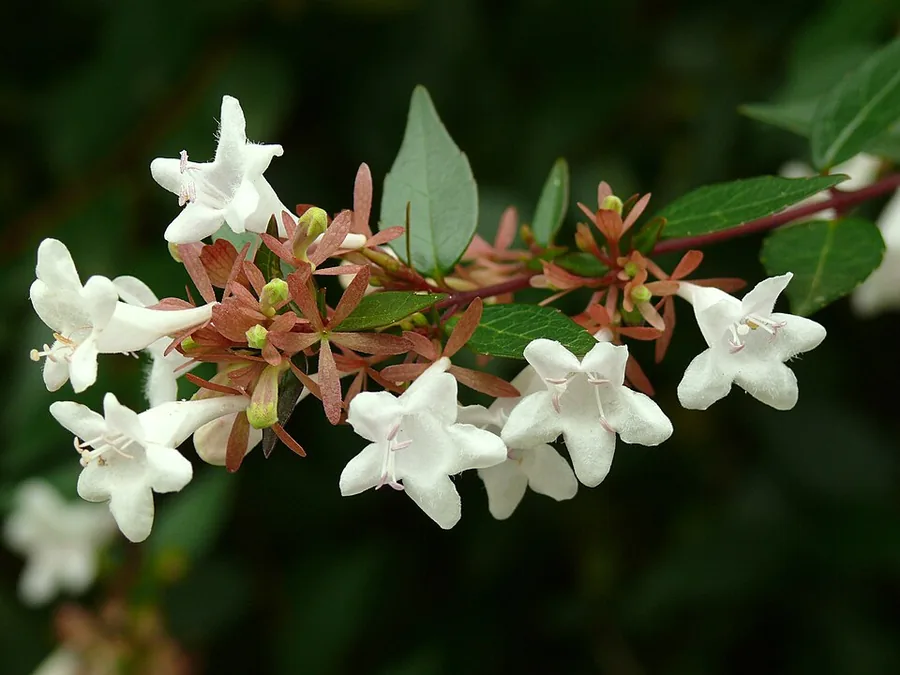
Glossy abelia is a durable, low-demand shrub that pulls real weight in a working landscape. From late spring until the first frost it produces small, fragrant flowers, and its arching framework lends a planting fluid line and movement. The botanical epithet points to its defining trait: foliage that holds a polished, reflective surface across much of the season.
Rated for USDA zones 6 to 9, the species performs best in full sun yet accepts partial shade without protest. At a moderate growth rate it reaches 2.5 to 8 feet (76 to 244 cm) in height, throwing a spread that extends to about 6 feet. After the root system establishes, it withstands drought and needs little ongoing attention.
For a newer gardener, abelia repays attention out of all proportion to the effort it asks. Because flowering occurs on new wood, one well-timed spring cut both controls form and preserves the bloom. Many named selections finish the season with color, the foliage turning toward orange and red as cold approaches.
Care
The short version: site it in full sun to part shade in well-drained soil holding some organic matter, water through establishment and dry spells, and prune once in late winter or early spring.
Light
Abelia performs best under full sun, the exposure that drives the heaviest flowering and the tightest habit. It accepts partial sun and even partial shade, but both bloom and fall color fade as available light declines, since the plant has less energy to invest in pigments and flowers. Choose a bright, open position.
Water
Supply steady moisture while the root system is developing, then taper off as the plant takes hold. Once established it reads as drought tolerant and needs irrigation only every 5 to 10 days, with more during dry stretches. A thorough soak in dry weather drives the strongest bloom, because flower production depends on the plant staying hydrated.
Soil
Establish it in moist, well-drained loam, clay, or sand amended with organic matter. The species accepts a pH band of 5.5 to 7.5, which spans most garden soils, so amendment for acidity is rarely necessary. The key limitation is salt: abelia will not tolerate saline soils.
Temperature
This shrub endures a broad thermal range, from about -9°F to 95°F (-23°C to 35°C). That tolerance corresponds to USDA zones 6 to 9 and lets it carry through both summer heat and winter cold. At the cold end of its range, a sheltered position reduces the freezing stress on its stems.
Humidity
Ambient outdoor humidity is sufficient, so no target reading applies. Air movement is the variable that counts, because stagnant, moisture-laden air trapped within crowded plantings is precisely what allows gray mold to establish. Allow each shrub enough room for air to circulate through the canopy.
Feeding
Apply a single annual feeding of a balanced slow-release fertilizer or a compost mulch in early spring, timed to support the season's long flowering. One seasonal application meets the plant's needs. Resist heavier nitrogen, which forces the soft, succulent growth that aphids preferentially colonize.
Pruning
Because abelia flowers on new wood, prune in late winter or early spring before the season's growth breaks. An overgrown specimen accepts hard rejuvenation back to roughly 12 inches (30 cm) above the soil once spring growth begins. Steer clear of late-fall-through-mid-winter cuts, which strip protective wood and invite cold injury.
Repotting
Grown as a landscape shrub, abelia is rarely repotted and is best left in open ground. In a container, shift it to a larger pot when roots circle the rootball or escape the drainage holes. Irrigation passing straight through with little absorption is a further signal that the plant has outgrown its vessel.
Size & spacing
Mature plants stand 2.5 to 8 feet (76 to 244 cm) tall with a spread of 3 to 6 feet (91 to 183 cm). Allow each shrub enough room to develop fully so that air circulates freely around it, which denies gray mold the still, damp conditions it needs to establish.
When to plant
Set abelia out during the milder transitions of the year. Plant in spring or fall once hard frost is no longer a threat, which gives the roots time to anchor before they meet summer heat or winter cold. The flowering display then runs from late spring to frost, a long return for so modest an input.
Northern hemisphere
Southern hemisphere
Typical months for a temperate climate: start earlier in warm zones, later where spring frosts linger.
- Plant: Spring or fall after danger of hard frost has passed.
- Harvest: Late spring through fall (roughly May until frost).
Hardiness
USDA hardiness zones: 6–9
Temperature: down to -23°C
Troubleshooting
Glossy abelia is a low-problem shrub, and the handful of issues it does develop are easy to diagnose. Nearly all of them trace to one of three drivers: hard winters, stagnant humid air, or a surge of tender new growth. Match your symptom to the entries below and intervene early, before a minor disorder gains ground.
Stems killed back and few flowers after a cold winter
What you are seeing is winter dieback, a predictable result in colder zones where the shrub sits near the edge of its hardiness range. Pruning carried out between late fall and mid-winter compounds the damage because it removes the protective wood that buffers the crown against freezing. Test the bark in spring with a thumbnail scratch: where the cambium beneath reads brown and dry, the stem is dead and should be removed to live tissue or to ground level once growth resumes. Because abelia sets its flowers on the current season's wood, that spring cutback costs you no bloom.
Fix:
- Prune dead stems back to live wood or to the ground when spring growth begins
- Since it blooms on new wood, plants flower the same season after spring cutback
Gray, fuzzy spots on the flowers and soft new growth
The disorder here is Botrytis, a gray mold whose spores germinate readily in still, saturated air around congested growth. The diagnostic sign is fuzzy gray-brown sporulation on spent blooms and the softest shoots. Strip out the infected flowers and stems to remove the spore source, then reduce the humidity at canopy level by thinning the plant and widening its spacing so air can move through it.
Fix:
- Remove and discard affected blooms and stems
- Improve air circulation by thinning and spacing plants
Curled new growth with a sticky film
This points to aphids, sap-feeding insects that turn up now and again on the tenderest shoots. Examine the growing tips and the undersides of leaves for colonies of small soft-bodied insects, along with the honeydew they excrete as they feed. A forceful jet of water physically dislodges most of a colony, and insecticidal soap clears the stragglers by breaking down their soft cuticle. Abelia carries strong general pest resistance, so an outbreak seldom escalates.
Fix:
- Dislodge aphids with a strong spray of water
- Treat persistent infestations with insecticidal soap
Toxicity
For homes with pets or young children, the verdict on glossy abelia is favorable: it is non-toxic. The species is absent from ASPCA toxic-plant references and is treated as safe around cats and dogs. The worst plausible outcome is mild stomach upset from eating a large amount, a risk shared by nearly any plant, and nothing about this shrub warrants special precautions.
Safe for
People · Cats · Dogs · Horses · Rabbits · Livestock · Birds
Cats Safe
A cat that grazes a leaf or rubs through the foliage takes no toxic dose, because glossy abelia carries no known poison for them.
Dogs Safe
The shrub poses no poisoning risk to dogs, so an opportunistic mouthful of leaves does no real harm.
Horses Safe
Abelia growing in a paddock or along a fence presents no toxicity hazard to horses.
Rabbits Safe
Rabbits incur no poisoning from the plant, though any leafy material belongs in only a modest share of their diet.
Livestock Safe
Grazing cattle, goats, and sheep are under no threat of poisoning from contact with the shrub.
Birds Safe
Both aviary birds and backyard poultry coexist with abelia without any toxic consequence.
People Safe
The shrub carries no toxicity concern for households, making it suitable for gardens where children play.
No special handling required; large quantities of any plant material may cause mild stomach upset.
Varieties
A number of named selections of abelia diverge in flower color, foliage, and habit. The following are the ones worth recognizing before settling on a plant.
Rose Creek
A dense, low mounding selection whose pink-flushed flowers sit above stems that flush red.
Kaleidoscope
Prized for variegated gold-and-green leaves that ignite to orange-red as autumn sets in.
Edward Goucher
A sister hybrid bearing lavender-pink flowers along slender, arching branches.
Prostrata
A ground-hugging selection that spreads outward into a loose, low cover.
How to propagate
Few shrubs reproduce as readily as abelia, and one parent plant will yield several offspring from cuttings collected through the warmer months.
Stem cuttingsEasy
Take softwood or semi-hardwood cuttings in late spring through summer. · Roughly 35 to 70 days to root depending on temperature.
Vegetative propagation is straightforward with this shrub. Collect softwood or semi-hardwood cuttings across the warm season, from late spring through summer, when shoot tissue roots most reliably. Held in warmth around 80°F to 86°F (27°C to 30°C), cuttings callus and form roots in roughly 35 to 50 days, since warmth drives the cell division that builds new roots. Cooler conditions slow that process toward 70 days, so steady heat and patience produce the highest strike rate.
Myths
Glossy abelia is poisonous to dogs and cats.
The species does not appear on ASPCA toxic-plant references and is regarded as non-toxic to both cats and dogs. The only realistic consequence is mild stomach upset, which any plant can trigger if an animal eats a great deal of it. You can plant it freely in a garden that pets share.
You must prune abelia in fall to keep its size in check.
Since abelia flowers on the current season's wood, the correct pruning window falls in late winter or early spring. Cutting from late fall through mid-winter strips away the wood that shelters the stems and leaves them exposed to cold injury. Hold off until growth resumes in spring, and the plant keeps both its form and its flowers.