Shrub · Caprifoliaceae
Old Fashioned Weigela
Weigela florida
Sited in full sun and pruned on old wood in time, weigela sets a heavy flush of tubular late-spring flowers.
Full sun
Every 7–14 days
USDA 4–8
6–10 ft · 1.8–3 m
Overview
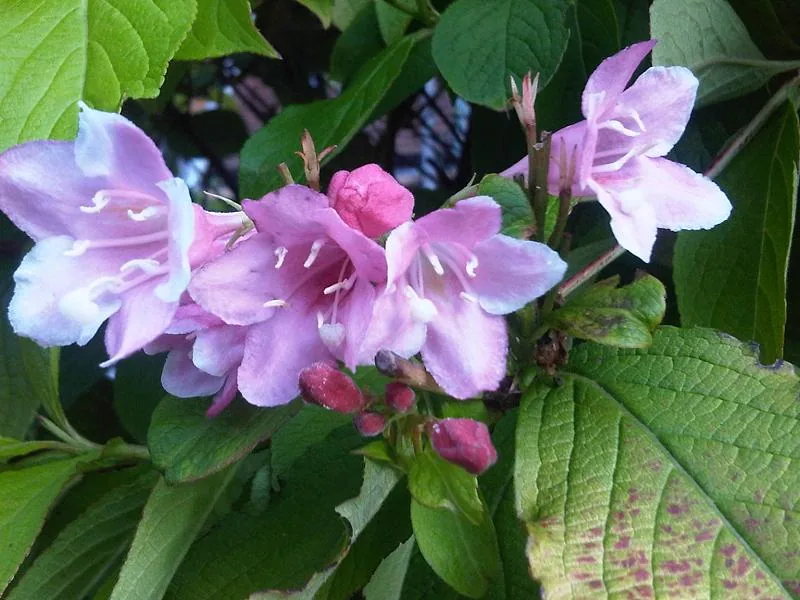
Weigela florida is a deciduous shrub in the honeysuckle family, Caprifoliaceae, valued for the flush of tubular, rose-pink to red flowers it produces in late spring. The corolla shape suits nectar-feeding pollinators, which is why it draws hummingbirds and butterflies as the borders mature. Unpruned, it develops a broad, arching habit.
The species is undemanding once established. It performs in full sun to light shade, adapts to a wide range of soils, and is cold hardy to zone 4. The governing detail for bloom is that flower buds are borne on old wood, so pruning date determines whether the following spring flowers heavily or not at all.
At species size the shrub is large, but breeding has widened the palette. Dwarf and reblooming cultivars now suit small borders and containers, several carrying purple or variegated foliage that extends the season of interest well past bloom.
Care
The short version: grow weigela in full sun and average, well-drained soil, irrigate through dry periods until it is established, then confine shaping cuts to the interval directly after flowering, since the buds sit on old wood.
Light
Flowering is maximized in full sun, though the plant persists in partial sun or light shade. Provide 6 or more hours of direct sun daily, because insufficient light reduces bud initiation and thins the display faster than any other factor.
Water
Irrigate a young plant consistently through the establishment season to support root development, then reduce watering and supply moisture only during drought. Allow the top inch or so of soil to dry between irrigations, which corresponds to roughly every 7 to 14 days without rain, and an established specimen is fairly drought-tolerant.
Soil
Weigela accepts clay, loam, or sandy substrates provided drainage is adequate and the medium holds average, medium moisture. It is tolerant across a broad range of 5.5 to 7.5 pH, so amendment of the planting site is seldom warranted.
Temperature
The species is cold hardy, rated from -29°F to 90°F (-34°C to 32°C) across zones 4 through 8. In the coldest zones the distal shoots may be killed over winter, but the crown survives and regenerates new growth from lower, protected wood in spring.
Humidity
Ambient outdoor humidity is sufficient, so no target value applies. Good airflow is the more relevant factor, since it keeps foliage dry and suppresses the limited pest pressure the shrub experiences.
Feeding
Weigela has low nutrient demand. A single application of slow-release shrub fertilizer in spring meets its requirement for the season, and further feeding is unnecessary unless growth is visibly weak, which signals a genuine deficiency.
Pruning
Pruning date is the decisive variable. Shape the plant immediately after the late-spring bloom, because buds are set on old wood and a later cut removes the following year's flowers. In late winter, remove a few of the oldest stems along with any dead or winter-damaged wood to maintain vigor through renewal.
Repotting
Weigela is seldom container-grown and never requires repotting in open ground. Where a dwarf cultivar is kept in a pot, shift it up one size once roots circle the rootball or emerge from the drainage holes, since a constricted root system limits both growth and flowering.
Size & spacing
The species matures into a large shrub, 6 to 10 feet (1.8 to 3 m) tall with a greater spread of 9 to 12 feet (2.7 to 3.7 m). Allow space for the arching habit to develop, or select a dwarf cultivar where footprint is limited or a container is used.
When to plant
As a woody shrub, weigela has no seed-starting schedule. Plant it out in spring or fall, expect flowering from April into June, and carry out shaping pruning in the narrow window immediately after the bloom, before next year's buds are set on the old wood.
Northern hemisphere
Southern hemisphere
Typical months for a temperate climate: start earlier in warm zones, later where spring frosts linger.
- Plant: Spring or fall
- Harvest: April to June, with sparse repeat bloom in mid to late summer on modern cultivars
Hardiness
USDA hardiness zones: 4–8
Temperature: down to -34°C
Troubleshooting
The common weigela disorders trace to pruning date, winter cold, or soil moisture at either extreme. Because the causes are few and predictable, reading the early symptoms usually points to a single corrective, a properly timed cut or an adjustment to irrigation and drainage. Match the presentation below before it costs a flowering season.
Sparse or absent spring bloom
The primary cause is mistimed pruning, because weigela initiates its flower buds on old wood and any cut made in late summer, fall, or winter removes the following spring's bloom along with the wood. Inadequate light and winter loss of the flowering shoots produce the same result. Restrict pruning to the period just after the late-spring bloom, provide 6 or more hours of direct sun, and retain the healthy old stems.
Fix:
- Prune only immediately after the late-spring bloom since flowers form on old wood
- Relocate or limb up surrounding plants so the shrub gets 6 or more hours of direct sun
- Remove only dead, winter-damaged wood and leave healthy old stems intact
Brown, dead shoot tips in spring
The presentation is winter dieback, most pronounced in colder zones or on a cultivar grown near the limit of its hardiness. Confirm by scratching the bark: killed wood is brown and dry with no green cambium beneath. Cut the dead stems back to live tissue in late winter and allow regeneration from the surviving lower wood.
Fix:
- Prune out dead wood back to live, green growth in late winter or early spring
- Let the shrub regrow from healthy lower stems
Browning, wilting foliage with poor growth
General decline of the whole shrub most often reflects a water imbalance, either drought or roots held in soggy, poorly drained soil. Nutrient deficiency or soil salinity produces a comparable pallor and weakness. Assess soil moisture and drainage, irrigate through dry spells, correct drainage where it remains wet, and apply a slow-release shrub fertilizer if a deficiency is indicated.
Fix:
- Provide regular water during dry spells and improve drainage in soggy sites
- Apply a slow-release shrub fertilizer if a deficiency is suspected
Sticky, stippled, or distorted foliage
The usual agent is mealybugs, recognizable as white cottony masses at the stem junctions, although flea beetles will also chew the leaves. Verify by examining leaf undersides and nodes. A forceful water spray dislodges light populations, and insecticidal soap or horticultural oil controls persistent infestations by contact.
Fix:
- Wash off light infestations with a strong stream of water
- Treat persistent mealybug infestations with insecticidal soap or horticultural oil per label
- Remove and dispose of heavily infested shoots
Toxicity
Weigela presents no household toxicity concern. It is absent from the ASPCA toxic-plant lists and is regarded as non-toxic to pets, livestock, and people, with no recognized irritant in the sap. The only reported effect is mild, transient gastrointestinal upset when an animal consumes a large quantity of foliage.
Safe for
People · Cats · Dogs · Horses · Rabbits · Livestock · Birds
Cats None
Weigela is non-toxic to cats and is not listed by the ASPCA. Incidental browsing is harmless, though ingestion of a large volume of leaf tissue may cause brief gastrointestinal upset.
Dogs None
Dogs may consume the foliage without toxic effect. The most that results from heavy ingestion is transient digestive upset, consistent with overconsumption of most garden vegetation.
Horses Safe
Weigela contains no compound harmful to horses, so the shrub can be established near a paddock or pasture without risk.
Rabbits Safe
Rabbits can browse the foliage safely, as no part of the plant carries a toxin, and an occasional bite presents no hazard.
Livestock Safe
Cattle, goats, and sheep are unaffected by weigela, and the shrub poses no toxic risk to grazing stock.
Birds Safe
Weigela is harmless to birds, and its tubular spring flowers supply nectar that attracts hummingbirds.
People Safe
The plant is non-toxic to people, with no recognized irritant in the sap. It is ornamental rather than culinary, so no part is intended for consumption.
No special handling precautions; sap is not a known irritant.
Varieties
The straight species remains attractive, but the named cultivars account for most current plantings. The following selections are the ones to recognize.
'Alexandra' WINE AND ROSES
A compact selection at 4 to 5 foot, grown for dark purple foliage and a heavy flush of reddish-pink flowers in spring.
'Verweig' MY MONET
A dwarf reaching only 12 to 18 inches, distinguished by variegated pink, cream, and green foliage beneath soft pink blooms.
'Tango'
Among the smallest weigelas, forming a 2 to 2.5 foot mound of purplish foliage that flowers freely in spring.
SONIC BLOOM
An upright reblooming selection that opens lipstick-red flowers in May and continues to produce successive flushes until frost.
How to propagate
Weigela roots readily from cuttings, by a rapid softwood method in summer and a slower hardwood method during dormancy, so additional plants are straightforward to raise.
Stem cuttingsEasy
Late spring to early summer (late May through early July) · Several weeks to root; a full season to establish
The most reliable method is a softwood cutting taken from late May into early July from the current season's growth. Select a shoot flexible enough to bend yet firm enough to snap under a sharp bend, which indicates the correct physiological stage. Rooting occurs within a few weeks, and a full growing season is required for establishment.
Stem cuttingsModerate
Dormant season (late fall to winter) · One growing season
Hardwood cuttings may also be taken from dormant stems through late fall and winter. This method is somewhat slower and requires a full growing season before the young plant is established.
Myths
Weigela is toxic to dogs and cats.
Weigela does not appear on the ASPCA toxic-plant lists and is classed as non-toxic to both dogs and cats. Consuming a large amount of foliage may produce only a mild, transient stomach upset, with no systemic toxicity involved.
Weigela can be pruned at any time without sacrificing bloom.
Because the species sets its buds on old wood, a cut made in late summer, fall, or winter removes the following spring's flowers. Confine shaping to the interval directly after flowering to preserve each successive display.