Shrub · Caprifoliaceae
Honeysuckle
Lonicera sempervirens
In full sun on a sturdy support, trumpet honeysuckle produces coral tubular flowers that hummingbirds are built to feed on.
Full sun
Every 5–10 days
USDA 4–9
8–20 ft · 2.4–6.1 m
Overview
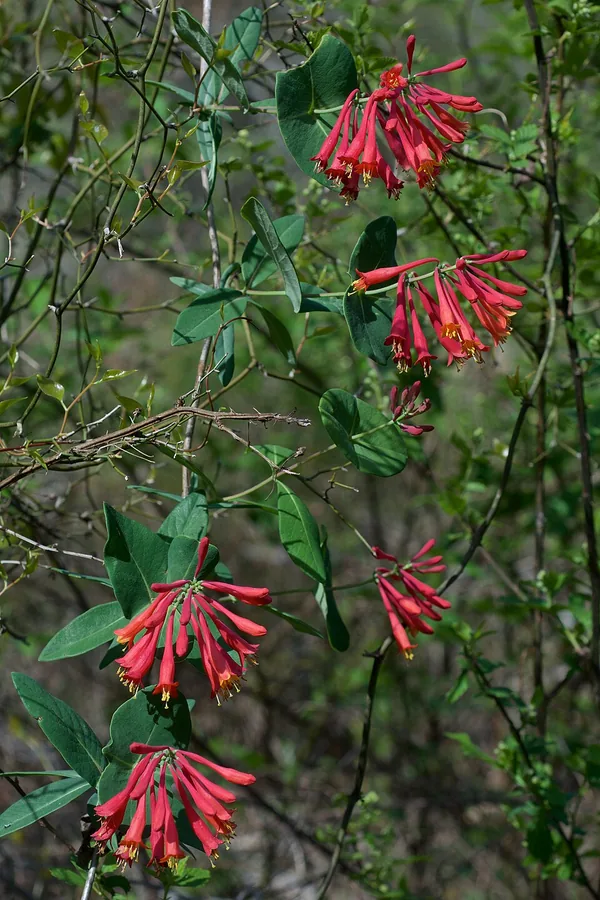
Trumpet honeysuckle is a native flowering vine that, unlike its invasive relative, poses no threat to surrounding plant communities. It bears whorls of narrow, coral-red to orange tubular flowers from late spring into summer, frequently reblooming in fall, and the tubular corolla is precisely the form that suits hummingbird pollination. Red berries develop afterward and feed birds.
Culturally it is an easy, adaptable vine. It accepts a broad range of soils, withstands cold to a severe low, and demands little once established. Provided with a trellis, arbor, or fence, its fast growth rate carries it well overhead within a season or two.
The decision that matters is species selection. The native trumpet type, Lonicera sempervirens, is the correct choice. Avoid Japanese honeysuckle, the aggressive white-flowered vine that overruns natural areas across much of the country.
Care
The short version: site it in full sun on a support, in average well-drained soil, and hold steady moisture through establishment, after which it becomes largely self-sufficient.
Light
Flowering is heaviest in full sun, though the vine tolerates partial shade and still blooms. Sun also dries the foliage, and that rapid drying is what suppresses powdery mildew.
Water
Maintain evenly moist soil during establishment, watering every 5 to 10 days. An established vine tolerates drought reasonably well, but consistent moisture yields the fullest flowering.
Soil
The vine is undemanding, growing in average to rich, well-drained loam or clay loam. It accepts a wide pH span of 5.5 to 8.0, so most garden soils serve provided drainage is adequate.
Temperature
This is a hardy vine, tolerant from a severe -29°F (-34°C) to roughly 100°F (38°C). That amplitude accommodates cold winters and hot summers across most temperate gardens.
Humidity
Ambient outdoor humidity suffices and no target figure applies. Air movement is the operative factor, since stagnant, moist air around dense foliage is what encourages mildew.
Feeding
Apply a balanced fertilizer sparingly in spring. Excess nitrogen shifts the plant toward foliage at the expense of flowers, so feeding is best kept modest.
Pruning
Prune immediately after the main flush to shape the vine and restrain its size. Because flowers form on new growth, a light cut stimulates reblooming. Reserve hard renewal pruning for late winter and only when the plant requires rejuvenation.
Repotting
In open ground repotting is unnecessary, and even container specimens are repotted only rarely. Roots circling the pot or emerging from the drainage holes, alongside diminished flowering, indicate the plant has outgrown its container.
Size & spacing
On a support the vine attains 8 to 20 feet (2.4 to 6 m) in height and spreads 3 to 6 feet (91 to 183 cm). Supply a sturdy trellis or arbor and allow space for that development.
When to plant
Because honeysuckle is a hardy perennial vine, the calendar governs establishment rather than frost avoidance. Plant in spring or fall so the root system develops before peak demand, then expect the first flush of coral flowers from late spring into summer, extended by the light pruning that promotes reflowering.
Northern hemisphere
Southern hemisphere
Typical months for a temperate climate: start earlier in warm zones, later where spring frosts linger.
- Plant: spring or fall
- Harvest: late spring into summer, often reblooming into fall
Hardiness
USDA hardiness zones: 4–9
Temperature: down to -34°C
Troubleshooting
Trumpet honeysuckle is largely problem-free, and the issues that do occur are cosmetic. Two are worth recognizing, both favored by warm, humid conditions. Identify the sign below to intervene before the vine's appearance suffers.
White powdery layer on foliage during warm, humid spells
The white coating is powdery mildew, a fungal infection that establishes where humidity is high and air circulation is poor, the two conditions that let its spores germinate on the leaf surface. Because the growth is superficial it wipes away, unlike the fixed lesions of leaf blight that penetrate the tissue. Thinning the vine and siting it in full sun works by drying the foliage quickly, which denies the fungus the surface moisture it needs.
Fix:
- Improve air circulation by thinning and providing support such as a trellis or arbor
- Remove and discard severely affected foliage
- Avoid overhead watering and water at the base of the plant
- Site the vine in full sun where foliage dries quickly
Colonies of soft insects and sticky residue on new growth
The soft-bodied clusters on the shoot tips and flower buds are aphids, sap feeders that congregate on tender growth and excrete the sticky honeydew that in turn attracts ants. A forceful spray of water dislodges the colonies mechanically, and insecticidal soap or horticultural oil deals with the remainder. Since infestations run heaviest on stressed plants and lush, nitrogen-forced shoots, adequate watering and restrained feeding are the more durable controls.
Fix:
- Dislodge aphids with a strong spray of water
- Apply insecticidal soap or horticultural oil to affected growth if needed
- Encourage natural predators such as lady beetles and lacewings
- Reduce plant stress through adequate watering and avoiding excess nitrogen
Toxicity
Honeysuckle rates at the low end of the risk scale. The foliage, flowers, and nectar present little hazard, and the trace a child sips from a bloom does no harm. The exception is the red berries, which contain saponins capable of causing gastric upset when eaten in quantity, so pets and children should be kept from grazing on the fruit.
Toxic to
Cats · Dogs · Horses · Rabbits · Livestock · People
Safe for
Birds
Cats Mild
Foliage and flowers rarely trouble a cat that samples them. The concern is the fruit, since a quantity of the saponin-bearing berries can provoke vomiting or loose stools.
Dogs Mild
Leaves and nectar generally pass through a dog uneventfully. The red berries are the exception, and a meaningful dose can produce drooling, gastric upset, and diarrhea.
Horses Caution
No listing marks honeysuckle as a serious equine poison, yet the berries carry the same saponins implicated in other grazers, which justifies keeping an inquisitive horse from stripping the fruit.
Rabbits Mild
A leaf sampled by a rabbit is unlikely to cause harm. The berries are the risk, capable of producing a sour gut, so the fruit should not be offered as a treat.
Livestock Caution
Cattle, goats, and sheep typically ignore the vine. A grazer that consumes the berries in bulk may develop mild digestive upset from the saponins, so valuable stock is best fenced off from a heavy fruit set.
People Caution
A sipped drop of floral nectar has no effect. The berries, by contrast, are not food and can cause gastric upset in any quantity, so children should be taught to leave the fruit alone.
Birds Safe
Birds consume the red berries without ill effect and disperse the seed as they move, which is the plant's natural mode of spread. Here the fruit functions as forage rather than a hazard.
The sweet flower nectar that children sometimes sip is harmless in tiny amounts, but discourage anyone from eating the berries. Keep pets from grazing on the fruit.
Helpline numbers

United States
ASPCA Animal Poison Control: (888) 426-4435 (fee applies)
Poison Control: (800) 222-1222


Canada
Poison Centres: 1-844-764-7669
Varieties
Garden honeysuckle reduces to a small set of dependable selections, nearly all native trumpet types or restrained hybrids. The following merit attention, together with one that warrants avoidance.
Lonicera sempervirens 'Major Wheeler'
A native trumpet honeysuckle valued for a heavy flush of reddish-orange flowers that reblooms strongly and draws hummingbirds throughout the season.
Lonicera sempervirens 'John Clayton'
A compact native selection bearing clear yellow flowers that repeat their bloom and set a generous crop of red berries.
Lonicera × heckrottii (Gold Flame honeysuckle)
A fragrant, restrained hybrid distinguished by showy two-toned blooms, rose-pink externally and yellow within.
Lonicera × brownii 'Dropmore Scarlet'
An unusually cold-hardy Brown's honeysuckle hybrid that flowers bright red across a long season while remaining vigorous rather than aggressive.
Lonicera japonica 'Halliana' (Hall's honeysuckle)
An aggressive Japanese honeysuckle whose fragrant white flowers age to yellow; it is discouraged or banned in many regions and best replaced by the native selections above.
Companions
Keep apart
Lonicera japonica (Japanese honeysuckle): Invasive non-native that smothers desirable plants and the native honeysuckle alike; should not be planted near or in place of native species.
How to propagate
Honeysuckle propagates readily, and the vegetative methods yield a flowering vine considerably sooner than seed. Select the technique suited to the season and the degree of patience available.
Stem cuttingsEasy
Late spring to summer (softwood/semi-hardwood) · Several weeks to a few months
Softwood or semi-hardwood cuttings taken from late spring into summer, held under humid conditions to limit moisture loss while they form roots, establish over the following several weeks to a few months. This vegetative route is the fastest and most dependable means of reproducing a clone true to the parent vine.
LayeringEasy
Spring to summer · One growing season
Layering exploits the vine's readiness to root at a node: pin a low, flexible stem against the soil from spring through summer and the buried node forms roots while still nourished by the parent. Allow a full growing season for that root system to develop before severing the new plant.
SeedModerate
Fall sowing or after cold stratification · A season or more
Seed cleaned from the ripe red berries carries a dormancy that a period of cold breaks, so sow in fall or apply cold stratification to supply that chilling requirement. Because a usable plant takes a season or more to develop, the vegetative methods remain the quicker options where speed matters.
Myths
Every honeysuckle vine is an invasive weed that should never be planted.
The invasive reputation belongs specifically to Japanese honeysuckle, Lonicera japonica, a non-native bearing fragrant white-to-yellow flowers that smothers native plants across much of the eastern, central, and southern US and is regulated or banned in some states. The native trumpet or coral honeysuckle, Lonicera sempervirens, identifiable by whorls of coral-red to orange tubular blooms, is not invasive at all. It is non-invasive and the recommended alternative.
Sources
- NC State Extension Gardener Plant Toolbox
- Missouri Botanical Garden
- USDA National Invasive Species Information Center
- USDA Forest Service Fire Effects Information System
- NC State Extension Gardener Plant Toolbox
- Penn State Extension
- Lady Bird Johnson Wildflower Center
- NC State Extension Gardener Plant Toolbox