Herb · Caprifoliaceae
Valerian
Valeriana officinalis
Site it in full sun with steady moisture and valerian delivers fragrant summer flower heads above the sedative root that defines the species.
Full sun
Every 3–7 days
USDA 4–9
3–5 ft · 0.9–1.5 m
Overview
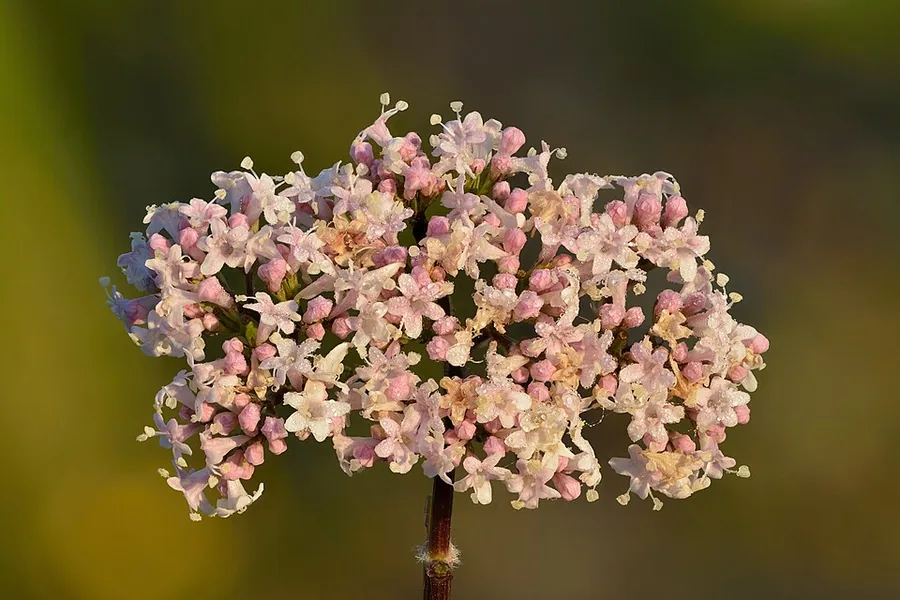
Valeriana officinalis is a clump-forming cottage perennial valued equally for its aromatic summer inflorescence and the medicinal root system beneath it. Tall flowering stems carry airy, domed corymbs of pale pink to white bloom from early to midsummer, a strong nectar source that draws pollinators and releases a sweet scent. As a cool-climate species it establishes readily in moist, fertile ground and demands little maintenance thereafter.
The root is the plant's defining organ. Dried and infused, it has served for centuries as a herbal sedative used to promote sleep and reduce nervous tension, the origin of the old name all-heal. The same tissue contains volatile compounds that act on many cats much as catnip does, producing a stimulatory behavioral response with no toxic consequence.
In cultivation valerian is genuinely low-difficulty, but its vigor cuts both ways. Fast growth, prolific seed production, and rhizomatous spread let it escape cultivation, and in several regions it now carries an invasive designation. Full sun, consistent moisture, and deadheading before seed set keep the plant productive and confined.
Care
The short version: full sun, dependable moisture in fertile loam, and early deadheading to check its heavy seeding. The species is broadly soil-tolerant and exceptionally cold-hardy, so irrigation and seed control are the operative tasks.
Light
Flowering and stem strength both depend on light, so site valerian in full sun. It persists in partial shade, but reduced light produces drawn, weak-stemmed growth that lodges under its own weight, which is why an open aspect matters.
Water
The species evolved in cool, damp habitats and performs best in consistently moist soil, resenting drought. Irrigate every 3 to 7 days, and more frequently under heat, to sustain steady growth. It endures brief dry intervals but never reaches full vigor when moisture is short.
Soil
Provide fertile, moist, well-drained loam, since higher fertility supports the plant's rapid growth. It adapts to clay, loam, or sand across a pH range of 6.0 to 7.5, which encompasses most cultivated soils.
Temperature
Cold-hardiness is a defining trait: valerian tolerates winter lows near -31°F (-35°C) and upper limits around 86°F (30°C). Metabolic performance favors cool conditions, so prolonged summer heat depresses vigor.
Humidity
As an outdoor perennial in the 40% to 70% range, valerian requires no humidity management. Ambient air suits it, and the value has no practical bearing on culture.
Feeding
A single spring application at the resumption of growth, using a balanced fertilizer or incorporated compost, meets the plant's nutrient demand. Excess nitrogen drives soft, lodging-prone stems rather than additional bloom, so restraint is deliberate.
Pruning
Deadhead spent inflorescences promptly, because seed set is the primary route of unwanted spread. Cut stems back once flowering ends, and remove senescent foliage as the plant dies back to ground level for winter.
Repotting
Valerian is not a long-term container subject; instead, divide established crowns every 2 to 3 years to sustain vigor. Congested crowns, declining flower output, and roots occupying the container all signal the need to lift and split.
Size & spacing
Mature height reaches 3 to 5 feet (90 to 150 cm), placing the plant at the rear of a border. Allow 2 to 4 feet (60 to 120 cm) between plants to maintain airflow and light penetration around the open flowering habit.
When to plant
Valerian follows a cool-season developmental cycle. Sow indoors from late winter to early spring, transplant after the risk of hard frost has passed, and expect fragrant bloom across early to midsummer. For medicinal use, roots are lifted in the fall of the second year, when root strength is greatest.
Northern hemisphere
Southern hemisphere
Typical months for a temperate climate: start earlier in warm zones, later where spring frosts linger.
- Sow: Late winter to early spring, 6-8 weeks before last frost
- Plant: Spring after danger of hard frost
- Harvest: Fragrant pinkish-white flower clusters in early-to-mid summer (June-July); harvest roots in fall of the second year for medicinal use
Hardiness
USDA hardiness zones: 4–9
Temperature: down to -34°C
Troubleshooting
Valerian presents few genuine problems, and the two most common are physiological rather than pathological, concerning growth habit and reproductive spread instead of pests or disease. Identify the disorder below and intervene early, before a minor tendency becomes established.
Self-sown seedlings colonizing the garden
Valerian is a prolific self-seeder with additional rhizomatous spread, so an isolated plant develops into a colony. Seedlings appear around the parent and in adjacent beds, ditches, and wild margins. Deadhead before seed matures, remove volunteers while young, and excavate any rhizomes that have advanced beyond the intended area.
Fix:
- Deadhead before seed set
- Remove volunteer seedlings while young
- Dig and discard escaped rhizomes
Lodging of tall flower stems
Leaning, lodged stems indicate insufficient light, sometimes compounded by excessive fertility. Under shade or in over-rich soil, valerian produces soft, weak-stemmed growth that cannot support the flowering stem, so relocate the plant to full sun, limit nitrogen, and stake the tallest stems where correction is incomplete.
Fix:
- Site in full sun
- Provide staking or grow-through support for tall stems
- Avoid excess nitrogen
Toxicity
For animal households the assessment is favorable: valerian is non-toxic and pet-safe. The root's well-documented effect on cats mimics catnip and reflects a behavioral, not toxicological, response, and the same root is employed as a mild calmative for both people and animals.
Safe for
People · Cats · Dogs · Horses · Rabbits · Livestock · Birds
Cats None
Many cats respond to the root as they do to catnip, rolling, rubbing, and displaying heightened play. The reaction is a benign behavioral effect mediated by volatile compounds, not poisoning, and requires only supervision and cleanup.
Dogs None
Dogs are unaffected toxicologically. The plant contains no compound harmful to them, and the root is in fact used as a gentle calmative for anxious dogs.
Horses Safe
Horses are at no risk. Ingestion of the foliage during grazing produces no toxic effect.
Rabbits Safe
Rabbits tolerate the foliage without harm, though any unfamiliar green is best introduced in limited quantity.
Livestock Safe
Grazing livestock are unharmed by valerian, which functions as a benign forage species rather than a toxic weed.
Birds Safe
Birds are safe in its presence, as no part of the plant is toxic if they sample the foliage or seed heads.
People Safe
In humans the dried root has a long record as a sedative taken to aid sleep and reduce anxiety. The plant is non-toxic, though medicinal use warrants appropriate dosing.
The root acts as a catnip-like attractant: many cats become excited, playful or euphoric around it. This is a benign behavioral response, not toxicity. Store dried root away from cats if you do not want them disturbing it.
Varieties
The species is grown almost exclusively in its wild form rather than as selected cultivars, so a single form covers the plant in practice.
Valeriana officinalis (species)
This standard medicinal garden valerian is distinguished by airy domed corymbs of fragrant pale pink to white flowers on tall stems, held above the aromatic, sedative roots from which the species takes its name.
How to propagate
Valerian propagates easily by two dependable methods: seed, for raising numbers, and crown division, for cloning a selected plant.
SeedEasy
Sow indoors late winter to early spring or direct sow in spring; self-sows readily · Germinates in roughly 2-3 weeks; establishes and flowers within the first to second season
Seed is the simplest method for producing numbers. Sow indoors from late winter to early spring or direct sow at the onset of spring, leaving seed on the surface because light promotes germination. Emergence follows in roughly 2 to 3 weeks, with establishment and first bloom across the first or second season. Left to mature, the flower heads reseed abundantly, frequently exceeding what the grower intends.
DivisionEasy
Spring or early fall · Divisions re-establish within a few weeks to a single growing season
Division reproduces a selected plant most directly. During spring or early fall, lift a mature clump, separate the crown into viable sections, and reset them into moist, fertile soil. Re-establishment proceeds within a few weeks to one full growing season.
Myths
The catnip-like excitement valerian causes in cats proves the plant is a drug that harms them.
The display is striking but pharmacologically benign: it is the same attraction cats show toward catnip, mediated by valerian's volatile compounds rather than any toxin. The plant is classed as non-toxic and is even administered as a mild calmative to anxious animals. The catnip-type response is stimulation, not intoxication.