Ornamental · Caprifoliaceae
Macedonian Scabious
Knautia macedonica
Set it in full sun and lean, well-drained soil, and crimson pincushions carry the border through the whole summer.
Full sun
Every 5–10 days
USDA 5–9
18–24 in · 45–60 cm
Overview
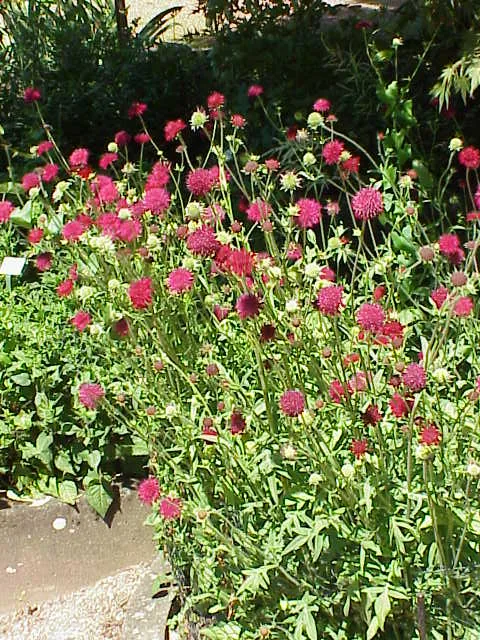
Knautia macedonica is a border perennial valued for the small, deep crimson pincushion inflorescences it holds on wiry stems from early summer into fall. Placed in family Caprifoliaceae alongside the scabious it closely resembles, it originates in the meadows of southeastern Europe. In cultivation it reads as an airy wildflower form well suited to cottage borders and prairie-style schemes.
Its cultural requirements are modest. Full sun and lean, well-drained soil meet essentially all of them, and an established plant tolerates drought. Excess fertility and moisture are counterproductive here, because they generate soft tissue that lodges by midsummer, a tendency that sharpens where night temperatures remain high.
Manage it as a short-lived perennial that renews by seed. Individual crowns decline after a few years, but the plant self-sows freely and recruits seedlings that succeed the parents. Retaining a portion of these volunteers sustains the planting without replanting.
Care
The short version: full sun and average, well-drained soil kept on the lean side, irrigation while the plant establishes and restraint once it has, and consistent deadheading through the season to sustain bloom.
Light
Full sun drives the firmest stems and the heaviest flowering, so site Knautia in full sun. It accepts light shade, but insufficient light yields soft tissue that lodges, which is why exposure matters for structure as much as bloom.
Water
Irrigate young plants to establish them, then let the top half of the profile dry between waterings, on the order of every 5 to 10 days. Established clumps are drought tolerant and resent saturation, so the dry interval protects the roots from the soggy conditions the record warns against.
Soil
Average, well-drained soil satisfies it, ideally in the neutral to alkaline range at a pH of 6.5 to 7.5. Drainage outranks fertility, and lean ground produces firmer, self-supporting stems rather than the lax growth rich soil encourages.
Temperature
The species is cold-hardy to roughly -20°F (-29°C) and endures summer heat to about 95°F (35°C). Performance peaks where nights stay cool, since warm, humid nights are the direct cause of the stem laxity described under troubleshooting.
Humidity
Ambient outdoor humidity needs no target, hence the absent percentage. What matters is air movement, because stagnant humid air in hot regions promotes the midsummer lodging.
Feeding
A light feeder content in moderately fertile ground, it needs only a single spring application of balanced fertilizer or compost. Additional feeding is counterproductive, since surplus nitrogen produces the weak, floppy growth that fails structurally.
Pruning
Deadhead spent inflorescences as they fade to extend bloom from early summer into fall by diverting energy from seed set. In hot climates, cut declining stems back in late summer, then clear the old foliage in late fall or early spring.
Repotting
As a garden perennial rather than a container subject, it is not repotted. Where a clump becomes crowded or begins to decline, divide the crown to restore vigor.
Size & spacing
Mature plants stand about 18 to 24 inches (45 to 60 cm) tall with a comparable spread. Allocate roughly that spacing so the open stems have room and air circulates, which itself reduces the humidity-driven lodging.
When to plant
Hardy across zones 5 to 9, Knautia persists outdoors year-round. Sow under cover in late winter, transplant after the last frost, and the crimson inflorescences run from July into September before the plant retreats for winter.
Northern hemisphere
Southern hemisphere
Typical months for a temperate climate: start earlier in warm zones, later where spring frosts linger.
- Sow: Late winter to early spring, about 6-8 weeks before last frost
- Plant: After last spring frost
- Harvest: July to September (early summer into fall)
Hardiness
USDA hardiness zones: 5–9
Temperature: down to -29°C
Troubleshooting
With no serious pests on record, an easy-care species like Knautia presents only a short list of issues, and both trace to summer heat and its own capacity to self-seed. Recognize the early indications below and a modest intervention preserves the planting.
Stems lodge and vigor drops through the hottest weeks
This pattern reflects heat and humidity stress, and it concentrates in southern gardens where summer nights fail to cool. The species evolved for cool-night conditions, so warm nights and rich culture both push soft, water-heavy tissue that cannot support itself. Site it in full sun with open air movement, withhold extra feed and water, and cut lodged stems back so the plant regenerates firmer growth.
Fix:
- Provide full sun and well-drained, only moderately fertile soil
- Avoid overfeeding and overwatering
- Cut back leggy stems to encourage tidier regrowth
- Site in a location with good air movement
Dense volunteer seedlings ringing the parent clump
A well-sited plant is a strong self-seeder, and the following spring it recruits offspring across the ground around it. That reproductive strategy is precisely what carries a short-lived perennial forward, yet it disrupts a controlled border. Remove spent heads before seed matures, mulch to bury and suppress shed seed, and rogue out the volunteers you do not intend to keep.
Fix:
- Deadhead spent flowers before seed sets to limit self-sowing
- Remove unwanted seedlings by hand
- Maintain a layer of mulch to suppress germination
Toxicity
For animal-keeping households the assessment is favorable: Knautia macedonica is not toxic. It is absent from the ASPCA list of poisonous plants and is cultivated as a pollinator resource rather than a hazard. Cats, dogs, grazing stock, and children are all safe in its presence.
Safe for
People · Cats · Dogs · Horses · Rabbits · Livestock · Birds
Cats None
The species carries no compounds toxic to cats. A cat that ingests a large quantity may show minor digestive upset, as bulk plant matter can cause in any animal, but the foliage and flowers pose no poisoning risk.
Dogs None
Dogs face no toxic risk, since the plant contains no poisonous compounds. A dog that chews a stem or flowerhead should show nothing beyond transient gastrointestinal upset.
Horses Safe
The record reports no toxins in any part of the plant, so it is regarded as safe for horses.
Rabbits Safe
Rabbits may browse the foliage without harm, as it holds nothing poisonous to them.
Livestock Safe
Cattle, goats, and sheep incur no risk when grazing near it, because it carries no toxins that affect them.
Birds Safe
Birds are safe around the plant and tend to work the seedheads rather than suffer any effect. Its role is to attract pollinators, not to endanger visiting wildlife.
People Safe
The plant is harmless to handle and to grow near children. Standard garden hygiene, meaning washing the hands afterward, is the only measure warranted.
No special handling precautions reported; routine garden hygiene such as washing hands after handling is sufficient.
Varieties
The straight species accounts for most plantings, though a pair of named selections extend the available height range and color palette.
Melton Pastels
A taller seed strain reaching 3 to 4 feet that departs from the deep purple-red of the species toward pastel mauve, pink, rose, salmon, and crimson, and it flowers in its first year from seed.
Mars Midget
A compact dwarf selection bearing deep crimson-red pincushion heads, well matched to the front of a smaller border.
Companions
Knautia's open, see-through habit lets it thread between firmer plants, so it pairs well with upright perennials and grasses that give it something to lean through.
Plant near
Iris pallida: Wisconsin Horticulture Extension recommends interplanting Iris pallida with taller ramblers such as Knautia macedonica.
Ornamental grasses: Airy crimson pincushion flowers weave attractively through grasses and other open perennials in borders and meadow plantings.
How to propagate
Three straightforward methods increase Knautia, ranging from natural self-sowing to crown division and cuttings taken from a named form.
SeedEasy
Sow indoors late winter to early spring, or allow self-sowing in the garden · One growing season; some selections flower the first year from seed
Seed is the primary means of perpetuating this short-lived perennial. Sow under cover in late winter to early spring, or permit natural self-sowing in situ, and plants will reach flowering within one growing season. Certain selections express bloom in their first year from seed.
DivisionModerate
Spring or early summer · One season
Divide an established crown in spring or early summer to propagate new plants and rejuvenate a declining one. The resulting divisions re-establish across a single season and resume the parent's performance.
Stem cuttingsModerate
Spring to summer · Several weeks to root
Because seed does not come true, propagate a named selection from basal cuttings taken off new growth in spring or summer. Rooting proceeds over several weeks and yields plants genetically identical to the stock plant.
Myths
Knautia macedonica is a true long-lived perennial that comes back reliably for many years.
By habit it is a short-lived perennial, so a given crown typically declines after a few seasons. Persistence in the garden comes from self-seeding, whereby successive volunteer generations replace the parents as they senesce.
Knautia macedonica is poisonous to pets.
No toxicity is documented, and the species is absent from the ASPCA list of toxic plants. It is cultivated strictly as a pollinator-friendly ornamental and is regarded as safe around cats, dogs, and other animals.