Ornamental · Malvaceae
Hardy Hibiscus
Hibiscus moscheutos
Give it full sun and soil that never dries out, and hardy hibiscus produces dinner-plate flowers across the summer.
Full sun
Every 2–4 days
USDA 4–9
3–7 ft · 0.9–2.1 m
Overview
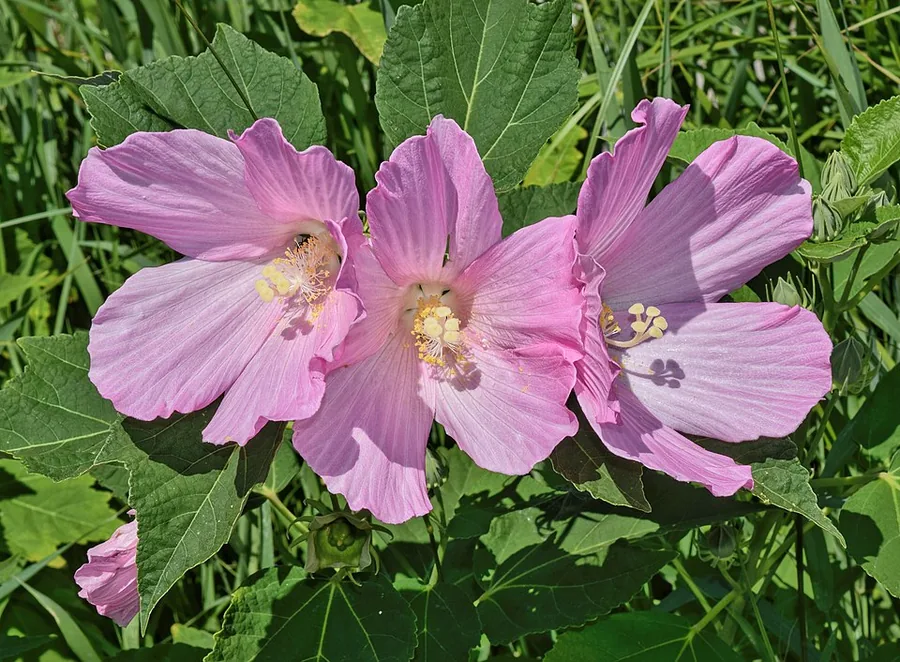
Hardy hibiscus delivers a tropical flower form on a fully cold-hardy frame, which is what makes it so useful in a northern border. The blooms reach the diameter of a dinner plate, yet the plant is a native perennial that survives winter lows of -20°F (-29°C). As a member of the mallow family found wild in marshes and wet meadows, its native habitat effectively prescribes its culture: the wetland origin explains its demand for continuous soil moisture.
The individual flower is short-lived, opening for only a day or two, but sequential flowering compensates. A mature clump can present 20 or more open blooms per day through high summer, sustaining the display from midsummer into early fall. Flower color spans white, soft pink, and deep crimson according to the cultivar selected.
Culturally this is an undemanding plant with a single non-negotiable requirement: keep the root zone wet. Under full sun in rich, moist ground it grows fast and flowers heavily, its vigor matching its water supply. Allow the soil to dry and the tissue responds with leaf scorch and bud drop, so irrigation is the one input you cannot allow to lapse.
Care
The short version: provide full sun and soil held moist to wet rather than dry, feed through the growing season, cut the dead stems back after frost, and allow for its late emergence in spring.
Light
Flowering is maximized in full sun, since photosynthetic output scales with light and directly funds bud production. The plant tolerates partial shade, but the trade-off is a looser, floppier habit and a reduced flower count.
Water
This is the input the plant cannot do without. Hardy hibiscus is a wetland species that requires soil held moist to wet, and it withstands standing water and short flooding that would drown most ornamentals. Irrigate deeply every 2 to 4 days in hot, dry conditions, because once the profile dries the leaves scorch and the buds abort.
Soil
It performs best in rich, organic loam, silt, or sandy soil with good moisture retention, though average garden soil suffices provided it is kept damp. Its pH tolerance is broad, spanning 5.5 to 7.5, so soil reaction is rarely a limiting factor.
Temperature
The species is exceptionally cold-hardy, enduring winter lows to -20°F (-29°C) and summer highs to 95°F (35°C). That cold tolerance is the basis of its reliable perennial return in climates where most large-flowered ornamentals fail to overwinter.
Humidity
Ambient outdoor humidity is entirely adequate, so no target figure applies. The controlling variable is soil moisture, not atmospheric humidity, a distinction that separates it from most large-flowered ornamentals.
Feeding
Apply a balanced general-purpose fertilizer monthly across the growing season. Its fast growth rate and large flowers impose a high nutrient demand, which a steady feeding schedule meets.
Pruning
After frost kills the top growth in late autumn, cut the stems back to 3 to 4 inches. To build a denser, more self-supporting habit, pinch the growing tips at roughly 8 and 12 inches in early summer, and deadhead spent flowers to keep the display going.
Size & spacing
Mature dimensions run 3 to 7 feet (90 to 210 cm) in height and 2 to 5 feet (60 to 150 cm) in spread. Allot each plant the full spread so air moves through the canopy and the foliage stays free of moisture-borne disease.
When to plant
Hardy hibiscus follows a warm-season schedule and breaks dormancy late in the year. Sow seed indoors in late winter, transplant after the spring frost has cleared and the soil has warmed, and the large flowers follow from midsummer into early fall.
Northern hemisphere
Southern hemisphere
Typical months for a temperate climate: start earlier in warm zones, later where spring frosts linger.
- Sow: Late winter to early spring (about 8 to 10 weeks before last frost); seed started very early can flower the first year
- Plant: Spring after the last frost once soil has warmed
- Harvest: Midsummer to early fall (roughly July to September); individual flowers last only 1 to 2 days but a mature plant can open 20 or more per day
Hardiness
USDA hardiness zones: 4–9
Temperature: down to -34°C
Troubleshooting
The majority of hardy hibiscus problems register on the foliage, whether the cause is insect feeding, moisture stress, or fungal infection. Reading those symptoms correctly lets you intervene before an issue advances. Match the sign you observe below, then apply the corresponding measure while it remains effective.
Marginal scorch and bud abscission under heat
Browning margins and dropped buds are the classic signature of drought stress, which sets in once the soil has dried several inches down during a hot spell. As a wetland species, hardy hibiscus has little tolerance for that deficit, so a thorough soaking restores root uptake and the foliage regains turgor. To prevent a recurrence, mulch to slow evaporation from the soil surface and site the plant in a low, naturally moist position where the water table works in your favor.
Fix:
- Water deeply and consistently to keep soil moist to wet
- Apply mulch to conserve soil moisture
- Site the plant in a low or naturally moist part of the garden
Foliage reduced to a vein skeleton in midsummer
The primary agent here is the Japanese beetle, feeding in numbers on the leaf tissue between the veins, with sawfly caterpillars a secondary contributor. Confirm it by the clusters of metallic green-bronze adults and the lacy, vein-only pattern they leave through midsummer. Because an established plant readily replaces this leaf area, hand-picking the beetles into soapy water at dawn, when they are sluggish and drop easily, keeps the injury cosmetic.
Fix:
- Hand-pick beetles into soapy water in early morning
- Tolerate minor cosmetic feeding on established plants
- Use a labeled insecticide only for severe infestations
Foliar lesions and rust pustules on the leaves
Circular spots, discolored blotches, and orange pustules indicate fungal leaf spots and rust, pathogens that establish where crowded, persistently wet foliage gives spores the moisture they need to germinate. Remove and dispose of the affected and fallen leaves to cut the inoculum, then open the canopy and keep irrigation off the foliage so leaf surfaces dry faster. A thorough clearing of debris at season's end denies the fungi an overwintering site and breaks the cycle.
Fix:
- Remove and dispose of affected and fallen leaves
- Improve air circulation and avoid overhead wetting of foliage
- Clean up plant debris at season end
Honeydew, sooty mold, and distorted young growth
The sticky film and warped new leaves trace to sap-sucking pests, typically aphids, whiteflies, or scale, whose feeding on tender tissue distorts growth and whose honeydew becomes the substrate for sooty mold. Confirm by inspecting leaf undersides and stems for small soft insects, white fliers, or bumpy scale, together with the sticky residue. A forceful stream of water dislodges a light population, and insecticidal soap or horticultural oil, which kills soft-bodied insects on contact, clears what remains.
Fix:
- Rinse off light infestations with a strong stream of water
- Apply insecticidal soap or horticultural oil to affected foliage
- Encourage natural predators
Toxicity
For households with pets and children, the profile is reassuring: hardy hibiscus is safe throughout. The ASPCA classifies hibiscus as non-toxic to cats, dogs, and horses, and the large flowers are edible for people. The worst outcome from an incidental mouthful is a mild, transient digestive upset, no different from overconsumption of any plant.
Safe for
People · Cats · Dogs · Horses · Rabbits · Livestock · Birds
Cats None
Poses no toxic risk to cats. The ASPCA classifies hibiscus as non-toxic to cats, so an exploratory nibble yields nothing beyond the mild gastric upset that large quantities of any plant material can provoke.
Dogs None
Presents no hazard to dogs. Hibiscus is classified non-toxic to dogs, and ingestion of a leaf or flower carries no danger.
Horses Safe
Horses may graze in its vicinity without harm, as the plant contains no compound that affects equines.
Rabbits Safe
Suitable around rabbits. The foliage and flowers hold no toxic principle, so incidental browsing is of no consequence.
Livestock Safe
Cattle, goats, and sheep may browse the plant freely, since it is not toxic to grazing livestock.
Birds Safe
Presents no risk to birds. Poultry and wild species may take the buds and petals with no adverse effect.
People Safe
Safe for people, and the large flowers are edible. The petals serve in teas, salads, and garnishes, leaving nothing that must be kept from children.
Varieties
Breeders have produced a range of named hardy hibiscus hybrids, differentiated chiefly by flower color, foliage color, and mature height. The following selections are the ones most worth knowing.
Lord Baltimore
A tall established hybrid distinguished by very large flowers in a brilliant crimson red.
Lady Baltimore
A selection reaching roughly 5 feet that bears clear pink flowers marked with a deep red central eye.
Kopper King
Notable for coppery bronze-red foliage that contrasts with its large light-pink, red-veined blooms.
Disco Belle Series
A group of compact, dwarf selections that reach only about 3 to 4 feet, suiting restricted planting spaces.
How to propagate
Hardy hibiscus can be increased by dividing an existing clump or by raising it from seed, and the two methods serve different objectives.
DivisionModerate
Spring as new growth emerges, or early fall · Establishes over one growing season
Division is the dependable method for reproducing a cultivar true to type, since it propagates the parent clone rather than recombined seed. Working in spring as new shoots emerge, or in early fall, lift the clump and cut the woody crown into sections, each retaining its own shoots and roots. Replant the divisions at once and keep them moist, and they establish over a single growing season.
SeedEasy
Start indoors in late winter to early spring; seed started very early can bloom the first year · Several weeks to germinate and grow on before transplanting
Seed propagation is straightforward, though the named hybrids rarely come true, so seedlings diverge from the parent. Sow indoors in late winter to early spring, and scarify the hard seed coat by nicking or soaking it to improve germination. The seedlings require several weeks to germinate and grow on before transplanting outdoors, and seed sown very early can flower in its first season.
Myths
A hardy hibiscus that hasn't leafed out by spring is dead.
It is merely among the last perennials to break dormancy. New shoots arise from the crown in late spring, well after neighboring plants have leafed out. Give it time before you dig it out, because a delayed emergence is characteristic of the species, not a sign of loss.
Hibiscus flowers are poisonous to dogs and cats.
The ASPCA classifies hibiscus as non-toxic to dogs, cats, and horses. The plant is safe around pets, with the caveat that ingesting a large volume of any foliage may induce a transient digestive upset.