Houseplant · Malvaceae
Money Tree
Pachira aquatica
Adapted to bright, diffuse light and tolerant of neglect, the money tree is a fast-growing, pet-safe specimen.
Bright indirect
64–75°F · 18–24°C
USDA 10–12
6–8 ft · 1.8–2.4 m
Overview
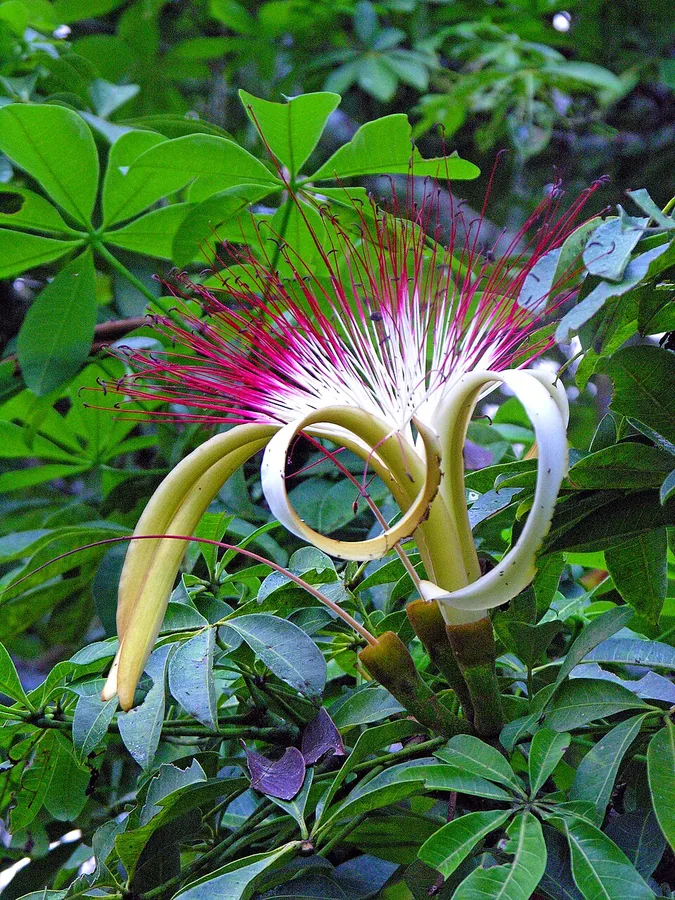
The money tree, Pachira aquatica, is a Malvaceae species from the seasonal wetlands of Mexico and Central and South America, where it matures into a substantial tree. Grown as a houseplant it is held to a manageable 6 to 8 feet (183 to 244 cm), bearing glossy palmate leaves that radiate from the crown of a slender trunk. Retailers typically sell it with several trunks braided together, a form imposed by the grower rather than one the plant assumes on its own.
Its reputation as a beginner's plant rests on genuine physiological tolerance: it accepts light levels well below what many houseplants require, adds growth quickly under favorable conditions, and withstands a lapse in watering far better than saturation. It is also among the minority of common houseplants confirmed safe around cats, dogs, and small children.
The two controlling variables are light quality and drainage. Bright but filtered light and a substrate that never leaves the roots standing in water satisfy the plant's core requirements. Exceed its tolerances with direct sun or chronic saturation and the predictable outcomes follow, namely leaf abscission or root rot.
Care
The short version: provide bright indirect light, water once the top of the soil dries, hold it warm and humid, and never allow the pot to stand in water.
Light
The money tree performs best in bright, indirect light, the illumination found near a window but outside the direct beam. It tolerates medium light and even partial shade, which explains its survival in dim interiors, yet the brightest position short of direct sun drives the strongest growth.
Water
Allow the top of the soil to dry between waterings, then irrigate thoroughly. The plant is far less tolerant of saturation than of drought, and standing water is the direct route to root rot. Excessive dryness, in turn, triggers leaf drop.
Soil
Grow it in a moist but well drained mix built from peat, perlite, and a little loam or sand, so excess water clears the rootzone. It is indifferent to soil reaction across a broad band, from 6.0 to 8.0.
Temperature
Maintain typical interior warmth, 64°F to 75°F (18°C to 24°C). As a tropical species it has no cold hardiness, so exclude it from chilly drafts and cold windows through winter.
Humidity
The plant is native to humid habitat and favors high humidity. It persists in average indoor air but grows more vigorously with added moisture, so cluster it with other plants or position it near a humidifier in dry, heated rooms.
Feeding
Apply a balanced houseplant fertilizer monthly through spring and summer, coinciding with active growth. Reduce or suspend feeding in fall and winter, when metabolic demand falls with the slower growth.
Pruning
Prune to regulate size and form, which the plant tolerates well. The pliable young stems are also the tissue growers braid together, so any braiding must be performed while the trunks remain young and flexible.
Repotting
Repot every 1 to 2 years, or sooner once roots circle the container or emerge from the drainage holes. Water that runs straight through and a decline in growth rate are the remaining indicators of a rootbound plant.
Size & spacing
Indoors the money tree attains roughly 6 to 8 feet (183 to 244 cm), though container volume restrains it well below that. Allow vertical clearance and rotate it a quarter turn periodically to counter phototropic lean.
Troubleshooting
The money tree is resilient, and nearly every disorder resolves to a fault in water or light. Leaf drop, softened roots, and scorched foliage each point to a distinct cause. Identify the matching entry below and correct the underlying condition before the setback advances.
Wilting plant with soft, brown roots
Root rot develops where prolonged saturation displaces air from the soil and the roots are denied oxygen. The affected tissue turns brown and mushy and gives off a sour odor, and because the failed roots can no longer draw water, the canopy wilts even in soaked soil. Lift the plant, excise all rotted tissue, and repot into fresh, free draining mix in a container that actually drains.
Fix:
- Remove from wet soil and cut away rotted roots
- Repot into fresh well-drained mix in a pot with drainage
- Water only after the top of the soil dries
Leaves turning yellow and dropping
Leaf yellowing and abscission in a money tree reflect a disruption to root function, most often from moisture that swings too far in either direction. A rootball taken to bone dry loses turgor, but saturated, oxygen-starved soil impairs uptake and yields the same shedding, and an abrupt shift to lower light or a draft compounds the stress. Hold the plant in one position, water only as the top of the soil dries, and supply modest nutrients across the growing season.
Fix:
- Adjust watering so the top of the soil dries between waterings but the rootball is never bone-dry or waterlogged
- Stabilize the plant's location and light exposure
- Raise ambient humidity and feed during the growing season if nutrient-deficient
Waxy white clusters, sticky foliage, or gnats at the soil line
Under indoor conditions a money tree attracts the common sap-feeding pests. Diagnose by the cottony colonies of mealybugs, the raised bumps of scale, aphid clusters on new growth, or fungus gnats whose larvae exploit persistently moist soil. Dislodge the insects mechanically, apply insecticidal soap or horticultural oil against residual populations, and dry the soil surface to interrupt the gnat life cycle.
Fix:
- Wipe off or wash off pests
- Treat with insecticidal soap or horticultural oil as needed
- Let soil surface dry to discourage fungus gnats
Pale burned areas on leaves exposed to direct sun
Unfiltered sun overloads the leaf surface and produces bleached or browned patches on the foliage nearest the window. The species is adapted to bright but diffuse light and cannot dissipate the intensity of direct midday exposure. Set it back from the glass or behind a sheer curtain, and remove the leaves too scorched to recover.
Fix:
- Move to a spot with bright indirect light or filtered sun
- Remove badly scorched leaves
Toxicity
The verdict is reassuring for households with pets or children: the money tree is non-toxic across the board. The ASPCA lists it as non-toxic to cats, dogs, and horses and identifies no toxic principle in the plant. It can share floor space with a curious dog or a toddler without concern.
Safe for
People · Cats · Dogs · Horses · Rabbits · Livestock · Birds
Cats None
The ASPCA classifies the money tree as non-toxic to cats and identifies no toxic principle in the tissue. Ingestion by a curious cat carries no expected poisoning.
Dogs None
The same ASPCA listing names the plant non-toxic to dogs, so a chewed leaf or stem presents no toxic risk, although the mechanical bulk of any ingested foliage may still provoke transient gastrointestinal upset in a sensitive animal.
Horses None
Horses fall under the same non-toxic determination from the ASPCA. No toxic compound is present, so an incidental mouthful poses no poisoning hazard.
Rabbits Safe
No toxic principle is recorded in the money tree, so it poses no poisoning risk to rabbits; the most a novel leaf would cause is minor digestive disturbance.
Livestock Safe
Ruminant grazers such as goats and sheep face no toxicological hazard from this species, which contains no identified toxin.
Birds Safe
The plant presents no toxic constituent to pet birds, so cohabitation in the same room carries no risk.
People Safe
No toxic compound has been identified in the money tree, making it safe to keep around children. The large seeds are consumed as food within parts of the native range, so incidental contact with a leaf warrants no concern.
How to propagate
The money tree propagates by stem cuttings, fresh seed, or air layering, though cuttings dominate in practice because the plant rarely flowers, and therefore rarely sets seed, indoors.
Stem cuttingsModerate
Spring to summer · Several weeks to root
Collect softwood or stem cuttings during spring or summer, when the plant is in active growth and rooting competence is highest. Hold them in a warm, humid environment, where roots initiate over several weeks. Sustained warmth and even moisture govern whether a cutting establishes or stalls.
SeedModerate
When fresh seed is available · Germinates readily from fresh seed
The large saba nuts germinate readily while the seed is fresh, so sow without delay after collection. The constraint is reproductive: houseplants rarely flower, and a non-flowering plant sets no seed, which is why cuttings remain the practical method for most growers.
Air layeringModerate
Spring to summer · Several weeks
Air layering serves as a third method, best executed in spring or summer. A wounded section of stem is wrapped to retain moisture, and adventitious roots form on the intact plant over several weeks before the layer is severed and potted.
Myths
Pachira aquatica develops its plaited trunk form naturally as the stems mature.
No inherent growth habit produces the braid. A grower interlaces several young stems by hand while the tissue is still soft and pliable, and the trunks subsequently fuse as they add girth. The braid is a cultivation technique, not a natural growth form.
Indoor conditions are sufficient for Pachira aquatica to reach flowering.
Pachira aquatica seldom initiates flowering under interior conditions, and a braided specimen still less. Reliable blooming is confined to plants established outdoors over several seasons. Indoors the plant is valued for its glossy foliage rather than its flowers.