Houseplant · Crassulaceae
Aeonium
Aeonium
Supply strong light, an abrasive substrate, and a dry summer rest, and this cool-season grower holds its rosettes plump and firm.
Full sun
Every 7–21 days
41–77°F · 5–25°C
USDA 9–11
Overview
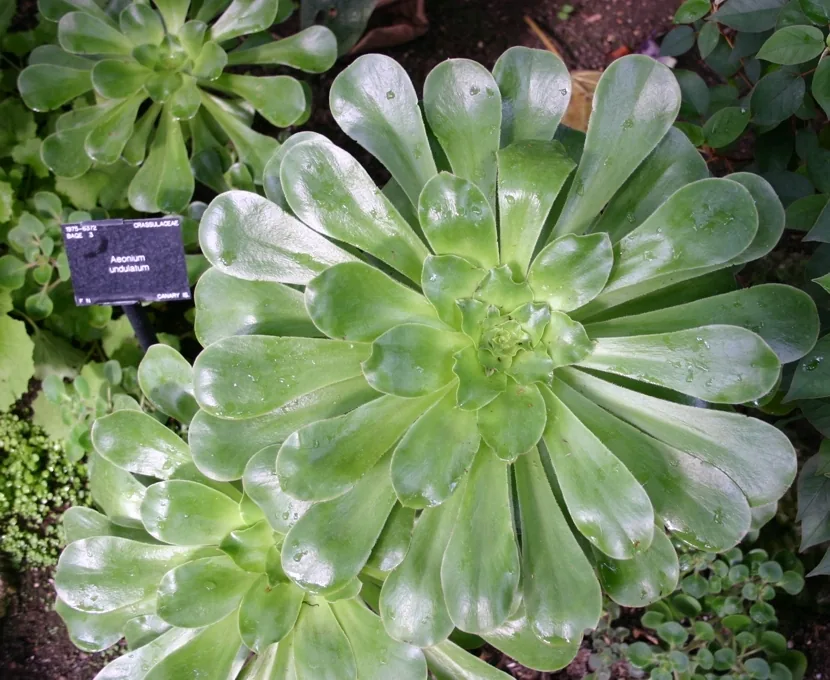
Aeonium is a stonecrop-family succulent built around rosettes, cultivated indoors or in frost-free gardens. Its fleshy leaves crowd into tight whorls borne at the stem tips, and the genus spans everything from a ground-flat disc to a small branching shrub. The easy-care reputation is earned: with sun overhead and a coarse, draining mix at the roots, it demands little further attention.
The defining trait is an inverted growth cycle. Where most plants accelerate in warmth and idle through winter, Aeonium reverses the pattern, putting on growth through cool weather and dropping into a summer rest under heat. During that rest the rosettes contract and the lowest leaves wither and fall away. Newcomers often read this as a crisis, yet it is the plant conserving itself, not declining.
Across the genus the habit shifts from neat, compact rosettes to broad spreading colonies, and the palette is broad. A number stay clear green, while the celebrated black rose carries rosettes pigmented so darkly they pass for purple-black. Given a suitable climate it builds a sculptural outdoor clump, and confined to a container it serves as an undemanding occupant for a bright ledge.
Care
The short version: site it in full sun to bright light over a coarse, fast-draining substrate. Apply water only after the mix has dried in the cool growing season, hold it far drier through the summer rest, and supply half-strength feed while it is in growth.
Light
Aeonium performs best under full sun to bright light, while tolerating partial sun or a bright indirect position once moved indoors. Strong illumination is what holds the rosettes dense and tightly packed, because the plant has no reason to reach. Deprived of it, the stems elongate and tilt toward the source, opening visible gaps between the leaves.
Water
Apply water only after the substrate has gone fully dry, keeping in mind that growth runs through the cool season. During those active cool months an interval of 7 to 21 days generally fits, whereas the summer dormancy calls for far less so the shut rosettes can rest undisturbed. Waterlogged roots in summer are the surest route to stem rot, since the resting plant draws up almost nothing.
Soil
Use a coarse, free-draining substrate that releases moisture rather than holding it against the roots. A pH falling between 6.0 and 7.0 sits within the agreeable band. Drainage outranks fertility for this plant, because lingering wetness at the base is precisely what it cannot endure.
Temperature
The comfortable range spans roughly 41°F to 77°F (5°C to 25°C). With essentially no tolerance for frost, it must be sheltered from freezing conditions. As warmth pushes beyond the upper limit, the plant transitions into its summer rest.
Humidity
This succulent favors low humidity and copes with dry indoor air without complaint. No target moisture figure applies. Free movement of air around the rosettes benefits it more than any humidity tray, since it stores its own water in the leaves.
Feeding
Apply a half-strength balanced fertilizer, scheduling it for the cool active period that runs fall through spring. A single feeding each month covers its needs. Withhold all feed across the summer dormancy, when the resting plant takes up little and added nutrients would simply accumulate.
Pruning
Trim elongated or stripped stems back to a leaf rosette to prompt fresh branch points. Clear away finished flower stalks and shriveled lower leaves to keep the form clean. The trimmings need not be discarded, as such cuttings strike roots with little trouble.
Repotting
Move it up a pot every 2 to 3 years, scheduling the work at the opening of the cool growing season so the roots reestablish as growth resumes. Act when roots push through the drainage holes, the medium drains far too quickly, or the rosettes press against the rim. Fresh coarse substrate primes it for the coming growth period.
Size & spacing
Mature height runs 6 to 35 inches (15 to 90 cm) by type, paired with a spread of 6 to 24 inches (15 to 60 cm). Saucer-flat forms remain near the soil surface, whereas branching treelike types climb to real stature. Since it grows at a moderate clip, the dimensions at planting stay close to what you end up with.
Troubleshooting
Nearly every Aeonium complaint comes down to moisture or illumination. The plant signals problems early, whether through softened tissue, drawn-out stems, or a summer lull that reads worse than it is. Find the matching case below and correct course before a minor symptom escalates.
Stem or rosette base turning soft, squishy, and see-through
Tissue that has gone translucent and pulpy signals rot driven by excess water, and the risk peaks when a summer-dormant plant is left standing in damp soil with little uptake to dry it. Excise all the discolored, collapsed material until you reach firm green tissue, allow the salvaged cuttings to seal over, and set them into a dry abrasive medium to regenerate roots. Pairing a sharply draining substrate with water held until the plant is actively growing removes the conditions that let the pathogen take hold.
Fix:
- Cut away all rotted tissue back to firm, healthy stem
- Let cuttings callus, then re-root in dry gritty mix
- Withhold water until new roots form
Rosettes pull shut and outer leaves shed during the heat of summer
What you are seeing is summer dormancy, the resting phase of a winter-active succulent rather than decline. Because the genus times its growth to cool weather, high heat triggers the rosette to fold inward and shed its oldest outer leaves to conserve moisture, while the core of the rosette holds firm. Pull back on irrigation, screen the plant from fierce afternoon light, and active growth resumes once autumn brings temperatures down.
Fix:
- Reduce watering and let the plant rest
- Provide light shade from intense summer afternoon sun
- Resume normal care as temperatures cool in fall
Long naked stems carrying rosettes only at their ends
Elongated, sparse stems are the classic etiolation response to inadequate light. Starved of sun, the plant invests in stem extension and angles toward the brightest source, which widens the gaps between leaves as it stretches. Relocate it to a position offering several hours of direct exposure, and you can sever the drawn-out rosettes and root them afresh to recover a dense, low-growing habit.
Fix:
- Move to a brighter location with several hours of direct sun
- Behead leggy rosettes and re-root them to restart compact growth
Toxicity
For households with pets or children, the verdict is reassuring: Aeonium counts as non-toxic and pet-safe. It is absent from the ASPCA list of plants toxic to cats and dogs, and it presents no poisoning hazard to the other animals likely to encounter it indoors or out. An exploratory bite causes no harm, so it belongs on any bright sill without concern.
Safe for
People · Cats · Dogs · Horses · Rabbits · Livestock · Birds
Cats Safe
A cat sharing a sunny ledge with the plant is in no danger should it taste a leaf.
Dogs Safe
Because the foliage holds no toxic compounds, a dog mouthing a rosette will be fine.
Horses Safe
Grazing horses carry no risk of poisoning from contact with this succulent.
Rabbits Safe
It poses no hazard to rabbits, though greens of any kind belong as only a minor portion of their feed.
Livestock Safe
Goats, sheep, and cattle can browse nearby with no danger of toxic effect.
Birds Safe
Both caged birds and yard fowl remain unharmed in its presence.
People Safe
Children and inquisitive toddlers who handle it face no toxic threat.
Varieties
The genus takes many shapes, from saucer-flat rosettes hugging the ground to upright branching stems that behave like miniature trees. The three below are the most commonly grown and capture that spread.
Aeonium 'Zwartkop' (black rose)
Its deep purple rosettes read as almost black atop tall, branching stems, the source of the black rose name.
Aeonium arboreum
Woody, treelike trunks lift vivid green rosettes well off the ground for genuine vertical presence.
Aeonium tabuliforme
It forms a flat saucer pressed against the soil, its leaves arranged in compact concentric rows.
How to propagate
Among succulents, Aeonium ranks with the easiest to increase, and the cool growing season is the prime window. Root a stem cutting or detach a side rosette, and a new plant follows with minimal effort.
Stem cuttingsEasy
During the cool active growing season (fall to spring) · 2 to 4 weeks to root after callusing
Few succulents propagate as readily from stem pieces. Sever a cutting while the plant is in its cool growing phase, give the wound a few days to seal over, then insert it into an abrasive, free-draining medium. Expect rooting in 2 to 4 weeks, but bear in mind that many Aeonium rosettes are monocarpic, so a rosette dies after it flowers.
Offsets & pupsEasy
During the cool active growing season · 2 to 4 weeks once detached and rooted
Branching forms produce lateral rosettes that detach as fully formed young plants. Lift an offset during the cool growth period, settle it into gritty substrate, and it establishes within 2 to 4 weeks. Keep in mind that many Aeonium rosettes are monocarpic, so a rosette dies after it flowers.
Myths
Aeonium should be watered as often as an ordinary leafy houseplant.
As a drought-tolerant succulent that grows in the cool season, it needs very little at the roots. Hold it almost completely dry across the summer rest, and apply water during the cool growing period only once the substrate has fully dried.
If a rosette folds shut and sheds its bottom leaves in summer, the plant must be failing.
That closing and leaf drop is the ordinary summer rest of a cool-season grower. Growth resumes once autumn cool returns, so simply keep it dry and let the dormancy run its course.