Houseplant · Crassulaceae
Ghost Plant
Graptopetalum paraguayense
Supply bright light and a dry rest between waterings, and the ghost plant largely manages itself.
Full sun
Every 10–21 days
50–86°F · 10–30°C
USDA 9–11
Overview
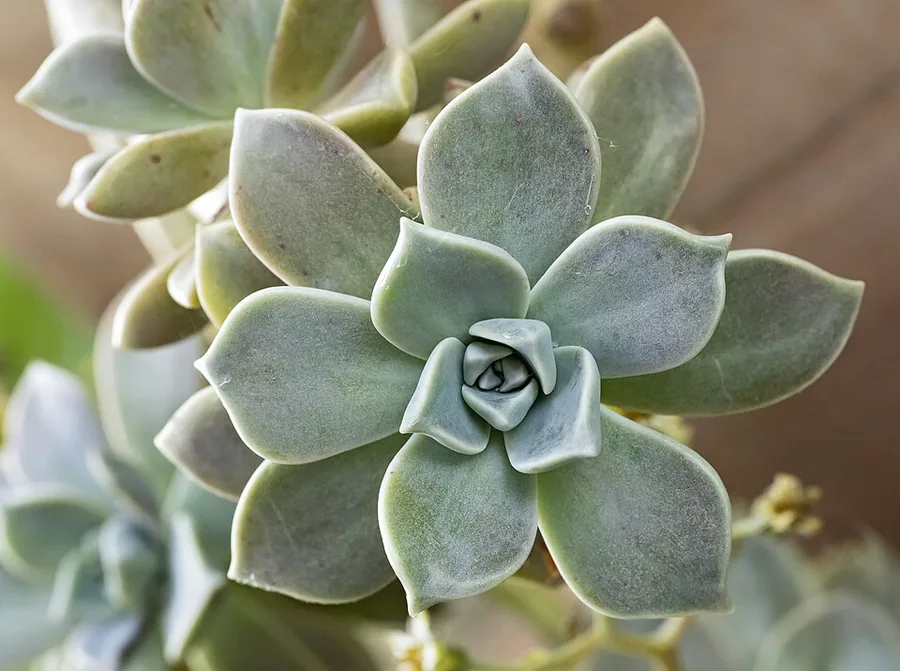
The ghost plant is a hardy Mexican succulent whose common name traces to the pale epicuticular bloom that gives its rosettes a chalky, ghostly cast. It sits in the Crassulaceae alongside the jade plant and the houseleeks, and like those relatives it holds water in thickened, fleshy leaves that grade from gray-blue to soft pink. Its cultural demands rank among the lightest of any houseplant.
The plant develops low rosettes that trail and spread as the stems elongate, cascading over a pot rim or a wall with age. Its leaves abscise at the slightest disturbance, an alarming trait to the uninitiated. That same fragility is a reproductive advantage, because nearly every detached leaf regenerates roots and founds a new plant where it comes to rest.
Its two governing requirements are strong light and very sharp drainage. Meet both and it withstands heat, drought, and extended neglect. Deny them, through saturated soil or a dim position, and the plant declares the deficit quickly by etiolating and by softening at the base.
Care
The short version: bright light or full sun, a gritty medium that drains rapidly, and a deep irrigation applied only after the substrate has dried completely. Restraint suits it, and it performs on a little neglect.
Light
Provide full sun or very bright light, which keeps the rosettes compact and well pigmented by supplying the energy the plant evolved to use. It persists in bright indirect light, but below that threshold the internodes elongate and the leaves separate.
Water
Irrigate deeply, then withhold until the substrate is bone dry, a cycle that generally falls every 10 to 21 days. Because the fleshy leaves store their own reserve, the operative risk is excess moisture rather than shortage. Overwatering is the direct trigger for rot.
Soil
Grow it in a gritty cactus or succulent mix that drains within seconds, never a standard potting soil that retains moisture around the roots. A pH from 6.0 to 7.5 is entirely suitable, so substrate texture governs success far more than its chemistry.
Temperature
It performs between 50°F and 86°F (10°C to 30°C) and tolerates summer heat without stress. It has no frost tolerance, so move it under cover or protect it before temperatures fall.
Humidity
This is a low-humidity plant with no defined target, well suited to the dry air of most interiors. Because damp, stagnant air favors rot, ventilation serves it better than misting.
Feeding
Fertilize monthly through spring and summer during active growth, using a diluted balanced or low-nitrogen succulent feed at half strength. Suspend feeding in the cooler months, and avoid rich fertilizer, which drives soft, structurally weak growth.
Pruning
Pruning is minimal by nature. Remove spent leaves and cut back leggy or etiolated stems to maintain a compact form, and behead any rosette that has drawn upward so the top can be replanted.
Repotting
Repot every 2 to 3 years, or earlier if the rosettes crowd the pot rim, and time it for spring. Roots emerging from the drainage holes or substrate that dries almost immediately both signal that the plant has outgrown its container.
Size & spacing
Each specimen remains low, about 6 to 12 inches (15 to 30 cm) tall, and broadens as the stems trail, spanning 12 to 24 inches (30 to 60 cm) across. Allow for that spread and for new rosettes to colonize the space around the base.
Troubleshooting
Nearly all disorders in the ghost plant reduce to two causes: excess water or insufficient light. Each declares itself early to an observant grower. Identify the sign below and correct it before rot or etiolation becomes entrenched.
Translucent, softening leaves above a rotting base
These symptoms point to root and stem rot, a consequence of a substrate that stays wet longer than the roots can respire in. Unpot the plant and examine the roots and lower stem for blackened, softened, or foul-smelling tissue, the hallmark of anaerobic decay. Excise all affected tissue, allow the sound rosettes or cuttings to callus over several days so the wounds seal, and re-establish them in a dry gritty medium.
Fix:
- Stop watering immediately
- Remove the plant and cut away all rotted tissue
- Let healthy cuttings or rosettes callus for several days
- Replant in dry gritty succulent mix
Elongating internodes and widening gaps between leaves
Elongated internodes and pale, spaced leaves are classic etiolation, the plant's response to a light budget below what it needs. Under that deficit the stems lean phototropically toward the window and the compact rosettes loosen and flatten. Restore several hours of direct sun, then behead the drawn rosette and replant the top, since the decapitated stem will break dormancy at its lower nodes and yield fresh offsets.
Fix:
- Move to a brighter location with several hours of direct sun
- Behead the stretched rosette and replant the top
- Propagate the bare stem to produce new offsets
Bleached, browning patches following an outdoor relocation
These lesions are sunburn, the result of moving foliage from low indoor light into full sun before its tissues have adjusted their protective pigments. The damage concentrates on the most sun-facing surfaces and appears within a day or two of the move. Return the plant to bright but lightly shaded light, raise the exposure over one to two weeks to let the leaves acclimate, and leave the scarred foliage until the plant sheds it naturally.
Fix:
- Move to bright but slightly shaded light temporarily
- Acclimate gradually to stronger sun over one to two weeks
- Leave scarred leaves in place until they are naturally shed
Toxicity
This is a sound choice for a household with animals or young children. The ghost plant is non-toxic in every respect, listed by the ASPCA as safe for cats and dogs, and it carries no toxic principle that would affect other pets or people. The most an incidental nibble produces is brief gastric upset from the fibrous bulk.
Safe for
People · Cats · Dogs · Horses · Rabbits · Livestock · Birds
Cats None
Cats face no toxic principle in this species. Ingesting leaf tissue may prompt brief gastric discomfort from the fibrous bulk, but no poisoning follows.
Dogs None
Dogs are equally unaffected, as the ASPCA classifies the species non-toxic. Chewed foliage might yield transient stomach upset and nothing more serious.
Horses None
Horses encounter no toxin in this succulent, atypical forage though it is. An incidental mouthful carries no consequence for them.
Rabbits None
Rabbits tolerate its presence without risk. The water-storing leaves hold no toxic compound, so an exploratory bite does no harm.
Livestock None
Grazing stock such as goats and sheep face no poisoning hazard from the plant. A few consumed leaves warrant no intervention.
Birds None
No toxic constituents affect birds. A pecked leaf may transfer a farinose smudge to the beak, a cosmetic residue that wipes away without effect.
People None
Handling and incidental ingestion are safe for people, children included. The chalky epicuticular bloom detaches onto the skin but remains harmless.
The powdery (farinose) coating on leaves rubs off easily when handled, which is cosmetic and harmless.
Varieties
Only a couple of forms circulate widely, and each substitutes added color for the typical gray-blue rosette. The two below are the ones worth recognizing.
Graptopetalum paraguayense 'Pink Form'
Under strong light or cool nights its rosettes develop pink to rose pigmentation, whereas the typical form retains a chalky gray-blue.
×Graptosedum (Graptopetalum × Sedum hybrids)
These intergeneric crosses with Sedum inherit the ghost plant's form while contributing brighter coloration and a faster, more trailing habit.
How to propagate
Few plants regenerate as readily as this one. A single leaf, an offset, or a beheaded rosette will each root with minimal intervention.
Leaf cuttingsEasy
Spring through summer during active growth · 3 to 6 weeks to root and form new rosettes
During the spring-to-summer growth phase, detach an intact healthy leaf with a clean twist and let the abscission point callus for a few days before setting it on a dry gritty medium. Adventitious roots and a small rosette emerge in roughly 3 to 6 weeks, the same regeneration that lets shed leaves establish unaided wherever they fall.
Offsets & pupsEasy
Spring through summer · 2 to 4 weeks
Across spring and summer the plant produces rosette offsets along its stems. Detach one, allow a brief callus period, and pot it up, after which it roots and establishes within 2 to 4 weeks.
Stem cuttingsEasy
Spring through summer · 2 to 4 weeks
In the warm season, sever a rosette with a short section of stem and let the cut surface callus fully. Once replanted it roots dependably, taking hold in approximately 2 to 4 weeks.
Myths
Because the foliage looks powdery and parched, the plant must be watered often.
The pale, powdery layer is an epicuticular waxy bloom, an adaptation to reduce water loss, not evidence of drought stress. Because the plant stores its own reserve in the succulent leaves, it performs best when the substrate dries completely between irrigations. Watering in response to that dusty appearance is the surest route to rot.
As with so many succulents, the species is hazardous to animals.
Toxicity is real in a number of succulents, but it does not extend to this taxon. The ASPCA lists the ghost plant as non-toxic to cats and dogs, so an exploratory nibble does not warrant concern.