Houseplant · Crassulaceae
Kalanchoe
Kalanchoe
A drought-adapted succulent that delivers bright, long-lasting blooms on minimal inputs.
Bright indirect
50–86°F · 10–30°C
USDA 10–12
6–35 in · 15–90 cm
Overview
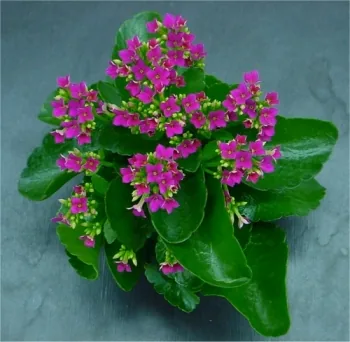
Kalanchoe is a succulent genus in the stonecrop family, Crassulaceae, with most cultivated houseplant species originating in Madagascar. Its thick, fleshy leaves function as water-storage organs, which explains both its drought tolerance and its low maintenance demand. The florist forms sold in garden centers carry dense inflorescences of small, brightly colored blooms that persist for weeks.
The genus is far broader than the single florist plant most growers know. Certain species are prized for their fuzzy silver foliage rather than flowers, some arrange their leaves into red-margined paddles, and others produce marginal plantlets that detach and root without assistance. Across that morphological range the cultural requirements converge on two constants: strong light and a substrate that drains rapidly.
One caveat governs placement. All kalanchoe tissue contains cardiac glycosides toxic to cats, dogs, horses, and other animals, so siting demands care in any household that keeps pets.
Care
The short version: provide bright indirect light, a gritty fast-draining substrate, and water only once the medium has dried out completely. Maintain warmth, feed lightly during the growing season, and reduce watering through winter dormancy.
Light
Provide bright indirect light; once acclimated the plant tolerates a measure of direct sun. Because inadequate light drives the etiolation and flowering failure that trouble most specimens, a bright windowsill is the most reliable position.
Water
Allow the medium to dry out completely between irrigations, then water thoroughly and discard any that collects in the saucer. The fleshy leaves hold an internal reserve, so it is standing moisture rather than drought that kills these plants, through root rot. Reduce watering markedly in winter as growth slows.
Soil
Use a gritty, well-drained cactus or succulent mix so water passes through quickly and does not linger at the roots. Sharp drainage is the single most important cultural provision, because it denies rot the standing water it requires.
Temperature
Hold the plant within 50°F to 86°F (10°C to 30°C), a range that ordinary interior warmth satisfies. It has no frost tolerance, so any specimen kept outdoors must come in well before temperatures fall.
Humidity
Low ambient humidity is precisely what this succulent prefers, so no target figure applies. Damp, stagnant air is counterproductive and encourages the very rot to be avoided.
Feeding
Fertilize monthly from spring through summer during active growth with a balanced water-soluble fertilizer at half strength. Suspend feeding entirely through winter dormancy, when the plant cannot use the nutrients.
Pruning
Deadhead spent inflorescences and pinch leggy stems after flowering to maintain a compact, branching habit. Remove any soft, rotted growth immediately to prevent its spread.
Repotting
Repot every 1 to 2 years, or sooner once the plant crowds its container. Roots emerging from the drainage holes, water running straight through, and stalled growth together indicate the roots have outgrown the available volume.
Size & spacing
Depending on species, a kalanchoe attains 6 to 35 inches (15 to 90 cm) in height and 6 to 18 inches (15 to 45 cm) in spread. Select container size accordingly, since the compact florist types remain well below the upper height figure.
Troubleshooting
Most kalanchoe disorders originate either at the roots or in the light regime. Because the causes are few and predictable, early recognition makes nearly all of them reversible. Match the presentation below, then correct the underlying condition before it advances.
Soft, blackening stems and a collapsing base
Softening tissue at the base points to root and crown rot, the predictable result of water held in soil that drains too slowly for a succulent's roots to tolerate. Lift the plant and examine the roots, which lose their firm pale structure and turn brown, soft, and foul as anaerobic decay takes over. Excise all rotted tissue with sterile tools, repot into fresh gritty mix that admits air to the roots, and withhold water so the surviving tissue can seal.
Fix:
- Remove the plant from wet soil
- Cut away all rotted tissue with clean tools
- Repot into fresh gritty, well-drained mix
- Withhold water until the plant recovers
Etiolated growth that fails to rebloom
Elongated internodes and wide leaf spacing are classic etiolation, the plant's response to insufficient light as it invests in reaching toward the source. Flowering kalanchoes are short-day plants, so bud initiation depends on long uninterrupted nights as much as on brightness; relocate to a brighter position and pinch the drawn stems to restore form. To reinitiate flowering, subject the plant to about six weeks of roughly 14 hours of complete darkness each night.
Fix:
- Move to a brighter spot with bright indirect light
- For flowering kalanchoes, provide about six weeks of roughly 14 hours of complete darkness each night to trigger budding
- Pinch back leggy stems
Cottony masses and honeydew in the leaf axils
Cottony white colonies paired with a sticky secretion are the signature of mealybugs, sap-feeding insects that shelter in the protected leaf axils. Touch each insect with a cotton swab charged with 70 percent isopropyl alcohol, which strips their waxy coat, then follow with insecticidal soap and repeat across the generations until the plant reads clean. Isolate it from neighboring succulents, since these pests spread readily by contact.
Fix:
- Dab insects with a cotton swab dipped in 70 percent isopropyl alcohol
- Treat with insecticidal soap and repeat until clear
- Isolate the plant from other succulents
Toxicity
Site this plant away from animals. All tissue contains bufadienolides, cardiac glycosides that produce salivation, vomiting, and diarrhea, and at higher doses can disturb cardiac rhythm. No part is edible, so treat it as toxic to pets and livestock and place it beyond the reach of children.
Toxic to
Cats · Dogs · Horses · Rabbits · Livestock · Birds · People
Cats Toxic
In cats, ingestion typically presents as salivation followed by vomiting and diarrhea. The concern scales with dose, because at higher intakes the cardiac glycosides can disturb normal heart rhythm.
Dogs Toxic
Dogs that consume any part commonly show drooling, vomiting, diarrhea, and lethargy. Larger ingestions can compromise cardiac conduction, producing an irregular heartbeat that warrants veterinary attention.
Horses Toxic
The same bufadienolides affect horses substantially. Salivation, colic, and loose manure are typical, and in quantity the toxin can derange cardiac rhythm and become life-threatening.
Rabbits Toxic
Kalanchoe should never be offered to rabbits. Even minimal intake provokes salivation and gastrointestinal upset, and the cardiac glycosides render it genuinely hazardous to so small an animal.
Livestock Toxic
Cattle, goats, and sheep are poisoned where the plant grows or clippings are discarded within reach. Signs progress from salivation and diarrhea to ataxia, and heavy exposure can arrest the heart.
Birds Toxic
Birds require careful separation from the foliage. The cardiac glycosides carry no lesser risk for them, and a bird that samples a leaf may develop gastrointestinal upset and rhythm disturbance.
People Caution
No part of the plant is edible, so it should not be consumed. Contact with the sap may leave skin mildly irritated, and ingestion of any amount can upset the stomach, so keep it beyond the reach of small children.
Sap can cause mild contact irritation; keep the plant out of reach of pets that chew foliage.
Helpline numbers

United States
ASPCA Animal Poison Control: (888) 426-4435 (fee applies)
Poison Control: (800) 222-1222



Canada
Poison Centres: 1-844-764-7669
Varieties
The genus encompasses far more than the flowering plant most people recognize. The following are the forms you are most likely to encounter.
Kalanchoe blossfeldiana (Flaming Katy)
This is the ubiquitous florist species, recognized by glossy scalloped leaves and dense clusters of small, brightly colored flowers.
Kalanchoe tomentosa (panda plant)
Cultivated for foliage rather than flowers, it carries thick, felted silver leaves margined with soft brown down.
Kalanchoe daigremontiana (mother of thousands)
It produces rows of miniature plantlets along each leaf margin, which abscise and root independently wherever they settle.
Kalanchoe luciae / thyrsiflora (paddle plant)
Its rounded, paddle-shaped leaves overlap in a rosette and develop deep red margins under strong light.
How to propagate
Kalanchoe propagates readily by vegetative means, whether by rooting a stem tip or by regenerating an entire plant from a single leaf.
Stem cuttingsEasy
Spring to summer during active growth · 2 to 3 weeks to root
Take a healthy stem tip during active growth in spring or summer, then allow the cut surface to dry and callus for a day or two before insertion. Set into gritty, barely moist medium, and adventitious roots emerge in about 2 to 3 weeks. The callus step seals the wound and is what prevents the cut from rotting in contact with the substrate.
Leaf cuttingsEasy
Spring to summer · 3 to 6 weeks to form plantlets
Many kalanchoes regenerate from a single detached leaf laid flat on well-drained medium in spring or summer. New plantlets and roots differentiate at the leaf base over the following 3 to 6 weeks. Allow the leaf to callus beforehand and keep the medium only barely damp to limit rot.
Myths
Kalanchoes are harmless succulents that make safe gift plants around pets.
The record contradicts this: the ASPCA lists kalanchoe as toxic to cats and dogs, and the toxicity extends across the genus. Every part contains bufadienolides, cardiac glycosides that induce salivation, vomiting, and diarrhea, and at higher doses can disturb cardiac rhythm. Ornamental appeal is no indicator of safety in a household that keeps animals.