Houseplant · Crassulaceae
Jade Plant
Crassula ovata
Provide bright light and a complete dry-out between waterings, and the jade plant will outlast most houseplants purchased alongside it.
Full sun
50–75°F · 10–24°C
USDA 10–11
1–6 ft · 0.3–1.8 m
Overview
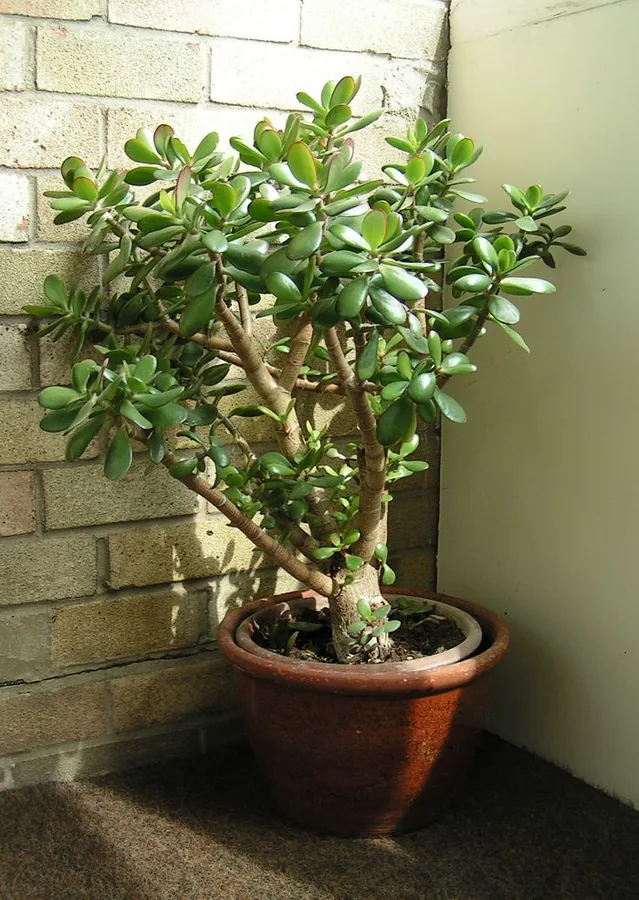
The jade plant is a succulent from southern Africa and ranks among the most dependable houseplants in cultivation. Its thick, glossy leaves and stout woody trunk act as water reserves, and that storage capacity is precisely why it endures the neglect that ends less resilient species. Positioned in a bright window and left undisturbed, it gradually assumes the proportions of a small tree.
Growth is slow but sustained over a long life. Indoors a jade may persist for decades and attain 1 to 6 feet (30 to 180 cm), thickening into a gnarled, bonsai-like form as woody tissue accumulates. Its folk names, money plant and lucky plant, reflect tradition rather than function, since its real merit lies in how tolerant it is of imperfect care.
The single condition it will not tolerate is a saturated pot. Nearly every jade fatality traces to excess water rather than deficit, because standing moisture invites rot at the roots. Manage watering and drainage correctly and the remainder of its care becomes close to trivial.
Care
The short version: supply bright light with some direct sun, a gritty fast-draining medium, and water applied only once the soil has dried out completely. Maintain warmth, feed lightly during active growth, and avoid the tendency to overwater.
Light
Jade performs best in bright light with several hours of direct sun, which a south-facing window supplies. Under low light the stems elongate and lean toward the source, turning pale and leggy as the plant reaches for more energy.
Water
Water thoroughly, then withhold until the soil has dried out completely before the next application, reducing sharply in winter when growth stalls. Overwatering is the principal cause of death because standing moisture rots the roots, whereas underwatering merely shrivels the leaves, which recover turgor after a soak.
Soil
Grow it in a gritty cactus or succulent mix that drains rapidly, always in a pot with drainage holes so moisture cannot accumulate. A slightly acidic pH of 6.0 to 6.5 suits it, and the coarse, sandy structure keeps water from settling around the roots.
Temperature
Standard room warmth of roughly 50°F to 75°F (10°C to 24°C) is ideal. Shield it from cold drafts and never allow it below 50°F (10°C), a threshold that can provoke sudden leaf drop.
Humidity
As a dry-climate species it prefers low humidity and reacts poorly to damp, stagnant air. Misting is unnecessary, since ordinary household air meets its needs.
Feeding
Feed monthly through spring and summer during active growth, then suspend feeding over winter when the plant is dormant. Apply a balanced or low-nitrogen succulent fertilizer diluted to half strength, because a slow grower like jade requires little.
Pruning
Pinch or prune in spring to promote fuller, tree-like growth and to remove leggy or weak stems. Jade tolerates hard pruning well, and each removed piece roots readily as a cutting, so nothing need be wasted.
Repotting
Repot every 2 to 3 years in spring, or when roots emerge from the drainage holes and the plant becomes top-heavy. Transfer it to a marginally larger pot with fresh gritty mix, and restrict watering for a week or so while severed roots heal.
Size & spacing
Indoors a jade reaches 1 to 6 feet (30 to 180 cm) in height with a spread near 1 to 3 feet (30 to 90 cm). Because growth is slow and the crown thickens with age, a stable, heavy pot is needed to counter the weight and prevent tipping.
Troubleshooting
Most jade disorders resolve to two variables, water and light. Soft, mushy growth points to excess moisture, whereas a wrinkled or elongated plant signals a need for water or brighter exposure. Match the presenting sign below and correction is usually possible before the plant is lost.
Soft, mushy stems and yellowing at the base
Softening and yellowing at the base signal root and stem rot, which sets in when saturated soil deprives the roots of oxygen and lets rot organisms take hold. Once the base tissue has collapsed it will not regenerate, so excise all rotten material back to firm growth, allow the cuts to callus, or restart from a sound cutting. Prevent a recurrence by watering only after the medium has dried completely.
Fix:
- Stop watering immediately and allow the soil to dry out
- Remove the plant, cut away rotted roots and tissue, and let cuts callus
- Repot into fresh, fast-draining gritty mix
- Propagate healthy stem or leaf cuttings if the base is lost
Leaves dropping all at once
An abrupt shedding of leaves reflects stress from a sudden change in light, temperature, or watering, as the plant sheds tissue faster than it can acclimate. Identify the recent trigger, whether relocation, a cold draft, or a shift from drought to saturation. Return it to a single stable position and routine, hold it above 50°F (10°C), and give it time to adjust, since acclimation is gradual.
Fix:
- Stabilize location, light, and watering routine
- Protect from cold drafts and temperatures below 10°C
- Allow the plant to acclimate gradually to new conditions
Wrinkled, shriveled, or drooping leaves
Leaves that turn soft and pliable over dry soil indicate underwatering, the visible result of the plant drawing down the water reserve held in its leaf tissue. Rehydrate with a thorough watering until it drains from the base, then resume watering only as the leaves begin to lose turgidity. Turgor returns and the plumpness is restored within a day or two.
Fix:
- Water thoroughly until it drains from the bottom
- Resume a regular dry-out watering cycle
- Move out of excessive heat if leaves continue to shrivel
Stretched, leggy stems with gaps between leaves
Elongated stems and widening gaps between leaves are etiolation, the growth response of a plant reaching for insufficient light. Relocate it to a bright south-facing window offering several hours of direct sun, and rotate it periodically so growth develops evenly rather than one-sided. Etiolated tissue does not revert, but pruning the drawn stems restores a compact, tree-like habit.
Fix:
- Move to a brighter spot with several hours of direct sun
- Rotate the plant periodically for even growth
- Prune leggy stems to restore a compact shape
Toxicity
Keep the jade plant away from cats and dogs. The ASPCA classifies it as toxic to both, and a pet that chews the leaves may vomit, become lethargic, lose coordination, and develop a slowed heart rate. The responsible toxin has never been identified, so the reliable safeguard is to position the plant beyond a pet's reach. For people it poses essentially no risk.
Toxic to
Cats · Dogs · Horses · Rabbits · Livestock · Birds
Safe for
People
Cats Moderate
Ingestion in cats typically presents as vomiting followed by depression and lethargy. Ataxia, meaning an uncoordinated gait, is common, and larger doses can bring on bradycardia, a slowed heart rate.
Dogs Moderate
Dogs that consume jade generally vomit and become lethargic and withdrawn. Incoordination may follow, and a heavier ingestion can depress the heart rate.
Horses Caution
Horses are not a documented species for this plant, but the responsible toxin remains unidentified, so susceptibility cannot be ruled out. The prudent course is to exclude the plant from their reach.
Rabbits Caution
No reliable data describe the effect of jade on rabbits, and a succulent of this kind has no dietary role for them regardless. Treat it as unsuitable and prevent any browsing.
Livestock Caution
Grazing livestock have not been evaluated against this species, and with the active compound still uncharacterized, exclusion is the defensible approach. Keep it away from goats, sheep, and cattle.
Birds Caution
The effect on birds is unconfirmed, though a curious parrot will chew a wide range of material. Keep the plant clear of cages and perches as a precaution.
People Low
Jade poses essentially no hazard to people through handling or presence in the home. It is not edible, however, so ingestion serves no purpose, and small children should be kept from mouthing the leaves.
Helpline numbers

United States
ASPCA Animal Poison Control: (888) 426-4435 (fee applies)

United Kingdom
Animal PoisonLine: 01202 509000 (fee applies)

Australia
Animal Poisons Helpline: 1300 869 738
Varieties
Beyond the type species, several cultivars are grown for distinctive leaf form and coloration. The following are the ones most worth seeking.
'Gollum'
Its foliage forms narrow tubular leaves terminating in reddish, suction-cup tips, lending the plant a coral-like silhouette.
'Hobbit'
Its leaves curl and roll back on themselves into small trumpet forms on a plant of noticeably more compact stature than 'Gollum'.
'Hummel's Sunset'
Its golden-yellow foliage develops red margins that intensify under bright light and cooler temperatures.
'Variegata' (Tricolor)
Each leaf is streaked with creamy white and green and frequently flushes pink along the margins.
How to propagate
Few plants propagate as readily as jade, because its succulent tissue roots with minimal intervention. A single dropped leaf or a trimmed stem will strike roots largely on its own, which is why one specimen soon yields many.
Leaf cuttingsEasy
Spring or summer during active growth · 2 to 4 weeks to root, several weeks more to form plantlets
A single detached leaf is sufficient to generate a new plant, which works because succulent leaf tissue readily forms roots and shoots at the cut. Detach a healthy leaf during the spring or summer growth phase, allow the wound to callus over several days, then place it on or barely into gritty mix. Rooting follows in 2 to 4 weeks, with plantlets emerging several weeks later, making this the slow but highly reliable method.
Stem cuttingsEasy
Spring or summer during active growth · 2 to 3 weeks to root
A stem cutting yields a structured plant more quickly because it already carries stem tissue rather than having to build it. Take a cutting during the spring or summer growth period, let the cut callus for several days, then insert it into dry succulent mix. Roots form in roughly 2 to 3 weeks, and establishment outpaces a leaf cutting for that reason.
Myths
The jade plant is the true money plant that brings wealth, the same one sold as a trailing vine.
The label money plant is applied loosely across several unrelated species. Jade is a succulent, whereas the trailing vine sold under the same name is generally a pothos or a Pilea, placing the two in entirely separate lineages. The name derives from folklore rather than any plant that generates wealth.
Jade plants are perfectly safe to keep in a home with pets.
The ASPCA classifies jade as toxic to cats and dogs, and notably the exact causative compound has never been characterized. An animal that ingests it may vomit, become lethargic, lose coordination, and develop a slowed heart rate. Keep it well out of reach of cats and dogs.