Houseplant · Crassulaceae
Echeveria
Echeveria
Supply bright light and a fast-draining substrate, and this rosette succulent largely manages itself.
Full sun
50–77°F · 10–25°C
USDA 9–11
3–12 in · 8–30 cm
Overview
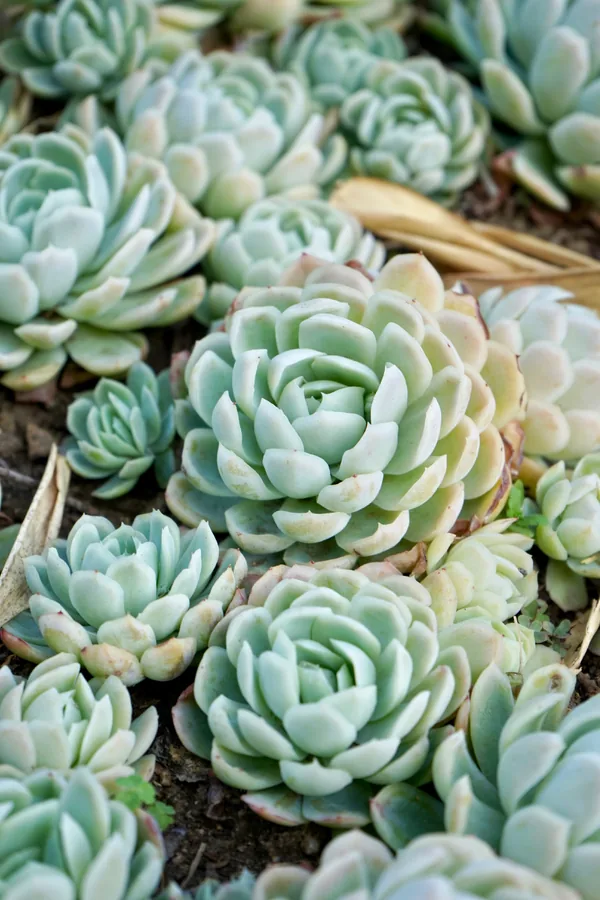
Echeveria is a rosette-forming succulent native to the arid highlands of Mexico and Central America, and that origin explains its windowsill ease. Leaves arranged in a tight phyllotactic spiral radiate from a central growing point into a near-sculptural rosette, in shades of blue-green, lavender, and silver. Many carry farina, a fine epicuticular wax that scatters light into a frosted bloom and shields the leaf surface.
Its low demands follow directly from its biology. Water stored in the swollen, succulent leaves buffers the plant through dry intervals, so it tolerates a lapse in watering far better than excess moisture at the roots. Under strong light and a gritty medium it holds a compact habit and develops pigment, often flushing pink or red at the leaf tips as bright sun drives anthocyanin production.
The plant remains small, generally 3 to 12 inches (8 to 30 cm) across, and propagates vegetatively by producing offsets around the base. Those pups let a single rosette establish a clonal colony over time. The two reliable killers are excess water and inadequate light, and both are straightforward to manage once understood.
Care
The short version: bright light, a gritty fast-draining medium, and a thorough soak only after the soil has dried out completely, with light feeding through the warm months.
Light
Echeveria requires full sun to very bright light for several hours daily to sustain the compact rosette and its coloration, both of which depend on high photon flux. A south or west window supplies that intensity indoors. Below this threshold the plant etiolates, the rosette draws out, and pigment fades.
Water
Irrigate the medium thoroughly, then withhold water until it has dried out completely, allowing the roots to respire in dry conditions. Because this desert species is highly susceptible to rot, apply water at the base and never let it collect in the rosette, where standing moisture promotes crown decay. When uncertain, extend the dry interval a few days.
Soil
Grow it in a gritty cactus or succulent medium that drains within seconds rather than retaining water around the roots, since sustained saturation is the primary cause of root rot. A pH between 6.0 and 7.0 is suitable. Drainage is the governing factor, so amend a dense mix with perlite or coarse sand.
Temperature
It performs best between 50°F and 77°F (10°C to 25°C) and is comfortable at ordinary room temperature. The tissue has no frost tolerance, so relocate outdoor plants indoors well before the first hard chill.
Humidity
Low ambient humidity matches the plant's arid origin, so no added moisture is warranted. Steamy bathrooms and kitchens are unsuitable, because humid air lingering around the leaves favors rot.
Feeding
Fertilize lightly through spring and summer, the period of active growth when the plant can use the nutrients. A dilute balanced or low-nitrogen succulent formula applied a few times across the season meets its modest needs. Suspend feeding in winter as growth slows.
Pruning
Maintenance is minimal. Remove the spent lower leaves and faded flower stalks to limit decay sites and keep the rosette clean. Where a rosette has elongated and gone leggy, behead the apex and re-root it, since the drawn stem will not recover its form.
Repotting
Transfer it to a marginally larger pot every 2 to 3 years, or sooner when offsets crowd the rim and roots emerge from the drainage holes. Use the occasion to renew the gritty medium and inspect the root system for soft, decayed sections.
Size & spacing
A mature rosette stays small, reaching 3 to 12 inches (8 to 30 cm) in height and a comparable spread depending on the species. Its slow, compact growth suits a windowsill, a small container, or a position within a mixed succulent planting.
Troubleshooting
Most echeveria disorders resolve to a single underlying cause, either light below the threshold the plant needs or moisture above what its roots tolerate. Examine the rosette and the base together, since each reports a different stress, and intervene before the response advances. Match the symptom below to its mechanism, then correct the cause rather than the symptom.
Translucent, mushy leaves over a soft and blackening base
Soft, water-soaked leaves and a collapsing stem base indicate root and crown rot, the result of pathogens taking hold in soil kept wetter than this drought-adapted succulent can withstand. Once decay reaches the crown, the vascular core fails and the original plant cannot recover. Withhold water, excise every softened tissue back to firm growth, and re-root a clean apical cutting or a sound offset in dry gritty mix.
Fix:
- Stop watering and let the plant dry
- Cut away rotted tissue and dust with no further water until callused
- Re-root healthy top growth or offsets in dry gritty mix
Cottony white tufts seated in the leaf axils
Cottony white masses lodged in the leaf axils, paired with a sticky residue, are mealybugs feeding on sap from sheltered crevices the rosette form provides. Apply 70 percent isopropyl alcohol to each insect with a cotton swab to dissolve its protective wax and kill it on contact, then rinse the plant and isolate it from the collection. Inspect weekly, since eggs hidden in the axils hatch in waves and a single pass rarely clears them.
Fix:
- Dab insects with a cotton swab dipped in 70 percent isopropyl alcohol
- Rinse and isolate the plant
- Repeat treatment weekly until clear
Tall, drawn-out rosette with pale, widely spaced leaves
A lengthening stem with leaves spreading apart and leaning toward the window is etiolation, the growth response a succulent makes when light falls below what it needs. Starved of the energy to build a dense rosette, the plant invests in stem elongation instead and loses its compact form. Restore strong light or supplement with a grow lamp, then behead the drawn top and re-root it, because elongated tissue will not retighten.
Fix:
- Move to a sunnier spot or add grow lighting
- Behead the stretched rosette and re-root the top
- Propagate usable leaves from the bare stem
Toxicity
For a household with pets and children, the safety record is straightforward. Echeveria contains no recognized toxic compounds, and the ASPCA classifies it as safe for both cats and dogs. A nibbled leaf may produce a brief gastric upset typical of any non-food plant, but no toxic mechanism is at work.
Safe for
People · Cats · Dogs · Horses · Rabbits · Livestock · Birds
Cats None
No toxic compound makes this a hazard to cats. Ingestion of a leaf by a curious animal may provoke a brief, mild gastric upset, a mechanical response to unfamiliar plant matter rather than poisoning.
Dogs None
Dogs face no toxic effect from the plant. A chewed rosette can yield transient drooling or loose stool as the gut processes the novel material, with no lasting consequence.
Horses Safe
The plant presents no poisoning risk to horses, though the diminutive rosettes are cultivated as houseplants and hold no value as forage.
Rabbits Safe
Rabbits encounter no toxin in the foliage. A grazed specimen represents a loss to the grower rather than a threat to the animal.
Livestock Safe
Grazing stock such as goats, sheep, or cattle face no toxic principle in this plant.
Birds Safe
The plant holds no toxicity for pet birds, so an incidental peck at a leaf carries no risk.
People Safe
Cultivation and handling pose no risk to adults or children. The plant is ornamental rather than edible, yet an exploratory taste will not cause poisoning.
Varieties
The genus encompasses hundreds of species and hybrids, yet a few recur consistently in cultivation. These are the names worth recognizing.
Echeveria elegans
Marketed as Mexican snowball, it builds dense pale blue-green rosettes whose leaf margins thin to an almost translucent edge.
Echeveria 'Perle von Nurnberg'
This hybrid is selected for dusty lavender-pink foliage coated in a fine powdery farina that veils the leaf surface.
Echeveria agavoides
Its rigid, triangular leaves echo the form of a small agave and frequently terminate in a bright red apical tip.
How to propagate
Echeveria propagates readily by clonal means, regenerating a complete plant from a single detached leaf or from the offsets it produces without intervention.
Leaf cuttingsEasy
Spring through summer during active growth · Several weeks to a few months to form roots and a new rosette
Propagate from leaves during spring or summer, when active growth supplies the energy for new tissue. Twist a whole healthy leaf cleanly from the stem so the basal meristem stays intact, allow the wound to callus over several days to seal against rot, then lay it on dry gritty mix and mist sparingly. Across several weeks to a few months adventitious roots and a daughter rosette differentiate from the leaf base.
Offsets & pupsEasy
Spring through summer · A few weeks to root once separated
Offsets, or pups, that form around the mother rosette through spring and summer give the quickest establishment because they already carry developing roots. Detach one, let the cut surface callus, and set it in dry succulent mix, where it anchors within a few weeks.
Myths
Echeveria is taxonomically the same plant as true hens and chicks.
The shared common name masks placement in separate genera. True cold-hardy hens and chicks is Sempervivum, a monocarpic alpine that endures hard winters and dies after a single flowering, whereas Echeveria is tender and frost will kill it.
Succulents such as echeveria never require watering.
Drought adaptation lets the plant ride out a dry interval on stored water, but it still depends on a thorough soak once the substrate has dried out completely. Leave one thirsty too long and it shrivels, the foliage going soft and wrinkled as turgor and reserves fail.