Houseplant · Crassulaceae
Hen and Chicks
Sempervivum tectorum
Give it sun, grit, and almost no water, and this hardy alpine succulent essentially manages itself.
Full sun
USDA 3–8
6–12 in · 15–30 cm
Overview
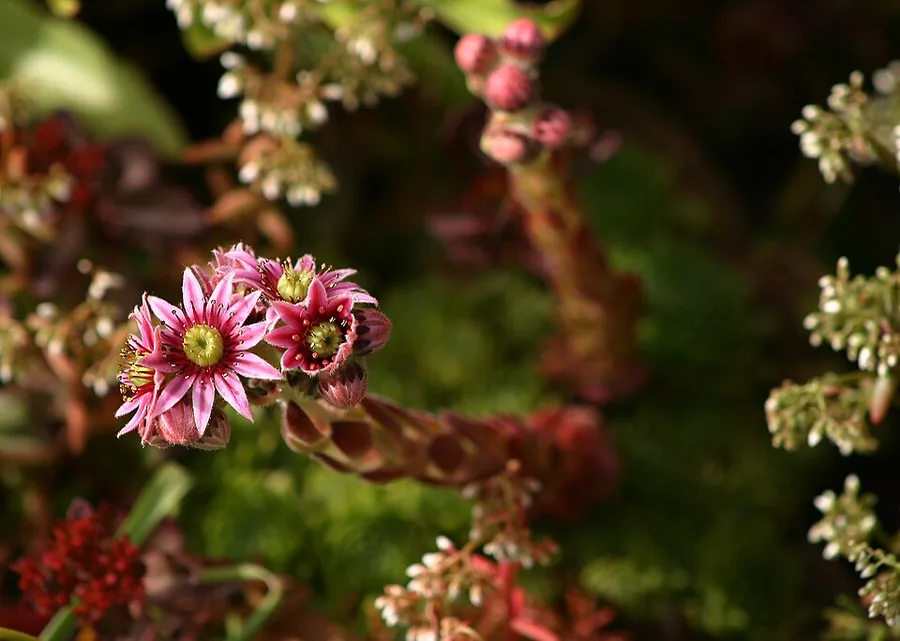
The common name describes the growth habit: a central mother rosette, the hen, encircled by clustered offsets, the chicks. Sempervivum tectorum is an alpine succulent native to the mountains of Europe, and the genus name Sempervivum, meaning always living, records its persistence under harsh exposure. That toughness is why it was historically established on European roofs.
The trait that makes it undemanding is also the trait behind most failures. It is adapted to poor, gritty substrate and very little water, so conventional houseplant treatment, frequent irrigation in a rich mix, saturates tissue that is built to run dry and drives rot. Lean conditions suit its physiology. Each rosette is monocarpic, expending its reserves on one flowering and then dying, but it produces offsets first, so the colony renews continuously as individual rosettes complete their cycle.
Care
The short version: provide bright light, a fast-draining gritty medium, and water only after the substrate has dried completely. Feeding requirements are minimal, and the plant tolerates neglect far better than attentive care.
Light
Provide full sun to develop the strongest pigmentation and the most compact rosettes. It tolerates partial sun or light shade, but insufficient light causes the rosettes to etiolate and loosen and fades the red and purple coloration, because that pigment is a light-driven response.
Water
Water sparingly and only after the medium has dried completely. As an alpine succulent it stores moisture internally, so overwatering saturates the crown and is the principal cause of death. Reduce watering sharply in winter, when standing moisture around the crown initiates rot.
Soil
Use a gritty cactus or succulent mix that drains rapidly and never remains saturated, since free drainage is what keeps the crown from rotting. It is indifferent to pH across 6.0 to 8.0, and it performs better in lean substrate than in anything nutrient-rich.
Temperature
Its thermal tolerance is exceptional, spanning -40°F to 86°F (-40°C to 30°C). Cold poses no threat to the frost-hardy tissue. Summer heat is likewise tolerated provided drainage remains sharp so the roots do not sit wet.
Humidity
The plant is adapted to dry conditions and is unaffected by low household humidity. Damp, stagnant air is the concern, because it favors the rot and rust that establish on crowded rosettes.
Feeding
Fertilize rarely, if at all. A dilute low-nitrogen succulent feed once or twice across spring and summer meets its needs, and omitting it does no harm. It is adapted to poor soil, so excess nitrogen produces soft growth it does not benefit from.
Pruning
Intervention is minimal. After a hen flowers and dies back, remove the spent rosette and clear the dried outer leaves; the surrounding chicks then colonize the vacated space unaided.
Repotting
Repot every 2 to 3 years, or earlier once offsets crowd and spill over the rim. Roots emerging from the drainage holes or the mix drying faster than before indicate the container is exhausted, at which point move it into fresh gritty mix.
Size & spacing
The clumping rosettes remain low, reaching 6 to 12 inches (15 to 30 cm) in height and spreading 6 to 18 inches (15 to 45 cm) across as offsets accumulate. Allowed room, a colony extends laterally and gradually fills the available area.
Troubleshooting
Nearly every failure in hen and chicks resolves to a single mechanism, excess moisture at the crown. Correct the drainage and the watering interval and few other disorders remain. Match the symptom below and act before rot advances through the rosette.
Soft, blackening rosette that collapses from the crown
The cause is crown and root rot, and in nearly every case it follows overwatering or a mix that fails to drain, which leaves the crown tissue saturated and open to decay. Discard the mushy rosettes and withhold water until the medium dries fully, since the pathogens stall once conditions turn dry. Firm offsets remain viable, so replant them in fresh gritty mix where sharp drainage keeps the crown aerated.
Fix:
- Remove and discard affected rosettes
- Withhold water and let the mix dry fully
- Salvage firm healthy offsets and replant in fresh gritty mix with sharp drainage
Raised orange-brown pustules on the leaf surface
The disorder is rust, a fungal infection that establishes where foliage stays damp and rosettes sit too close for air to circulate. Remove the marked leaves and rosettes to cut the inoculum, then widen the spacing so the canopy dries between waterings. Watering at the base rather than over the leaves, and dividing packed colonies, removes the moist crowded conditions the fungus depends on.
Fix:
- Remove and dispose of affected leaves and rosettes
- Improve airflow and spacing
- Avoid wetting the foliage when watering
A rosette bolts, flowers, and then senesces
This is the monocarpic life cycle, in which a rosette invests its stored reserves in a single flowering and then dies, exactly as the species is programmed to do. Before it declines, the hen produces a ring of offsets that inherit the site and continue the colony. Cut out the senescent rosette and let the chicks occupy the gap, or lift and replant them elsewhere.
Fix:
- Remove the spent flowered rosette
- Allow surrounding offsets to fill the space
- Replant detached offsets if desired
Toxicity
The verdict here is straightforward: hen and chicks is non-toxic in every category. The ASPCA places Sempervivum among its safe succulents, and no toxic principle is documented for the plant. It can be kept around cats, dogs, and children without concern, though it remains an ornamental rather than something to be eaten.
Safe for
People · Cats · Dogs · Horses · Rabbits · Livestock · Birds
Cats None
No toxic principle is on record for cats, so the species is safe around them. Ingestion of a rosette may provoke transient, mild gastrointestinal upset from plant matter alone, without systemic effect.
Dogs None
Dogs face no toxic hazard from this succulent. A large volume of any plant material can loosen the stomach for a day, but no poisonous compound is involved.
Horses None
No toxic principle affects horses, so incidental grazing in pasture or from a planter carries no consequence.
Rabbits None
The fleshy leaves hold nothing harmful to rabbits, so the plant is safe in their company. It is still better regarded as an ornamental than as a routine forage green.
Livestock None
Cattle, goats, and sheep are at no risk from grazing this plant, since it contains no toxin capable of disturbing a ruminant digestive tract.
Birds None
Pet and backyard birds can pick at the rosettes without harm, as the foliage carries nothing poisonous to avian species.
People None
Cultivated on rooftops and windowsills for centuries, the plant presents no toxic risk to people, and no precaution is needed around curious children.
Varieties
Most hen and chicks selections are separated by the pigmentation their rosettes develop over the season. A few named cultivars are worth identifying when a specific coloration is wanted.
Sempervivum tectorum 'Rubin'
The rosettes develop a deep ruby-red to purple pigmentation that persists through the season.
Sempervivum tectorum 'Sunset'
As the rosettes mature, the foliage shifts into glowing orange-red sunset tones.
Sempervivum tectorum subsp. tectorum 'Triste'
This subspecies selection shows a muted, dull reddish-brown cast in place of strong pigment.
How to propagate
This is among the easiest plants to increase, largely because it propagates itself by producing offsets. Division and seed are also available, chosen according to how quickly established plants are needed.
Offsets & pupsEasy
Spring to early summer · 2-4 weeks to root
Separating offsets is the standard and most reliable method, since the plant produces rooted daughter rosettes on its own. From spring into early summer, twist a rooted chick from the mother rosette and set it into gritty mix, where it establishes roots in roughly 2 to 4 weeks. This propagation route is inseparable from the monocarpic habit: the hen dies after flowering, and the offsets are the mechanism by which the colony persists.
DivisionEasy
Spring · 2-4 weeks
Division is appropriate for a mat that has become congested. In spring, lift the entire clump and separate it into individual rooted rosettes, then replant each. Reestablishment follows within about 2 to 4 weeks because each division already carries functional roots.
SeedModerate
Spring · Several months to a year
Seed is the slow method, justified mainly when large numbers are the goal. Sow in spring and expect a long timeline, as seedlings require several months to a year to develop into usable plants, and named cultivars seldom reproduce true from seed because they do not breed uniformly.
Myths
The ASPCA Hens and Chickens listing proves Sempervivum tectorum was tested and cleared as pet-safe.
The referenced database entry describes Echeveria elegans, a tender Mexican succulent in a separate genus, not Sempervivum. The cold-hardy houseleek is documented independently on the ASPCA roster of non-toxic succulents. Both are safe, but they are cleared under two distinct listings.
Houseleeks have to come indoors for the winter.
These are among the most cold-tolerant succulents in cultivation, carrying an RHS H7 rating and enduring temperatures well below freezing across USDA zones 3 to 8. They persist outdoors year-round in cold climates because the tissue itself withstands frost. The lethal factor is moisture, not cold, so the operative winter measure is preventing waterlogging at the crown.
The whole plant is dying when the central rosette throws up a stalk and collapses.
Only the individual flowering rosette is dying. Each hen is monocarpic and senesces after reproduction, yet it establishes a surrounding ring of offsets beforehand. The colony continues through those offsets, frequently reading as denser than the original planting.