Houseplant · Crassulaceae
Flaming Katy
Kalanchoe blossfeldiana
Supply bright light, gritty soil, and full dry-downs between waterings, and this succulent returns weeks of bloom.
Bright indirect
59–77°F · 15–25°C
USDA 10–12
6–12 in · 15–30 cm
Overview
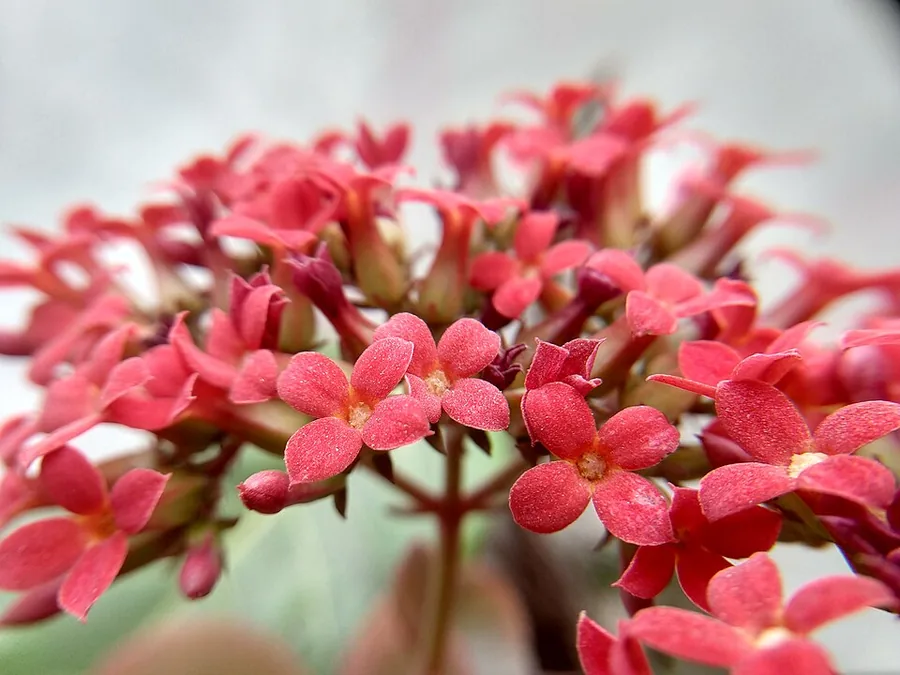
Flaming katy is a small Madagascan succulent grown for its persistent clusters of bright flowers. As a member of the Crassulaceae alongside jade and sedum, it holds water in thick, glossy leaves, a trait that buffers it against a skipped watering yet leaves it prone to rot under excess moisture.
Mature height is modest, with most plants reaching 6 to 12 inches (15 to 30 cm), which keeps it within the footprint of a windowsill. Flower color spans red, orange, pink, yellow, and white, and a single flush can retain its color for weeks. Commercial growers manipulate its flowering so that it reaches market in any season, which accounts for its year-round presence as a gift plant.
Keeping it alive is undemanding, and returning it to flower is straightforward once its physiology is understood. It requires bright light to fuel growth and a span of long nights to initiate buds, and it performs best when the substrate dries completely between waterings. Meet both conditions and it will reflower over successive years.
Care
The short version: bright indirect light, a gritty fast-draining substrate, and a thorough soak applied only after the soil has dried completely. Feed sparingly during the growing season and supply long fall nights to reinitiate bloom.
Light
Provide bright indirect light, for instance a position near a sunny window that is shielded from the most intense midday radiation. It tolerates some direct sun and even partial sun, but inadequate light produces etiolated growth and suppresses flowering.
Water
Allow the substrate to dry completely between waterings, then irrigate thoroughly and discard whatever collects in the saucer. As a succulent it decays rapidly in saturated soil, so when uncertain, defer watering. Reflowering additionally requires about six weeks of long nights, roughly 14 hours of uninterrupted darkness.
Soil
Grow it in a gritty, well-drained mix through which water passes freely, such as a cactus formulation. A slightly acidic pH of 6.0 to 6.5 suits it, and the sharp drainage is what prevents root decay.
Temperature
Ordinary interior warmth is appropriate, ideally 59°F to 77°F (15°C to 25°C). Exclude cold drafts and frost, as this tender species does not withstand chilling.
Humidity
Average household air is adequate, and it favors the low end of the humidity range. There is no target figure to meet, and dry interior air suits it better than the moisture of a bathroom.
Feeding
Apply fertilizer monthly through spring and summer during active growth, using a balanced water-soluble product diluted to half strength. Reduce or suspend feeding in fall and winter as growth slows.
Pruning
Deadhead spent blooms to maintain appearance, then pinch the stems after flowering. Pinching breaks apical dominance and promotes bushy, compact growth in place of a few long, bare stalks.
Repotting
Pot on every 1 to 2 years, or sooner under crowding, into a marginally larger container fitted with drainage. Roots emerging from the holes, water passing straight through, and stalled growth each indicate the rootball has outgrown its pot.
Size & spacing
Anticipate a compact specimen of 6 to 12 inches (15 to 30 cm) in height with a spread of 8 to 16 inches (20 to 40 cm). Allow sufficient clearance for air to circulate around the foliage, which helps suppress powdery mildew.
Troubleshooting
Most disorders in flaming katy resolve to one of two inputs: water or light. Excess water at the root zone drives rot, while inadequate light produces etiolated growth and suppresses flowering. Identify the symptom below and correct the underlying cause rather than the visible sign.
Soft, blackening tissue at the stem base
Softening, darkening tissue at the base points to root and crown rot, the predictable outcome when a rot-prone succulent sits in soil that holds water against its roots. Lift the plant and the diagnosis is clear: healthy pale, firm roots have turned brown, soft, and foul-smelling. Excise all affected tissue with clean tools, return it to fresh gritty mix, and withhold water until growth resumes, since wet medium around damaged tissue only feeds the decay. The durable correction is a draining pot and a complete dry-down between waterings, because the rot cannot advance in a substrate that does not stay saturated.
Fix:
- Remove the plant from wet soil
- Cut away all rotted tissue with clean tools
- Repot into fresh gritty, well-drained mix
- Withhold water until the plant recovers
Elongated stems and an absence of buds
Two distinct deficits show here. Elongation toward the window with widening internodes is the plant etiolating for want of light, while a failure to rebloom reflects an unmet photoperiod requirement, since this is a short-day species that sets buds only under long nights. Relocate it to bright indirect light to halt the stretching, then supply about six weeks of roughly 14 hours of complete darkness each night to induce flowering, pinching the elongated stems to recover form. Sustained bright light with a deliberate short-day period each fall satisfies both the carbon supply and the photoperiodic trigger that flowering depends on.
Fix:
- Move to a bright spot with indirect light
- Provide about six weeks of roughly 14 hours of complete darkness each night to trigger budding
- Pinch back leggy stems
Powdery white growth across the foliage
A pale, dusty film that wipes from the leaf surface is powdery mildew, a fungal disease that establishes where crowding and stagnant, humid air keep the foliage from drying. Remove the worst-affected leaves to reduce inoculum, then widen the spacing so air moves freely across the canopy and the leaf surface dries quickly. The reason overhead watering matters is that a wet leaf is what the spores need, so irrigating at the soil line and holding humidity low removes the conditions the fungus depends on.
Fix:
- Remove badly affected leaves
- Improve air circulation and spacing
- Avoid wetting the foliage when watering
Toxicity
Treat this species as a genuine hazard to animals. All tissues contain bufadienolides, cardiac glycosides that provoke gastrointestinal upset and, at higher doses, disturb cardiac rhythm. Site it beyond the reach of pets and livestock, and consult a veterinarian without delay if an animal ingests any part.
Toxic to
Cats · Dogs · Horses · Rabbits · Livestock · Birds · People
Cats Toxic
In cats, ingestion of any part typically produces drooling, vomiting, and diarrhea within a short window. A larger dose can disturb cardiac rhythm, which warrants urgent attention.
Dogs Toxic
Dogs commonly show drooling, vomiting, diarrhea, and lethargy. At higher intake the bufadienolides act on the heart and may slow or skip the beat.
Horses Toxic
Because the cardiac glycosides are present throughout the plant, a grazing horse risks colic, diarrhea, and a dangerous arrhythmia.
Rabbits Toxic
No intake is considered safe for a rabbit. Even a few leaves can produce gastrointestinal upset and the rhythm disturbance characteristic of these glycosides.
Livestock Toxic
Cattle, goats, and sheep that consume it may develop drooling, scouring, weakness, and an irregular heartbeat attributable to the bufadienolides.
Birds Toxic
Site it well out of reach of birds. The same cardiac toxin affects them, and their low body mass means a small quantity is enough to cause harm.
People Caution
No part of this plant is intended for consumption, and ingestion can cause gastric upset. Keep it from small children, who may sample the bright flowers.
Helpline numbers

United States
ASPCA Animal Poison Control: (888) 426-4435 (fee applies)
Poison Control: (800) 222-1222



Canada
Poison Centres: 1-844-764-7669
Varieties
Most flaming katy in commerce has been selected for fuller flowers and a compact habit. The two groups below account for what is generally available at the garden center.
Calandiva series
This compact series is defined by its fully double, rose-like flowers offered across a broad palette of colors.
Flapjacks-flowered florist hybrids
These single-flowered florist selections are recognized by dense clusters of red, orange, pink, or yellow bloom.
How to propagate
Flaming katy propagates readily, and one parent plant supplies ample material. Both a stem-tip cutting and a leaf cutting succeed, each performed in spring or summer when the plant is in active growth.
Stem cuttingsEasy
Spring to summer during active growth · 2 to 3 weeks to root
The most reliable route is a stem-tip cutting taken in spring or summer during active growth, when rooting hormones and reserves are highest. Remove a healthy tip and let the cut surface callus for a day or two, since a sealed wound resists the rot this succulent is prone to, then insert it into gritty, barely moist medium. Rooting follows in roughly 2 to 3 weeks.
Leaf cuttingsModerate
Spring to summer · 3 to 6 weeks to form plantlets
A single leaf taken in spring or summer can also regenerate a new plant, drawing on the stored reserves typical of the family. Allow the leaf to callus, lay or set it on well-drained medium, and hold it lightly moist while plantlets differentiate at the base over 3 to 6 weeks.
Myths
It is a harmless gift plant that is safe around pets.
This common florist plant is in fact toxic to cats and dogs. Its bufadienolides are cardiac glycosides that induce vomiting and diarrhea and, in sufficient quantity, can disrupt the heartbeat. Regard it as a plant to keep beyond an animal's reach rather than a risk-free houseplant.