Houseplant · Crassulaceae
Mexican Snowball
Echeveria elegans
Supply strong sun and a dry root zone, and the Mexican snowball maintains a compact silver rosette for years.
Full sun
50–77°F · 10–25°C
USDA 9–11
2–4 in · 5–10 cm
Overview
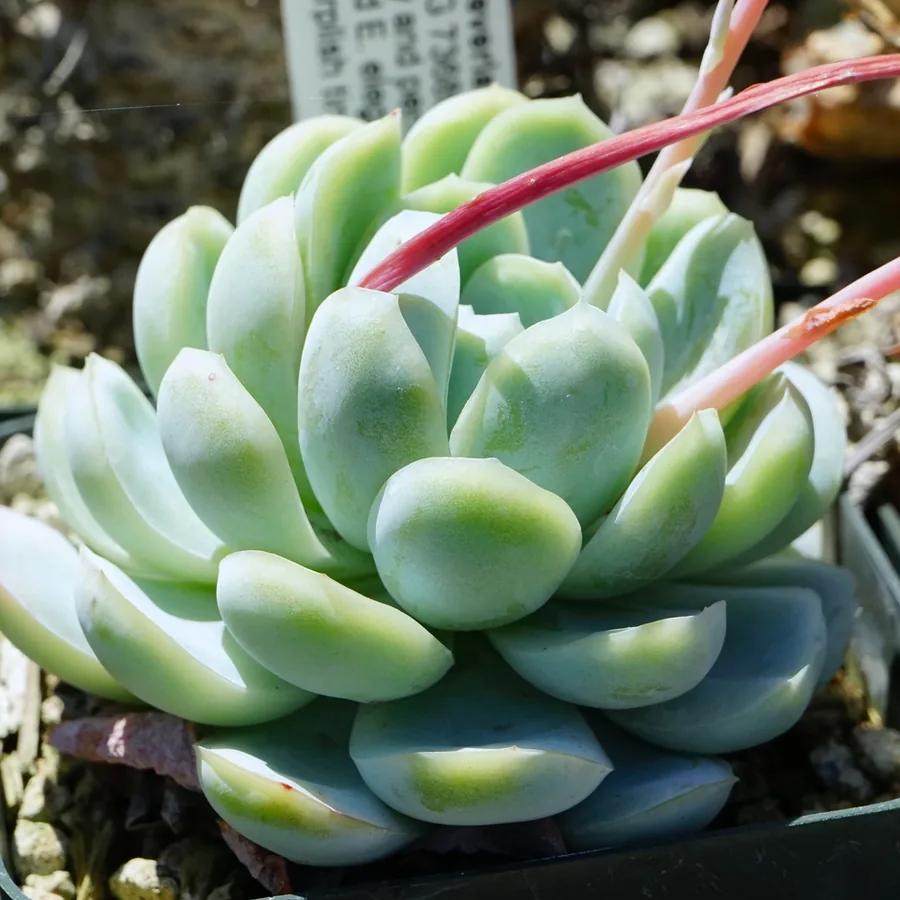
The Mexican snowball is a compact succulent that builds a dense rosette of pale, blue-green leaves coated in a silvery, waxy bloom. Its origin in the rocky Mexican highlands explains its requirements directly: sharp drainage, high light, and minimal intervention. Standing 2 to 4 inches (5 to 10 cm) tall and spreading to roughly 20 inches (50 cm) across, it remains small enough for a bright windowsill.
Sited correctly, it is remarkably forgiving. It grows slowly, persists as a perennial, and gradually forms a clump as it produces offsets around the base. Indoors it demands your brightest window, and in spring it may raise a slim stalk of small bell-shaped flowers above the foliage.
Nearly every failure with this plant comes back to moisture. It is adapted to drought, so keeping the substrate damp is the surest way to kill it. Manage watering correctly and supply intense light, and the frosted rosette holds tight and full with almost no attention.
Care
The short version: site it in your most intense light, set it in a gritty fast-draining mix, and irrigate only after the substrate has dried out completely.
Light
Provide full sun or the most intense position available, and the rosette stays tight and compact. It accepts bright indirect light, but below that threshold the plant elongates and loses color as it reaches for intensity. A grow light through winter keeps the form from loosening indoors.
Water
Let the substrate dry completely between irrigations, then drench it and allow full drainage. Reduce sharply in winter when growth pauses. Direct water to the base rather than the rosette, since moisture caught among the leaves is the fastest path to rot.
Soil
Use a gritty cactus or succulent mix that drains quickly and never holds saturation. A pH of 6.0 to 7.0 suits it. Drainage is the controlling factor, so choose a pot with a hole and avoid any dense, moisture-retentive potting medium.
Temperature
It performs best between 50°F and 77°F (10°C to 25°C). Standard room conditions serve it through the year, and because it has no tolerance for hard frost, bring it indoors before cold weather arrives.
Humidity
This succulent wants low humidity and dry foliage, which makes it well matched to most interiors. Omit misting altogether, since humid air and wet leaves only encourage rot.
Feeding
Feed sparingly from spring through summer during active growth, roughly monthly. Apply a balanced fertilizer at half strength or a low-nitrogen cactus feed. Its needs are slight, and overfeeding forces soft, pest-prone tissue.
Pruning
Maintenance is minimal. Strip away the dried lower leaves and cut off spent flower stalks to keep it neat. Detaching offsets periodically tidies the clump and yields new plants to grow on.
Repotting
Repot every 2 to 3 years, or earlier once offsets fill the pot. Watch for roots pushing through the drainage holes, substrate that dries unusually fast, or growth that has stalled. Step up to fresh gritty mix in a pot only one size larger.
Size & spacing
It remains small, reaching only 2 to 4 inches (5 to 10 cm) tall while spreading to about 10 to 20 inches (25 to 50 cm) across as it clumps. That low, broad habit suits a shallow dish or a windowsill pot.
Troubleshooting
Problems with this succulent nearly always originate at the roots or in the light it receives. The rosette is a reliable diagnostic surface, so reading it early lets you intervene before a soft base or an elongated stem becomes irreversible. Find the match below, then correct it while correction still works.
See-through soft leaves above a darkening, mushy base
This points to root and crown rot, which develops when excess moisture lingers in a substrate that cannot shed it fast enough. Saturated cells break down, so the lower leaves go translucent and yellow, the stem softens, and the roots turn brown and slimy. Withhold water and let everything dry, then lift the plant, excise all decayed roots and soft tissue, and allow the cuts to callus before potting into fresh gritty mix with drainage. Should the base be lost entirely, salvage a sound rosette crown and re-root it.
Fix:
- Stop watering and let the plant dry out
- Unpot, cut away rotted roots and tissue, and let cuts callus
- Repot into fresh gritty mix in a pot with drainage
- Re-root a healthy rosette top if the base is lost
Cottony white clusters lodged in the leaf joints
Those waxy white tufts are mealybugs, soft-bodied insects that shelter in the protected leaf axils and the rosette crown while excreting a sticky residue. Dab each one with a cotton swab soaked in 70 percent isopropyl alcohol, which dissolves their waxy coating, then quarantine the plant away from your other succulents to break the spread. Repeat the rounds every few days until the rosette reads clean, and drench the soil as well if root mealybugs are a concern.
Fix:
- Wipe off pests with a cotton swab dipped in 70 percent isopropyl alcohol
- Isolate the plant from other succulents
- Repeat treatment every few days until clear
- Treat soil if root mealybugs are suspected
Stem running long with leaves spreading apart and leaning
What you are seeing is etiolation: the plant elongating its internodes to chase a light level it cannot reach. Without enough intensity, the dense silvery rosette opens up, the stem lengthens, and fresh leaves space out and tilt toward the window. Relocate it to your strongest light or full sun, but raise the intensity in stages so the tissue does not scorch, and behead the compact crown to re-root it if the stretch is already pronounced.
Fix:
- Move to the brightest spot available or full sun
- Acclimate gradually to stronger light to avoid scorch
- Behead and re-root the compact top if severely stretched
Bleached, dry blotches on the leaves facing the sun
This is sunburn, the result of a sharp rise in light intensity that outpaced the plant's ability to adjust. The damaged side, the one angled toward the sun, develops dry discolored marks after a shift outdoors or into a brighter window. Ease it back into gentler, filtered light until new growth hardens off. Leave the scarred leaves attached, because the tissue cannot recover but still shades the rosette beneath it.
Fix:
- Move to slightly filtered light until new growth adjusts
- Leave scarred leaves in place; they will not heal but protect the rosette
Toxicity
For animal households the assessment is favorable: the Mexican snowball is non-toxic and pet-safe. The ASPCA does not classify Echeveria as poisonous, so a curious cat, dog, or other nibbling pet risks nothing worse than possible mild stomach upset from eating a plant that is not food.
Safe for
People · Cats · Dogs · Horses · Rabbits · Livestock · Birds
Cats None
Cats are fine alongside it. The ASPCA records no toxicity, so an inquisitive bite will not poison them.
Dogs None
Dogs face no toxic effects from this plant. Chewing a fleshy leaf might prompt a touch of stomach upset, the way any non-food plant can, but nothing dangerous.
Horses Safe
Horses are not at risk. The plant holds no compounds that poison them if one grazes on a rosette.
Rabbits Safe
Rabbits have nothing to fear from it. No toxins sit in the leaves, though the dense succulent flesh is not part of their usual diet.
Livestock Safe
Goats, sheep, and cattle can share space with it unharmed, as the plant contains no poisons that act on them.
Birds Safe
Birds are not endangered by it. A pecked leaf carries no toxic risk.
People Safe
It poses no harm to people. The plant is not grown as food, but handling it or an accidental taste causes no trouble.
Varieties
Several named forms of E. elegans circulate among collectors, each a distinct interpretation of the pale rosette. The following are the ones worth recognizing.
Echeveria elegans var. kesselringiana
A compact selection holding tighter, smaller rosettes than the standard species form.
Echeveria elegans 'Potosina'
Carries fuller, more rounded leaves of a deeper blue-green that close into a denser rosette.
Echeveria elegans 'Albicans'
Heavily frosted, distinctly whiter leaves lend this form an unusually pale, silvered rosette.
How to propagate
Few succulents reproduce as readily as this one. It supplies new plants at no cost, either through the pups it generates on its own or from a single detached leaf set on the substrate.
Offsets & pupsEasy
Spring through summer · 2-4 weeks to root once detached
The most reliable route is to let the plant propagate itself. Through spring and summer E. elegans produces offsets, also called pups, ringing the parent rosette. Lift a pup that has already rooted, pot it separately, and it establishes as an independent plant in 2 to 4 weeks.
Leaf cuttingsEasy
Spring through summer · 4-8 weeks to form roots and a tiny rosette
Individual leaves also propagate, at no cost. During spring or summer, remove an entire healthy leaf with a clean sideways twist, let the wound callus, then set it on gritty mix. Plantlets emerge from the leaf base, needing 4 to 8 weeks to push roots and a small rosette of their own.
Myths
Echeveria will poison cats and dogs.
The ASPCA carries no toxicity listing for Echeveria, E. elegans included, and it ranks as a recognized pet-safe choice. Heavy consumption may trigger mild digestive upset, as happens with most non-food plants, but no actual toxin is involved.
Because they store water, succulents like Echeveria do well in low light.
Water storage and light demand are unrelated traits. E. elegans needs bright light or full sun to keep its compact rosette, and a shaded position drives etiolation that stretches it into a loose, leggy form.
Regular misting keeps succulents in good health.
E. elegans prefers low humidity and dry foliage, so misting undercuts it. Moisture pooling in the rosette opens the door to rot, exactly the failure this plant is most prone to.