Houseplant · Crassulaceae
Burro's Tail
Sedum morganianum
Give it bright light and dry roots, and this trailing succulent cascades over the pot for years.
Full sun
Every 14–30 days
50–77°F · 10–25°C
USDA 10–11
Overview
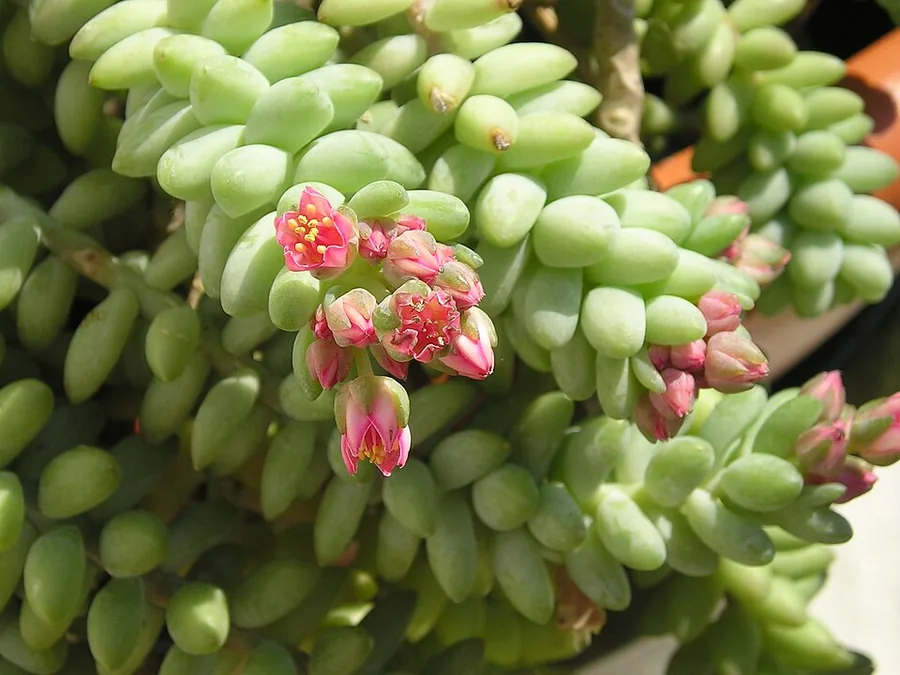
Burro's tail is a trailing succulent named for the thick, plaited stems that drape over the rim of a pot like a tail. It is native to southern Mexico and Honduras, where it grows on rocky slopes, and that montane origin accounts for nearly every preference it shows in cultivation. The plump blue-green leaves are swollen with stored water, which is why the plant tolerates dry intervals that would kill a less succulent houseplant.
The feature that makes it so distinctive is also the one that complicates daily life with it. Each overlapping leaf is held by only a weak attachment and breaks away at the gentlest touch, so a hanging basket set apart from regular traffic is the practical answer. Given good conditions, one plant can cascade several feet, and in summer the stems may finish in small pink to red flowers, though that display rarely appears indoors.
Its real virtue is how little it demands. Bright light, a sharply draining pot, and long dry spells between waterings keep it thriving, and the single greatest threat is overwatering it out of misplaced care. Grow it lean and disturb it seldom, and it performs for years.
Care
The short version: give it your brightest position, set it in a gritty cactus mix, and water only after the soil has nearly dried through, scaling back further in winter to head off rot.
Light
Burro's tail calls for bright light to full sun, the most luminous spot at your disposal. A sunny windowsill holds the stems compact and well-clothed in leaves, whereas a shaded corner draws them out thin and pale. When shifting it into stronger sun, make the transition over a week or so to protect the leaves from scorching.
Water
Water sparingly and only after the mix has nearly dried out, which indoors often falls to about once a month. The thick leaves hold their own reserve, so default to waiting when you're uncertain. Reduce watering further in winter, because saturated soil in cool conditions is the surest path to rot.
Soil
Set it in a gritty, fast-draining cactus or succulent mix, preferably amended with added perlite. A pH between 6.0 to 7.5 serves it well. The decisive factor is that water passes straight through instead of pooling around the roots.
Temperature
It sits comfortably between 50°F and 77°F (10°C to 25°C), the usual indoor range. It will endure a short dip toward 40°F (4°C), but bring it inside ahead of any frost, which it cannot survive.
Humidity
This is a low-humidity plant, suited to dry indoor air, so there's no target reading to meet and no misting required. Humid, still air offers it nothing and merely encourages rot.
Feeding
Feed it rarely, only once or twice over the spring-to-summer growing season, with a balanced or dilute liquid fertilizer. It is a lean grower by nature, and excess feeding works against it.
Pruning
It requires little to no pruning. Cut back any leggy or overlong stems purely to neaten the plant, and proceed gently, since the stems are brittle and the leaves release at a touch.
Repotting
Repot it only after it has completely filled its pot, which happens seldom. The signs are roots crowding the container and growth that stalls or looks congested. Handle it as little as possible during the move so the leaves stay on.
Size & spacing
Trailing stems can extend 2 to 4 feet (60 to 120 cm), with a spread of 1 to 3 feet (30 to 90 cm). A hanging basket gives those cascades the room to fall and keeps them out of reach of passing elbows.
Troubleshooting
Nearly every issue with burro's tail comes down to one of two causes: water held too long or light kept too low. Catch the early signals laid out below and you can correct the source before the plant pays for it.
Stems going soft and mushy as leaves turn translucent
These are the hallmarks of rot, driven by water held too long against the roots. Withhold water immediately and let the mix dry through, then excise every soft or discolored section before the decay travels up the stem. Should the crown be lost, root the firm upper tips instead, and going forward rely on a gritty, free-draining mix and a much drier hand in winter.
Fix:
- Stop watering and allow the soil to dry out
- Remove rotted portions and repot into gritty, fast-draining mix
- Propagate healthy stem tips if the base is lost
Cottony white clusters lodged in the leaf axils
The cotton-like tufts settled into the leaf joints are mealybugs, sap-feeding insects whose feeding often leaves a sticky residue. Apply rubbing alcohol to each one with a cotton swab, separate the plant from your collection, and repeat the treatment until the population is gone. Quarantine and inspect every new succulent before it joins the shelf, and avoid the wet, crowded conditions these pests prefer.
Fix:
- Dab insects with a cotton swab dipped in alcohol
- Isolate the plant and repeat treatment until clear
Fleshy leaves shedding at the slightest contact
The swollen leaves attach to the stem by a weak abscission point, so any contact or a jostled pot releases them. Treat this as normal plant architecture rather than a fault. Position the basket clear of foot traffic, support it by the container when you move it, and set the shed leaves on the mix, where each one will form roots and a new plantlet.
Fix:
- Place the plant where it will not be brushed against or knocked by passing traffic
- Handle by the pot rather than the stems
- Pot or scatter dropped leaves on soil, where they readily root into new plants
Leaf spacing widening as stems run thin and pale
Elongated stems and washed-out leaves signal etiolation, the response of a light-starved plant straining toward a brighter source. Relocate it to a window offering bright light to full sun, but stage the change across a week or two so the tissue adapts without burning. Steady strong light keeps the trailing stems compact and densely leaved.
Fix:
- Move to a brighter spot with bright light to full sun
- Acclimate gradually to stronger light to avoid scorching
Toxicity
This is reassuring news for a pet household: burro's tail is safe to keep around animals and children. The ASPCA classifies it as non-toxic to cats, dogs, and horses, and the leaves contain no harmful compounds. An inquisitive bite may bring on a passing stomach upset, as many plants do, but nothing more serious.
Safe for
People · Cats · Dogs · Horses · Rabbits · Livestock · Birds
Cats None
The ASPCA rates this species safe for cats. An inquisitive bite may produce light drooling or a short bout of stomach upset, and nothing beyond that.
Dogs None
Dogs face no risk either, since the plant holds no toxic compounds. A chewed trailing stem might bring on mild, short-lived digestive upset at worst.
Horses None
Horses are likewise cleared by the ASPCA, so a grazed mouthful presents no genuine hazard.
Rabbits Safe
With no toxins present, a rabbit takes no harm from a sample, though the succulent, water-laden leaves are better offered as an occasional treat than a staple green.
Livestock Safe
Goats, sheep, and cattle can taste it without injury. Kept indoors as a houseplant, it seldom comes within their reach in any case.
Birds Safe
Pet birds come to no harm near it, and a pecked leaf holds no poison. The brittle stems tend to shed long before much is consumed.
People Safe
It contains nothing toxic to people, so a child who samples a dropped leaf faces no danger. The plant isn't a food crop, so keep it on the windowsill.
Varieties
Burro's tail has a single close relative worth noting, a more compact form that handles more easily and grows just as readily.
Sedum morganianum 'Burrito' (baby burro's tail)
Bears shorter, rounder leaves packed more densely along the stem than the species, and they cling far more securely, which makes this the more forgiving form to handle.
How to propagate
Few houseplants propagate this freely. Every dropped leaf and every trimmed stem can grow into a new plant, so you will always have copies to pot up or hand along.
Stem cuttingsEasy
Growing season (spring to summer) · Several weeks to a few months to root well
Stem cuttings give you the fastest route to a sizable new plant. Sever healthy tips through the spring-to-summer growing season, allow the cut surfaces to callus for a day or two so they seal against rot, then rest them on or set them into a gritty mix. Rooting proceeds over several weeks to a few months, ahead of the pace of a single leaf.
Leaf cuttingsEasy
Growing season (spring to summer) · Several weeks to a few months, slower than stem cuttings
Each shed leaf already holds the makings of a new plant. Rest the fallen leaves on the soil surface during the growing season and they generate roots and miniature plantlets unaided. The method is dependable, though it tends to run several weeks to a few months, behind the speed of a stem cutting.
DivisionEasy
When repotting during the growing season · A few weeks to establish
After a clump has filled its container, you can divide it during a growing-season repot. Each piece reroots and resumes growth within a few weeks, yielding two plants from one with minimal effort.
Myths
Burro's tail is poisonous to cats and dogs and unsafe to keep around pets.
The ASPCA classifies Sedum morganianum as non-toxic to dogs, cats, and horses, which makes it a sound choice for a household with animals. A nibble might cause mild stomach upset, as eating nearly any houseplant can, but it poses no real danger.
The plant needs frequent watering to keep its plump leaves from shriveling.
This is a drought-adapted succulent that banks moisture inside those swollen leaves and prefers the mix to nearly dry out between drinks. Too much water is what kills it, decaying the roots and stems, so err toward waiting whenever you're unsure.