Houseplant · Asparagaceae
African Spear
Dracaena angolensis
Site it in bright light and let the mix dry fully between waterings, and this drought-adapted snake plant largely maintains itself.
Bright indirect
Every 14–30 days
USDA 10–11
2–7 ft · 0.6–2.1 m
Overview
The African spear is a drought-tolerant snake plant native to the seasonally dry country of southern tropical Africa, and that origin explains its care. Adapted to long rainless spells, it grows slowly and needs very little water, which is why it forgives neglect indoors. Taxonomists have since reclassified it as Dracaena angolensis, treating the long-familiar Sansevieria cylindrica as a synonym.
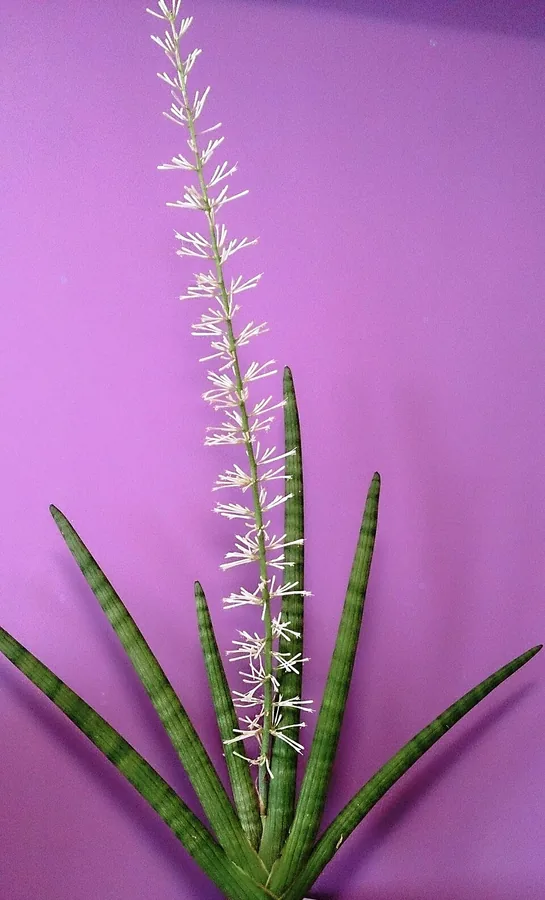
Its defining feature is the leaf form. Rather than flat blades, it produces stiff, cylindrical spears that taper to a point and radiate from the base in a clump. Growers may plait the young, pliable leaves or offer the dwarf 'Boncel' cultivar, but these are presentation only, and the underlying plant remains the same slow-growing species.
Its one true vulnerability is moisture at the roots. In bright light with a mix that dries hard between waterings, it holds condition for years. Left in heavy, water-retentive soil, the base and roots stay saturated and rot sets in, because tissue adapted to drought cannot tolerate standing wet.
Care
The short version: provide bright indirect light, a gritty fast-draining medium, and water only after the substrate has dried through, which typically means about every two weeks in summer and monthly in winter.
Light
It performs best in bright indirect light, yet tolerates a wide range from full sun to low light. In dim positions photosynthesis slows, so growth all but stalls. Acclimate it gradually before any move into strong afternoon sun, since unhardened tissue scorches under sudden intensity.
Water
Allow the medium to dry completely, then water thoroughly so the whole root zone is wetted. In practice this falls near every two weeks in summer and monthly in winter, tracking the plant's slower cool-season uptake. When uncertain, delay, because this species withstands drought far better than saturated roots.
Soil
Use a well-draining cactus or succulent mix so water passes through quickly. Rapid drainage prevents the roots and basal crown from sitting in moisture, the single condition this drought-adapted plant cannot survive.
Humidity
It is adapted to dry air, so low humidity poses no problem. Ambient room conditions are ample, and misting or a pebble tray adds nothing, since the plant evolved where humidity runs low.
Feeding
Nutrient demand is low. A monthly application of all-purpose fertilizer at half strength through the spring and summer growing season meets it, and feeding should stop in winter when growth pauses.
Pruning
Pruning requirements are minimal. Remove only leaves that are damaged or rotting at the base, since cutting healthy spears serves no purpose on a plant that grows this slowly.
Repotting
As a slow grower that tolerates being pot-bound, it needs repotting only every 3 to 5 years, or once roots and rhizomes crowd the container or distort its walls. Increase pot size by a single step to avoid an oversized volume of slow-drying mix.
Size & spacing
Indoors it reaches 2 to 7 feet (60 to 210 cm) over many years, forming a clump 6 to 24 inches (15 to 60 cm) across. Because the upright spears raise the plant's center of mass, a heavy container is needed to keep a tall specimen stable.
Troubleshooting
Almost every disorder here reduces to one of three inputs: water, light, or temperature. The spears and the basal crown register these stresses first, so inspect them early. Identify the pattern below and correct the underlying cause before minor damage becomes fatal.
Soft, mushy base with a sour odor from the pot
These are the signs of root rot, a consequence of excess water in a medium that retains it. Remove the plant, excise every blackened or softened root back to firm tissue, and repot into fresh, gritty mix. Withhold water until it recovers, since keeping the medium dry is what arrests the decay.
Fix:
- Unpot and cut away rotted roots
- Repot in dry well-draining mix
- Withhold water until recovered
Yellowing, softening, drooping spears
Yellow, limp spears indicate the plant is absorbing more water than it can use, the classic presentation of overwatering or a medium that stays saturated. Stop watering and let the mix dry through before the next application. Persistent cases call for a grittier medium or a container with better drainage.
Fix:
- Stop watering
- Let soil dry fully
- Improve drainage
Soft, discolored spears following cold exposure
Cold damage appears once the plant drops below 55°F (13°C) or meets frost, the expected result for a tender tropical hardy only in zones 10 and 11. Relocate it to warmth and cut away the collapsed tissue. Keep it indoors whenever temperatures threaten that threshold.
Fix:
- Move indoors
- Remove damaged tissue
Sticky film, white cottony masses, or fine stippling
Sticky residue and cottony masses indicate mealybugs or scale, whereas fine stippling with webbing signals thrips or spider mites. Wipe the spears with a damp cloth, apply insecticidal soap, and isolate the plant to halt spread. Routine inspection detects infestations while populations remain small and manageable.
Fix:
- Wipe leaves with damp cloth
- Treat with insecticidal soap
- Isolate affected plant
Bleached or browned tissue on the sun-facing side
This is sunburn, caused by intense afternoon sun or an abrupt transfer from shade into full exposure. Restrict it to morning sun and raise light levels over a week or two so the tissue can harden. The scorched areas will not recover, but subsequent growth emerges unmarked.
Fix:
- Move to morning sun only
- Acclimate gradually to brighter light
Toxicity
The leaves contain saponins, a natural compound that upsets the stomach, which makes this a poor plant to keep within a pet's reach. Cats and dogs that chew the tissue commonly drool, vomit, and develop digestive upset. People face little risk from handling it, but no part is edible, so keep it away from young children as well.
Toxic to
Cats · Dogs · Horses · Rabbits · Livestock · Birds · People
Cats Mild
The saponins in the leaves act on the gut, so an ingesting cat typically drools and vomits. Larger doses have produced dilated pupils and an unsteady gait, so exclude it from feline access.
Dogs Mild
In dogs, the same saponins provoke drooling, vomiting, and diarrhea. The reaction is generally mild and resolves once exposure ends.
Horses Caution
Horses are susceptible to the identical saponins, which disturb the digestive system, so the plant should be kept clear of any that might browse it.
Rabbits Caution
Rabbits gain no tolerance to the saponins that affect other animals, so grazing on the spears should be prevented entirely.
Livestock Caution
Grazing livestock exposed to the saponins can show drooling and digestive upset, so the plant warrants fencing where stock have access.
Birds Caution
A bird sampling the foliage ingests the same irritant saponins, so contact is best avoided.
People Caution
Human risk is minimal, though no part is intended for consumption. A child chewing a leaf may drool or feel nauseated, so keep it beyond reach of small children.
Helpline numbers

United States
ASPCA Animal Poison Control: (888) 426-4435 (fee applies)
Poison Control: (800) 222-1222



Canada
Poison Centres: 1-844-764-7669
Varieties
The species carries few named forms. Just two are worth distinguishing at point of sale.
'Boncel' (starfish sansevieria)
A dwarf cultivar distinguished by short, thick spears that radiate low from the base, giving the plant the outline of a starfish.
Braided form
Several young leaf cuttings interwoven by the grower while still flexible, which then continue growing as a single plaited column.
How to propagate
This plant propagates readily, and division is markedly faster and more reliable than seed or leaf cuttings.
DivisionEasy
Spring or summer, during repotting · Several weeks
Division is the most dependable method and is best done during a spring or summer repotting. Separate the offsets at the rhizome, retaining roots on each division, and pot them individually. They establish over several weeks and remain genetically true to the parent.
Leaf cuttingsModerate
Spring or summer · Several weeks to months
Leaf cuttings taken in spring or summer offer a slower alternative that demands more patience. Set the sections upright in gritty mix, where rooting takes anywhere from several weeks to several months. This is the technique used to raise the multiple cuttings needed for braided forms.
SeedDemanding
Spring or summer · Months
Seed is the least practical route indoors, where the plant rarely flowers. Sow fresh seed in spring or summer and expect germination and growth to take months. Most growers forgo it in favor of division or cuttings.
Myths
The starfish 'Boncel' represents a distinct species.
It does not. 'Boncel' is a cultivar of Dracaena angolensis, genetically the same species in a compact habit. It is not a separate species, regardless of how different its low fan of short spears appears.
Braided specimens develop that form naturally.
The braid is horticultural, not natural. A grower interlaces young leaf cuttings by hand while the tissue remains pliable, after which the plant retains the woven form as it matures.
Snake plants require no watering at all.
Their drought tolerance is considerable, but not absolute. Water roughly every two weeks in summer and monthly in winter, and in every case wait until the medium is dry before applying more.