Houseplant · Asparagaceae
Ponytail Palm
Beaucarnea recurvata
Bank on the caudex: strong light and a full dry-down between waterings keep this water-storing succulent thriving.
Full sun
50–86°F · 10–30°C
USDA 10–11
6–8 ft · 1.8–2.4 m
Overview
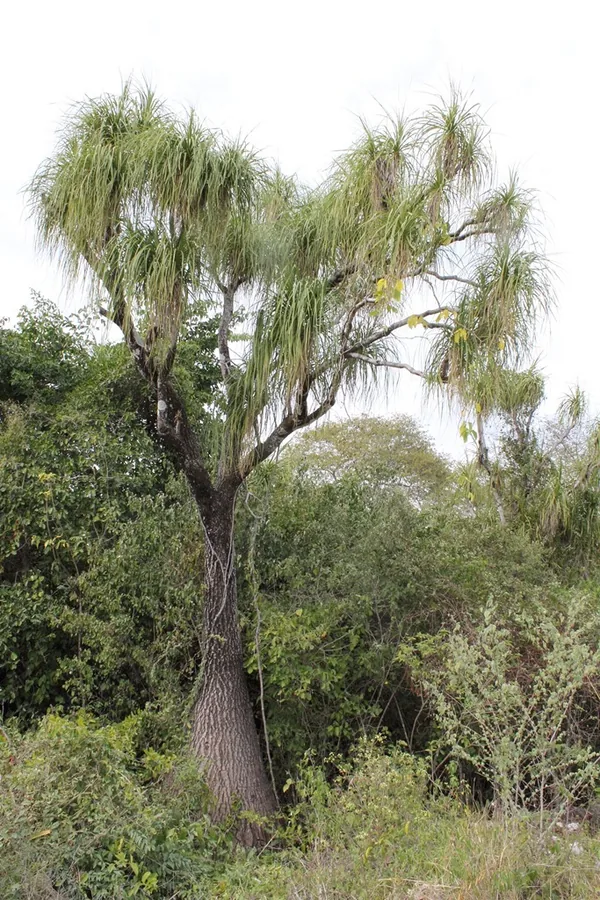
Classed as a caudex-forming succulent rather than a true palm, Beaucarnea recurvata belongs to the family Asparagaceae, alongside Dracaena and Agave. It grows wild in the arid regions of eastern Mexico, where a swollen, flask-shaped stem base holds a water reserve against long dry spells. From that base rises a crown of long, recurved, strap-like leaves. The enlarged base, the caudex, explains the common names elephant foot and bottle palm.
Its reputation for toughness rests on that water-storing caudex. Because the plant carries an internal reserve, it withstands a lapse in watering far better than saturated roots, which is why it reads as drought tolerant indoors. Growth is slow, so it holds its scale for years and seldom demands a larger container. Sited in strong light and allowed to dry between waterings, it is exceptionally long-lived.
The critical failure point is moisture at the roots. When the mix stays waterlogged, the caudex softens and root and stem rot set in, the single most common cause of death in cultivation. Managing it as the desert succulent it is, with sharp drainage and restrained watering, removes almost all of that risk.
Care
The short version: supply the strongest light available, a gritty fast-draining medium, and deep watering only after the substrate dries fully, with a marked reduction through winter.
Light
This species performs best under full sun, so position it at the brightest window available. It persists in bright indirect light, but light intensity governs crown density: the more sun it receives, the fuller and more vigorous the foliage.
Water
Overwatering is the principal risk, so irrigate deeply and then withhold water until the medium has dried through entirely. Since the caudex stores its own reserve, the plant tolerates drought far better than sustained moisture. Reduce watering sharply in winter, when uptake falls.
Soil
Use a gritty, fast-draining cactus or succulent medium, or amend a sandy mix with additional grit. Rapid drainage is the objective, ensuring the caudex is never left in standing moisture that would invite rot.
Temperature
It holds up across ordinary indoor temperatures, roughly 50°F to 86°F (10°C to 30°C). Keep it above the lower limit and clear of cold drafts, as it has no frost tolerance.
Humidity
Ambient humidity is a non-factor. Adapted to arid conditions, it accepts low household humidity without stress, so misting and humidity targets are unnecessary.
Feeding
Feeding is a light, seasonal matter confined to spring and summer, the period of active growth. A diluted balanced or cactus fertilizer applied once or twice per season meets its needs; excess feed accumulates as salts and scorches the leaf tips.
Pruning
Pruning requirements are negligible. Remove dried or browned leaf tips and spent lower leaves for appearance only, since the plant sets no structural demand for cutting back.
Repotting
It prefers to remain pot-bound and can go many years between repottings. Hold it in a comparatively small container with excellent drainage, and step up a size only once roots and caudex have clearly occupied the volume.
Size & spacing
Under indoor culture it attains about 6 to 8 feet (183 to 244 cm) in height with a crown spread of 3 to 5 feet (91 to 152 cm). Its slow growth rate means it retains room-appropriate proportions over an extended period.
Troubleshooting
Because this species is so undemanding, nearly every disorder resolves to a watering error. The two diagnostic signals are the firmness of the caudex and the condition of the leaf tips. A softening base caught early is still recoverable.
A softened caudex in place of a firm base
A spongy caudex indicates root and stem rot, an outcome of waterlogged soil and overwatering. Suspend irrigation and let the medium dry, then excise all soft, decayed tissue and repot into a dry, gritty, fast-draining mix. Relocate the plant to warmth and bright light, resuming only minimal watering once it stabilizes.
Fix:
- Stop watering and allow the soil to dry out completely
- Cut away soft, rotted tissue and repot into dry, gritty fast-draining mix
- Move to a warm spot with bright light and water only sparingly once recovered
Desiccated brown margins on green foliage
Brown, dry tips reflect irregular watering, overfeeding, or salt accumulation in the substrate. Standardize deep but infrequent irrigation, reduce fertilizer, and periodically leach the pot to remove salts. Damaged tips will not regreen, so trim them for appearance.
Fix:
- Adjust to deep but infrequent watering, letting soil dry between waterings
- Flush the soil periodically to leach out accumulated salts
- Reduce fertilizer frequency and strength
- Trim browned tips for appearance
Toxicity
On toxicity the record is clear and favorable. The ASPCA classifies Beaucarnea recurvata as non-toxic to cats, dogs, and horses, and it contains none of the compounds that endanger other animals or people. It can be sited anywhere in the home without concern over incidental browsing.
Safe for
People · Cats · Dogs · Horses · Rabbits · Livestock · Birds
Cats None
The ASPCA classifies the ponytail palm as non-toxic to cats, so ingestion of the strap-like leaves presents no poisoning hazard.
Dogs None
Dogs are likewise unaffected. The ASPCA rates the species non-toxic to dogs, though a large volume of fibrous foliage may still cause transient gastric upset in any pet.
Horses None
Horses may graze in its vicinity without risk, as the ASPCA records the plant as non-toxic to that species as well.
Rabbits None
No constituent of the plant is toxic to rabbits. The tough, fibrous leaves are not a typical forage, yet an occasional chewed leaf carries no poisoning risk.
Livestock None
Goats, sheep, and cattle encounter no toxic principle in the ponytail palm, which lacks the compounds that render various ornamentals hazardous to grazing stock.
Birds None
The species contains nothing injurious to birds, so a pet bird sampling the foliage is not at risk.
People None
For people it presents no toxic tissue and is safe around children. It is not cultivated as an edible, so no part invites consumption, and incidental contact or a minor taste produces no harm.
Varieties
Cultivated diversity is minimal here. A single species accounts for essentially all houseplant material and is the one worth studying.
Beaucarnea recurvata
The species itself, Beaucarnea recurvata, is the standard houseplant selection, identifiable by a solitary swollen flask-shaped caudex surmounted by a fountain of strap-like, curling leaves, and it is one of roughly seven species within the genus.
How to propagate
Propagation is limited by pace rather than technique, and two methods apply: rooting the basal offsets or raising plants from seed.
Offsets & pupsModerate
Spring · Several months to a year or more to root and grow on
In spring, detach the basal offsets, or pups, that develop around the caudex and pot them individually to root. Establishment is slow, spanning several months to a year or more, and some growers report that these basal pups fail to root at all.
SeedModerate
Spring · Germinates readily at about 18-21°C (64-70°F); seedlings grow slowly over years
Seed sown in spring and held warm at 64°F to 70°F (18°C to 21°C) germinates without pretreatment. The limiting factor is time, as seedlings develop slowly and require years to reach a recognizable form.
Myths
The ponytail palm is a true palm.
The common name misleads, since the plant has no place among the palms. Beaucarnea recurvata is a caudex-forming succulent in the family Asparagaceae, more closely allied to Dracaena and Agave, and the palm resemblance holds only at a distance.