Houseplant · Asparagaceae
Agave
Agave americana
Site it in full sun and gritty, fast-draining soil, water it sparingly, and agave performs best under near-total neglect.
Full sun
50–86°F · 10–30°C
USDA 8–11
6–10 ft · 1.8–3 m
Overview
Agave is an architectural succulent native to the arid zones of Mexico and the American Southwest, where its thick foliage banks water against extended drought. The plant develops a broad rosette of fleshy, blue-green leaves, each ending in a hardened, needle-sharp spine, and at maturity the spread roughly equals the height. Container culture restrains those dimensions, which is what makes the species workable indoors or on a patio.
The cultural demands are minimal because they map directly onto the plant's native conditions: strong light and a gritty substrate that drains within seconds. Departing from that, intervention does more harm than good. The single non-negotiable is drainage, since standing moisture against the roots produces wet feet and rapid rot, a risk that climbs through a cool winter when uptake slows.
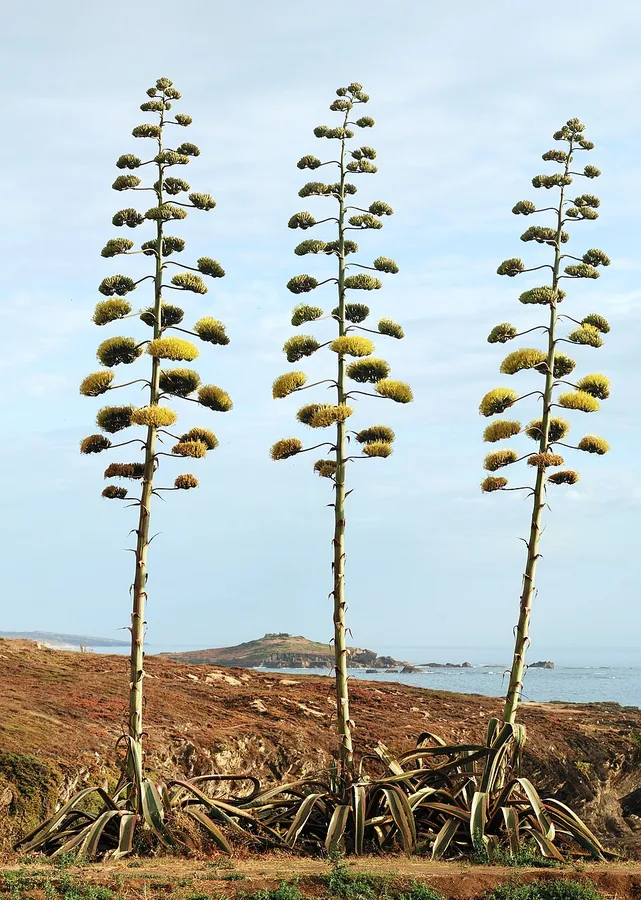
Agave is monocarpic, so the main rosette flowers exactly once, raises a tall stalk after a decade or two, and then senesces and dies. Well ahead of that terminal event it produces basal offsets, so the genotype persists through the pups even as the founding rosette declines.
Care
The short version: full sun, a gritty substrate with fast drainage, and irrigation withheld until the soil is bone dry. Hold it warm and frost-free, fertilize sparingly, and handle it in gloves on account of the sharp spines and irritant sap.
Light
Agave demands full sun and performs best in the most intense exposure, including a position that receives direct light the entire day. Partial sun or bright indirect light keeps it alive, but inadequate light triggers pale, etiolated growth. Introduce strong light incrementally so the leaf surface adapts without scorching.
Water
Irrigate thoroughly, then let the soil dry out completely before the next application, an interval that frequently extends to weeks. The plant's water-storing tissue equips it for drought, so it withstands dryness far better than saturation. When the moisture state is uncertain, withhold, because waterlogged roots rot quickly.
Soil
Grow it in a gritty, sharply drained sandy or cactus mix through which water passes immediately, denying moisture the chance to pool at the roots. A pH of 6.0 to 7.5, slightly acidic through slightly alkaline, suits it well. The substrate's one prohibition is remaining wet.
Temperature
The functional range falls between 50°F and 86°F (10°C to 30°C). The plant tolerates high heat without strain but is intolerant of cold combined with moisture, so maintain frost-free conditions and a drier regime over winter.
Humidity
As a species of arid habitats it favors low humidity and requires no misting whatsoever. Damp, stagnant air around the foliage works against it, so allow spacing and free air movement across the leaves.
Feeding
Nutrient demand is very low. A dilute, low-nitrogen cactus and succulent formulation applied once or twice through spring and summer suffices, and many specimens grow well unfed. Excess nitrogen forces soft, structurally weak tissue.
Pruning
Pruning is essentially limited to sanitation: cut away dead, shrivelled, or damaged lower leaves at the base. Work in thick gloves and eye protection, given the terminal spine, the toothed margins, and the irritant sap.
Repotting
Repot only every 2 to 3 years, or once the plant is visibly crowded, since agave responds poorly to root disturbance. Roots emerging from the drainage holes or pups congesting the surface signal the need, after which advance the plant a single pot size into fresh gritty mix.
Size & spacing
In open ground a mature specimen attains 6 to 10 feet (1.8 to 3 m) in height with a comparable spread, so allocate substantial space and keep the spined leaves away from circulation routes. Containment limits both ultimate size and growth rate, the standard approach for managing the species indoors.
Troubleshooting
Almost every agave disorder reduces to a mismanagement of water or light. Excess of the former saturates the roots and invites rot; deficiency of the latter drives pale, drawn growth. Identify the pattern below and intervene early, while corrective measures can still take effect.
Softening base and a rosette that sinks under its own weight
This is root and crown rot, the result of soil moisture lingering against the roots and crown long enough for pathogens to take hold, a problem that intensifies through the cold of winter dormancy when the plant draws up almost no water. Halt watering, lift the plant, and excise every soft, blackened section back to firm tissue with a sterile blade. Allow the wounds to callus, which closes the entry point, then reset the plant in bone-dry gritty mix.
Fix:
- Stop watering immediately
- Unpot and cut away all soft, rotted tissue with a clean blade
- Let the cut surfaces callus, then repot in dry gritty cactus mix
- Withhold water until new root growth resumes
Elongated, pale leaves angling toward the light source
This is etiolation, the elongation a light-starved agave undergoes as it invests in length to reach a brighter source, at the cost of the firm tissue and pigment normal light would build. The new leaves emerge weak and floppy and the compact rosette opens out and loses its symmetry. Relocate it to the strongest light available, ideally full sun, and restore that intensity in stages so the adapting tissue does not scorch.
Fix:
- Move to the brightest available spot, ideally full sun
- Reintroduce direct sun gradually to avoid scorch
Cottony white masses and brown bumps lodged in the leaf axils
These are mealybugs and scale, sap-feeding insects that colonize the sheltered leaf axils at the center of the rosette, where they go undetected, and they exploit the weakened defenses of a stressed indoor plant. Dislodge them with a cotton swab charged with 70 percent isopropyl alcohol, which dissolves their protective coating on contact, and reinspect weekly until the population stays gone. Quarantine the plant from the rest of the collection so the infestation does not spread.
Fix:
- Wipe insects off with a cotton swab dipped in 70 percent isopropyl alcohol
- Repeat weekly until clear
- Isolate from nearby plants
Bleached scorch on the leaf faces turned toward the sun
This is sunburn, which develops when tissue grown under softer light is thrown into intense direct exposure before the leaf surface can adapt, or when a heatwave overruns its tolerance; prolonged drought adds dry, browned tips. Raise the light intensity in stages across a week or two so the foliage can harden to it, screen the fiercest afternoon exposure with light shade, and remove only tissue that has died completely, since scorched cells will not green again.
Fix:
- Increase light gradually rather than abruptly
- Provide light shade during the most intense afternoon sun while acclimating
- Trim only fully dead tissue
Toxicity
Agave is not a systemic poison and does not appear in the ASPCA toxic plant database. The genuine hazards are mechanical and irritant: the sap carries calcium oxalate and saponins that burn and blister skin or inflame a mouth that chews it, and each leaf ends in a rigid, dagger-like spine flanked by marginal teeth capable of a deep puncture wound. Work in gloves, protect the eyes, and keep the plant clear of pets and children.
Toxic to
Cats · Dogs · Horses · Rabbits · Livestock · Birds · People
Cats Mild
A cat that bites the foliage may drool, paw at the mouth, or vomit lightly, and sap reaching the skin or eyes irritates the tissue. The sharp terminal spine, capable of a puncture wound, poses the larger threat.
Dogs Mild
Chewing brings a dog drooling and a mild gastrointestinal disturbance, while sap contact irritates skin and eyes. The rigid leaf spines, which puncture readily, account for the greater injury risk.
Horses Caution
No systemic toxicity affects horses, yet an investigative animal that mouths the leaves takes up mild oral and gastric irritation from the sap. The dominant hazard remains the rigid terminal spine, which can inflict a deep puncture wound.
Rabbits Caution
The calcium oxalate and saponins in the sap irritate the oral and digestive tissue of a rabbit, so the plant is unsuited to browsing. Position it beyond reach, accounting for both the irritant sap and the sharp spines.
Livestock Caution
Cattle, goats, and sheep face no systemic poisoning, though the irritant sap leaves the mouth sore and the digestive tract unsettled. For grazing stock the toothed margins and spear-tipped leaves constitute the principal danger.
Birds Caution
The literature records no systemic poisoning in birds, but the sap retains its irritant action, so exposure to beaks and feathers is best avoided. A captive bird stands at far greater risk of injury from a spine than from ingestion.
People Caution
Sap contact produces burning, blistering, and inflammation of the skin, and chewing any tissue yields mild oral and digestive irritation. Use gloves and eye protection, because the dagger-like spine and toothed margins injure many more people than the sap.
Handle with thick gloves and eye protection: each leaf ends in a very sharp, rigid terminal spine and the margins carry hooked teeth that can cause deep puncture wounds or eye injury, and the irritant sap can blister skin.
Helpline numbers

United States
ASPCA Animal Poison Control: (888) 426-4435 (fee applies)
Poison Control: (800) 222-1222



Canada
Poison Centres: 1-844-764-7669
Varieties
Apart from the plain blue-green species, a small set of agave forms recurs in cultivation, selected mainly for the patterning that pale variegation lays across the leaves. These are the cultivars worth recognizing by name.
Agave americana 'Marginata'
Broad creamy-yellow variegation borders each blue-green leaf and frames the rosette as a whole.
Agave americana 'Mediopicta Alba'
A single creamy-white median stripe runs the length of every blue-green leaf.
Agave americana var. expansa
It represents a larger, looser, more spreading expression of the typical species.
How to propagate
Agave propagates readily, largely because the plant generates its own basal offsets without prompting. Raising it from seed is feasible, yet rarely undertaken.
Offsets & pupsEasy
Spring to summer during active growth · Several weeks to a few months to root
Vegetative propagation by offsets is the most reliable method, since each pup is already a rooted clone of the parent. During active growth in spring and summer, sever a rooted offset at the base, hold it until the cut surface calluses to seal against rot, then set it in dry gritty mix where it establishes roots over several weeks to a few months. Because the main rosette is monocarpic and senesces after its decadal flowering, these offsets are what perpetuate the clone.
SeedModerate
Spring in warm conditions · Several months to over a year to reach a handling size
Seed propagation is possible but seldom pursued in practice. Sow fresh seed on a gritty surface under the warmth of spring, then allow for slow development, as a seedling commonly needs several months to over a year to attain a transplantable size. Offsets give faster, more uniform results, which is why seed remains the exception rather than the rule.
Myths
Agave belongs among the aloes, as its name American aloe would indicate.
Agave is classified in the Asparagaceae and aloe in the Asphodelaceae, placing them in distinct families with no close affinity. The resemblance rests entirely on convergent succulent rosettes and goes no further. The label American aloe is therefore a misnomer.
As the name century plant indicates, agave requires a full 100 years to flower.
The species does flower a single time before the main rosette dies, yet that event typically occurs at about 10 to 25 years, an order of magnitude short of a century. The century plant epithet is folklore that exaggerates the true interval.