Houseplant · Asparagaceae
Asparagus Fern
Asparagus aethiopicus
Soft, feathery, and remarkably drought-tolerant thanks to its water-storing roots.
Bright indirect
Every 7–10 days
50–77°F · 10–25°C
USDA 9–11
Overview
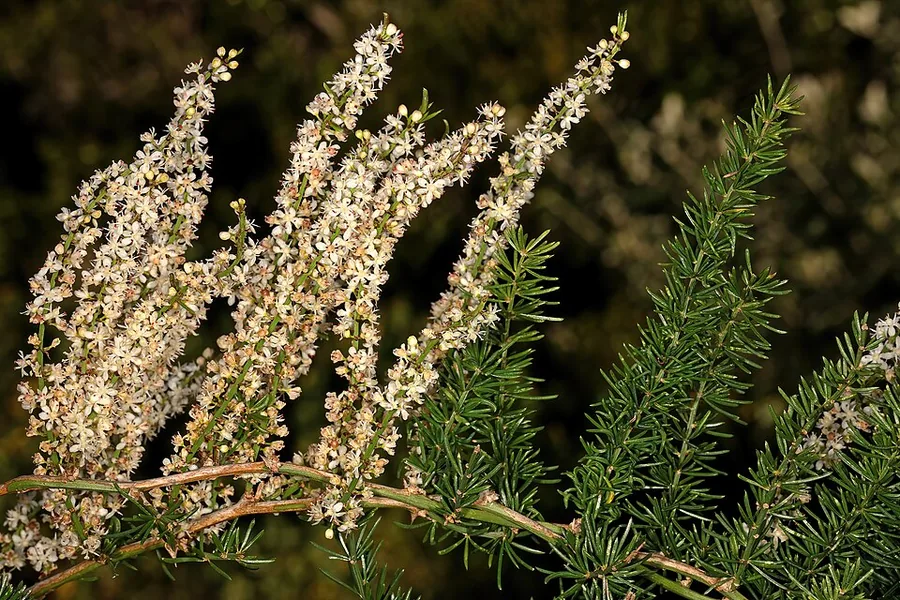
The asparagus fern carries the finely divided, arching foliage of a true fern, yet it is no fern. It is classified in the asparagus family, and the structures that read as soft, feathery 'leaves' are in fact flattened stems called cladodes that have taken over photosynthesis from reduced true leaves.
Its undemanding nature as a houseplant follows from its biology. It grows fast in bright indirect light and holds water in tuberous roots, a storage organ that buffers it against an irregular watering schedule far more effectively than a fern's fibrous roots could. Provide warmth and a freely draining pot, and it develops into a dense green mound.
The single caveat is the fruit. Summer brings small white flowers that mature into bright red berries, and those berries are the principal reason to site it away from pets and small children. The sap is a dermal irritant as well, which is why gloves are advisable during pruning.
Care
The short version: bright indirect light, water once the top few centimeters dry, monthly feeding through spring and summer, and berries kept away from pets and children.
Light
Provide bright indirect light for the densest, fullest growth. It will persist in partial shade or modest direct sun, but inadequate light causes thin, elongated stems, and intense midday sun scorches the fine cladodes.
Water
Maintain lightly moist soil during active growth, then let the top few centimeters dry out before rewatering. Because the tuberous roots already hold water, a perpetually soggy substrate induces rot. Reduce frequency over winter as growth slows.
Soil
Grow it in a well-draining, fertile potting mix with abundant organic matter. A slightly acidic pH of 6.0 to 6.8 is appropriate, and adequate drainage is what prevents the tubers from standing in water.
Temperature
Its comfortable range is 50°F to 77°F (10°C to 25°C). It is frost-intolerant, so keep it indoors or return it inside well in advance of the first cold nights.
Humidity
Average room humidity near 40% to 60% maintains good condition. Very dry air browns the tips, so group it with other plants or position it over a water-filled tray in an arid interior.
Feeding
Apply a balanced water-soluble fertilizer at half strength once monthly from spring through summer. Suspend feeding in autumn and winter while the plant is dormant.
Pruning
Cut yellowed or dead stems back to the base to maintain form, and remove leggy growth to stimulate denser, fresher fronds. Wear gloves, as the foliage and sap can irritate skin.
Repotting
Pot it up one size every 1 to 2 years, preferably in spring. The indications are tuberous roots heaving above the soil, roots emerging from the drainage holes, or pressure cracking the container.
Size & spacing
Indoors it attains roughly 12 to 24 inches (30 to 60 cm) in height and 24 to 35 inches (60 to 90 cm) in spread, so allow clearance for the stems to arch without crowding adjacent plants.
Troubleshooting
Nearly every disorder on this plant resolves to a water or light problem. Browning and crisping indicate dehydration, yellowing and shedding indicate excess moisture at the roots, and pale, elongated growth indicates a light deficit. Match the presentation below, and the correction is usually straightforward.
Chlorotic cladodes shedding needles
In most cases this is root rot, the predictable result of soil held too wet against tuberous roots that already store their own water and so resent saturation. Insufficient light or the routine senescence of older stems can produce the same yellowing. Allow the top few centimeters to dry before rewatering, relocate the plant to brighter indirect light, and remove fully yellowed stems at the base.
Fix:
- Allow the top few centimeters of soil to dry before rewatering
- Improve drainage and ensure the pot has open holes
- Move to a brighter spot with bright indirect light
- Remove fully yellowed stems at the base
Brown, brittle cladodes crisping off
This pattern signals drought stress, typically once the tubers have exhausted their stored water, and low humidity or intense midday sun accelerate the desiccation. Confirm by lifting the pot, since feather-light weight against bone-dry soil is diagnostic. Rehydrate by soaking the pot from below, move it out of direct sun into bright indirect light, and trim the browned stems.
Fix:
- Rehydrate by deep watering or bottom-soaking the pot
- Move out of harsh direct sun into bright indirect light
- Raise ambient humidity to around 40-60 percent
- Trim off browned stems
Elongated pale stems, sparse and thin
Pale, leggy growth is etiolation, the plant elongating its stems in a search for light it is not receiving, and a missed growing-season feeding compounds the weakness. The diagnostic clue is directional: stems on the brighter side stretching toward the window point to a light deficit. Relocate it to brighter conditions, feed monthly with diluted balanced fertilizer in spring and summer, and prune the elongated stems to redirect energy into denser regrowth.
Fix:
- Relocate to brighter indirect light
- Feed monthly with diluted balanced fertilizer in spring and summer
- Prune leggy stems to stimulate bushier regrowth
Toxicity
This is a toxic plant, and the bright red berries pose the real risk. They contain steroidal compounds known as sapogenins that induce vomiting and gastrointestinal upset on ingestion, and the sap can leave skin red and itchy after repeated exposure. Site it beyond the reach of pets and children, and clear any fallen berries promptly.
Toxic to
Cats · Dogs · Horses · Rabbits · Livestock · Birds · People
Cats Moderate
The ASPCA documents toxicity in cats. Ingestion of the bright red berries provokes vomiting, abdominal pain, and diarrhea, while repeated contact with the foliage can sensitize the skin into a red, irritated reaction.
Dogs Moderate
Dogs present the same clinical picture. A quantity of berries triggers vomiting and abdominal discomfort, and persistent exposure to the sap can manifest as an itchy contact dermatitis.
Horses Caution
The steroidal saponins that affect cats and dogs would likewise disturb an equine digestive tract, so exclude grazing animals from the berries and foliage even though horses seldom seek the plant out.
Rabbits Caution
Withhold every part of this plant from rabbits. The saponins concentrated in the berries and stems are unsuitable for so small a grazer, and no portion offers nutritional value worth the exposure.
Livestock Caution
Cattle, goats, and sheep are liable to the same gastrointestinal upset from the saponin-laden berries and foliage. Exclude the plant from pasture where browsing is possible.
Birds Caution
Wild birds consume and disperse the red berries, the very mechanism behind the species' invasiveness, yet the fruit can still irritate a captive bird's digestive tract. Keep cage birds away from it as a precaution.
People Caution
No part of this plant is intended for consumption, and the berries can produce abdominal pain and diarrhea if a child ingests them. The sap is also an irritant on bare skin, so wear gloves to prune or repot.
Wear gloves when pruning or repotting, as the sap and foliage can trigger allergic dermatitis with repeated skin exposure.
Helpline numbers

United States
ASPCA Animal Poison Control: (888) 426-4435 (fee applies)
Poison Control: (800) 222-1222



Canada
Poison Centres: 1-844-764-7669
Varieties
Several named selections reach garden centers, differing chiefly in how the fronds are held. The ones worth recognizing follow.
'Sprengeri'
This is the typical Sprenger's selection grown indoors, recognized by loose, arching, feathery stems that cascade over the rim of a pot.
'Myersii' (foxtail fern)
Known as the foxtail fern, this form substitutes dense, upright, plume-like fronds for the arching sprays, resembling a row of fox tails.
'Cwebe'
Distinguished by arching stems whose coppery-bronze new growth matures progressively to green.
How to propagate
Propagation is undemanding, and the most dependable route is to divide an established plant at the time you repot it in spring.
DivisionEasy
Spring, ideally at repotting time · 2 to 4 weeks
Division is the most reliable method, best carried out in spring to coincide with repotting. Lift the entire plant, then separate the tuberous clump by cutting or pulling it into sections, each retaining its own roots and several stems, and pot the divisions individually. Each section typically establishes and resumes growth within 2 to 4 weeks.
SeedModerate
Spring · Several weeks to germinate, months to fill out
Seed propagation rewards patience and is best initiated in spring. Wearing gloves because the fruit irritates skin, extract the seed from the ripe red berries and sow it into a warm, moist medium. Germination takes several weeks, with several further months before the seedlings fill out, and the outcome is slower and less uniform than division.
Myths
As a true fern, it propagates by releasing spores.
The common name and the finely divided foliage are misleading, because this is not a fern at all. It is an angiosperm in the family Asparagaceae that reproduces through flowers, berries, and seeds, and the apparent 'leaves' are cladodes, flattened photosynthetic stems.
Being fern-like, it demands perpetually moist soil and heavy shade.
Because its tuberous roots function as a water reservoir, the plant withstands drought far better than a true fern. It performs in bright indirect light, not deep shade, and continuously saturated soil is the principal cause of rot.