Houseplant · Asparagaceae
Foxtail Fern
Asparagus densiflorus 'Myers'
Give it bright indirect light and a pot that drains, and the foxtail fern throws up plumes like green bottle brushes.
Bright indirect
Every 7–10 days
50–77°F · 10–25°C
USDA 9–11
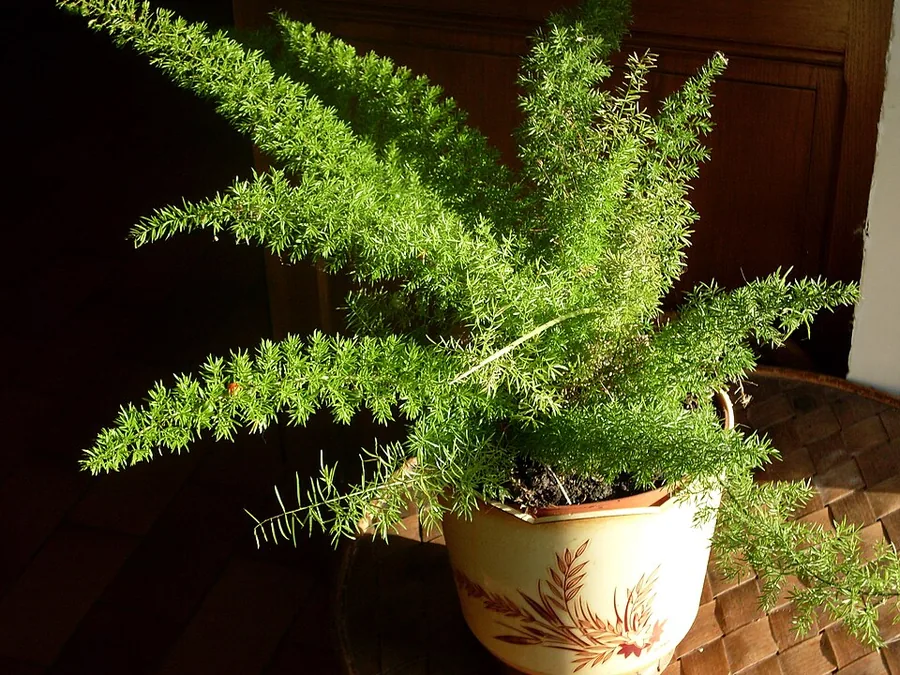
Overview
Few plants trip people up on the name the way the foxtail fern does. The foliage reads as soft and feathery, but there is no fern in it. The species sits within the asparagus family, and rather than spores it flowers, forms small red berries, and comes up from seed. The 'Myers' selection pushes out rigid, upright plumes that narrow to a point, each shaped like a stout green bottle brush.
The reason it counts as an easy houseplant lies underground. A set of fleshy tuberous roots banks water, which is why the plant absorbs a skipped watering with far more grace than most. What it asks for is bright indirect light and a pot that drains freely, and little beyond that. Given room, the clump fills out broad and dense, so it pays its way in a hanging basket or on a stand where the plumes can arch clear.
A few caveats come attached. The plant is mildly toxic to cats and dogs, the vivid berries most of all, and the sap can leave exposed skin itchy. In frost-free zones it also slips out of the garden and naturalizes, so treat it as a potted subject kept out of reach rather than something loose in a warm-climate bed.
Care
The short version: bright indirect light, a free-draining pot, and water only once the top few centimeters of soil have dried. Feed monthly through spring and summer, keep it warm, and divide it when the tuberous roots begin to heave it up out of the pot.
Light
Position it in bright indirect light, the sort found beside a window that catches sun without the direct midday glare. It tolerates partial sun and a degree of shade, but under too little light the plumes turn thin and pale and new growth stalls.
Water
Only water once the top few centimeters of soil have dried, generally every 7 to 10 days. Because the tuberous roots hold their own reserve, a spell of drying between drinks suits the plant, whereas soil that stays wet rots the roots. Reduce watering across winter as growth slows.
Soil
Set it in a well-draining loamy potting mix that drains freely rather than holding water at the roots. A pH between 6.0 and 7.0, close to neutral, keeps it content. Free drainage counts above all else, since waterlogged roots are the quickest way to lose the plant.
Temperature
Everyday room warmth of 50°F to 77°F (10°C to 25°C) suits it best. It carries no frost hardiness, so keep it clear of cold windowsills and winter drafts.
Humidity
It performs best at moderate humidity, around 40% to 60%, though it is undemanding and gets by in ordinary indoor air. Should the plume tips brown in a dry, heated room, lift the humidity in its immediate area.
Feeding
Apply a balanced water-soluble fertilizer monthly from spring through summer while the plant is in active growth. Withhold it over the cooler months when growth pauses, and flush the pot occasionally so feeding salts do not accumulate.
Pruning
Remove spent or yellowed plumes at the base to keep the clump tidy and draw out fresh upright growth. Worn or damaged stems can be cut back hard in spring to renew the plant. Wear gloves, since the sap can irritate the skin.
Repotting
Repot every 2 to 3 years, or earlier once the swollen tuberous roots start lifting the plant out of its pot. Further signs are roots circling the container and water passing straight through without soaking in. Spring is the moment for it, frequently combined with dividing the clump.
Size & spacing
Indoors it grows to 24 to 35 inches (60 to 90 cm) tall and spreads wider than that, 3 to 4 feet (90 to 120 cm) across. Allow the clump space for the plumes to arch outward, which is why it works well on a stand or in a hanging basket.
Troubleshooting
A foxtail fern signals trouble through its plumes well before the whole plant declines. Yellowing, shedding, and browning tips each trace back to a separate cause and fix. Read the symptom below and correct it before it takes hold.
Plumes yellowing evenly over the whole clump
In most cases the driver is overwatering or a mix that holds too much water, which stresses the tuberous roots until the plumes lose color. A dim spot or a plant that has run short on nutrients produces the same fading. Let the top few centimeters of soil dry between waterings, shift it into brighter light, and pick the monthly feeding back up while it is in active growth.
Fix:
- Allow the top few centimeters of soil to dry before watering
- Move to a brighter spot with bright indirect light
- Resume monthly feeding during the growing season
Fine needle-like foliage littering the floor
When the rootball dries out too far, the plant sheds its fine cladodes to conserve water, and a fresh relocation or a cold draft can prompt the same reaction. Give it a thorough soak and hold to a regular watering interval. Keep it clear of drafts and heat vents, in steady bright indirect light, and the drop tapers off.
Fix:
- Water thoroughly and maintain a consistent moisture cycle
- Keep the plant away from cold drafts and heat sources
- Provide steady bright indirect light
Crisp brown ends along the plumes
Low ambient humidity is the common reason for browning tips, but letting the rootball run dry or accumulating fertilizer salts will scorch them just as readily. Lift the humidity around the plant and hold the soil evenly moist during growth. Periodically pour plain water through the pot to leach out the salts that concentrate from feeding.
Fix:
- Raise humidity around the plant
- Keep soil evenly moist during active growth
- Flush the soil periodically to leach excess salts
Toxicity
Keep this one out of reach of pets. The sap and the conspicuous red berries are where the risk lies, and the ASPCA lists it under Asparagus Fern as toxic to cats and dogs; the same sapogenins are reason to keep it clear of horses, rabbits, and grazing stock. People are not meant to eat any part, the berries are mildly poisonous, and the sap can raise a rash, so wear gloves when you prune.
Toxic to
Cats · Dogs · Horses · Rabbits · Livestock · Birds · People
Cats Moderate
The ASPCA classes the sapogenins in this plant as toxic to cats. When a cat samples the red berries, expect vomiting, abdominal discomfort, and diarrhea; repeated brushing against the foliage can also leave the skin reddened and irritated.
Dogs Moderate
The response in dogs mirrors what happens in cats. Berries that get chewed trigger vomiting, diarrhea, and abdominal pain, and ongoing contact with the cut stems can provoke an itchy dermatitis.
Horses Caution
No horse-specific case is on record, yet the same sapogenins that upset the gut in cats and dogs make this one to keep away from horses. A grazing horse should not reach the foliage or any dropped berries.
Rabbits Caution
Consider it unsuitable for rabbits. Both the berries and the sapogenin-bearing tissue can disturb the digestive tract, so position the pot and clear any fallen fruit well beyond their reach.
Livestock Caution
Cattle, sheep, and goats meet the same toxin should they reach the foliage or the ripe red berries. Fence it off or place it where grazing animals cannot browse it.
Birds Caution
In the wild, birds consume the berries and disperse the seeds unharmed, which is precisely how the plant naturalizes, yet an inquisitive pet bird should not be pecking at the fruit. To be safe, keep it out of reach of cage birds.
People Caution
None of this plant is meant to be eaten, and the red berries are mildly poisonous when swallowed, so keep children away from them. Bare-handed contact with the stems and sap can raise a rash, so put gloves on before pruning or repotting.
Wear gloves when pruning or repotting, as repeated skin contact with the sap can cause allergic dermatitis.
Helpline numbers

United States
ASPCA Animal Poison Control: (888) 426-4435 (fee applies)
Poison Control: (800) 222-1222



Canada
Poison Centres: 1-844-764-7669
Varieties
Two forms of Asparagus densiflorus circulate under the asparagus fern label, and their habits diverge completely. Identifying yours tells you at once whether it will stand upright or trail.
Asparagus densiflorus 'Myers'
This is the genuine foxtail, producing dense upright plumes that narrow to a point and carry the profile of a bottle brush.
Asparagus densiflorus 'Sprengeri'
The common asparagus fern, it grows as loose, arching, trailing stems rather than the rigid upright plumes seen on 'Myers'.
How to propagate
There are two ways to increase your stock: the fast one is dividing an established clump, and the slow one is sowing the seed drawn from its berries.
DivisionEasy
Spring or early summer at repotting · 4 to 8 weeks
Division is the straightforward route to more plants, and it lines up well with repotting through spring or early summer. Lift the plant clear of its pot, then cut the fleshy tuberous mass into sections so that every piece holds both stems and roots. Set each division into its own pot and it will root down over the following 4 to 8 weeks.
SeedModerate
Spring · Several weeks to germinate, months to reach size
Raising it from seed demands patience. During spring, extract the seed from the ripe red berries with gloves on, as the fruit can irritate the skin, then sow into a warm, moist medium. Germination runs unevenly and takes several weeks, and the seedlings need months beyond that to build any real size.
Myths
The foxtail fern is a true fern.
The common name misleads. It is not a fern in any sense but a species in the asparagus family, Asparagaceae. True ferns reproduce by spores, whereas this plant flowers, produces red berries, and is raised from seed.
Because it's a fern, it must be safe around pets.
It qualifies as neither. The ASPCA records it under Asparagus Fern as toxic to cats and dogs, the berries producing stomach upset and the sap raising an itchy rash. Site it far from any animal inclined to chew.