Houseplant · Asparagaceae
Lucky Bamboo
Dracaena sanderiana
Supply clean water and bright, indirect light, and this undemanding Dracaena holds its color for years.
Bright indirect
Every 7 days
64–75°F · 18–24°C
USDA 10–12
Overview
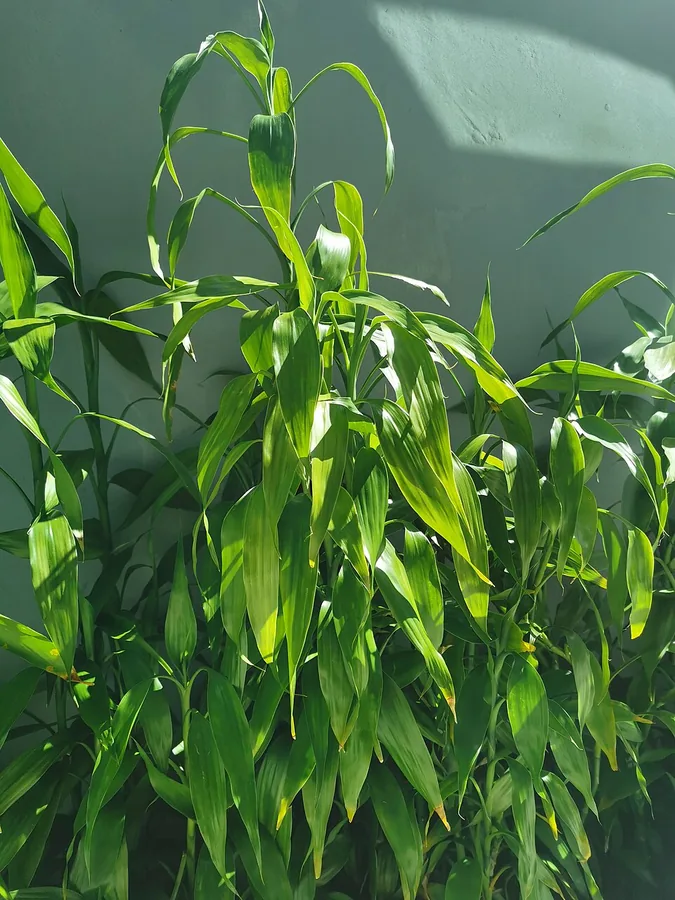
Among houseplants, lucky bamboo ranks as one of the least demanding and one of the most misidentified. It is not a bamboo but Dracaena sanderiana, a tropical relative of the corn plant whose habit of forming jointed green stalks invites the comparison. Growers direct those stalks into curls, spirals, and braids, then stand them in a shallow dish of water and pebbles.
Its defining trait is the capacity to grow hydroponically, in plain water without any soil. The pebbles or marbles anchor the roots while the submerged lower stem draws what it needs, and the plant sustains itself on that alone. Its tolerance of low light exceeds that of most houseplants, which explains its persistence in offices and interior rooms where light is limited.
The plant makes only one firm demand, and it is a chemical one: it will not accept the fluoride and chlorine in ordinary tap water, which concentrate in the foliage and brown the leaf tips. Resolve the water quality, provide bright indirect light, and lucky bamboo becomes about as reliable as a houseplant can be.
Care
The short version: provide bright indirect light, water free of fluoride and chlorine, and warm indoor temperatures. Grow it in pebbles and water or a well-drained mix, renew the water weekly, and apply a dilute feed through spring and summer.
Light
Lucky bamboo performs best under bright, indirect light, the quality found set back from an east or north window. It endures low light and shade more capably than most houseplants, but hot direct sun scorches the foliage, so an exposed sill is unsuitable.
Water
Grow it in chlorine-free water with pebbles or marbles anchoring the roots, or in a consistently moist mix, keeping the roots and lower stem submerged. Because it is sensitive to fluoride, chlorine, and salts, which concentrate in the leaf tips, use distilled, filtered, or rainwater, or let tap water stand uncovered for a day or two. Renew the water weekly to keep it fresh and deter mosquitoes.
Soil
In soil, use a well-drained, loam-based mix formulated for indoor or tropical plants. It accepts a broad pH range from 6.0 to 8.0, and it grows equally well without soil, held in plain chlorine-free water and pebbles.
Temperature
Maintain the warm, stable conditions of a typical interior, roughly 64°F to 75°F (18°C to 24°C). As a tropical species it has no cold tolerance, so any outdoor display must return indoors well before night temperatures fall.
Humidity
Average indoor humidity satisfies it, so no target figure applies. Very dry air can brown the leaf tips slightly, but water quality matters far more to this species than ambient humidity.
Feeding
Apply a dilute liquid houseplant fertilizer through the growing season, spring into summer. Water-grown specimens need even less: feed only about every other month at roughly a quarter of the labeled rate.
Pruning
Remove yellowed or damaged stalks and leaves as they occur. To limit height, cut a stem just above a node, which stimulates new shoots, and the removed sections can be rooted as fresh cuttings.
Repotting
Repot into a larger container every 1 to 2 years, or sooner once roots crowd or circle the pot or fill the vase. Slowed growth and congested roots are the reliable indicators, while water-grown displays require only periodic refreshing as they fill in.
Size & spacing
Indoors it attains roughly 3 to 5 feet (91 to 152 cm) in height and a comparable spread, though pruning keeps most specimens shorter. Its growth rate is slow, so allow space for gradual development rather than rapid coverage.
Troubleshooting
Lucky bamboo signals stress early, and the foliage registers it first. Two disorders account for nearly every complaint, browned tips and yellowed stalks, and both trace to water quality or water management more often than to anything else. Identify the pattern below, then correct the underlying cause rather than removing the visible damage.
A stalk or leaves turning yellow
Yellowing indicates overwatering or stagnant water, frequently compounded by insufficient light. When a stem stands in old, oxygen-poor water for too long, its base softens and rots, and the chlorosis follows. Remove the affected stalk, renew the water each week with only the roots and lower stem submerged so the tissue above the line can breathe, and move the plant into bright indirect light with a dilute feed to restore vigor.
Fix:
- Remove yellowing or rotting stalks
- Change the water weekly and keep only roots plus the lower stem submerged
- Provide bright indirect light and a weak fertilizer
Brown, crispy tips on the leaves
This pattern is classic tip burn from tap water. As a Dracaena, this plant accumulates the fluoride, chlorine, and salts carried in municipal water and moves them to the leaf margins, where they concentrate and kill the tissue at the tips. Correcting the water supply to distilled, filtered, or rainwater, or letting tap water stand uncovered for a day or two to off-gas, removes the source, and keeping the plant out of hot direct sun spares the already stressed foliage.
Fix:
- Switch to distilled, filtered, or rainwater, or let tap water stand uncovered 1-2 days before use
- Change water-grown plants' water weekly
- Move out of direct sun into bright indirect light
Toxicity
This is a plant to keep beyond a pet's reach. Lucky bamboo contains saponins, and the ASPCA classifies it as toxic to cats and dogs, producing vomiting, hypersalivation, and a depressed, off-color state. It poses essentially no risk to people, and no part is eaten, though the sap can cause minor skin irritation, so wash the hands after pruning.
Toxic to
Cats · Dogs · Horses · Rabbits · Livestock · Birds
Safe for
People
Cats Moderate
The saponins irritate a cat's digestive tract and provoke vomiting, at times containing blood, alongside hypersalivation and a depressed, withdrawn state. Anorexia commonly follows, and after a substantial dose the pupils dilate visibly.
Dogs Moderate
In a dog, chewing the stalks or leaves triggers the same saponin response, producing heavy drooling and vomiting that may be tinged with blood. Reduced appetite and a sluggish, low demeanor typically persist for a time afterward.
Horses Caution
The saponins responsible for the reaction in cats and dogs make ingestion inadvisable for a horse as well, so stalks belong well beyond reach. Any quantity consumed would most likely produce gastrointestinal upset.
Rabbits Caution
A rabbit's sensitive hindgut tolerates the saponins poorly, so this plant is unsuitable forage. Prevent access to any dropped leaf or trimmed stalk that a rabbit might graze.
Livestock Caution
Grazing stock exposed to the saponins can develop digestive upset, though as an indoor plant it seldom enters their range. Keep clippings clear of any area livestock can access.
Birds Caution
A pet bird that bites into a stalk risks gastric upset from the saponins, which places it off limits. Position the plant where birds cannot reach or pick at it.
People Safe
For people the plant presents essentially no toxic risk, and no part of it is eaten. The sap can produce minor skin irritation, so washing the hands after pruning or repotting is a sensible precaution.
Sap may cause minor skin irritation in people; wash hands after handling.
Helpline numbers

United States
ASPCA Animal Poison Control: (888) 426-4435 (fee applies)

United Kingdom
Animal PoisonLine: 01202 509000 (fee applies)

Australia
Animal Poisons Helpline: 1300 869 738
Varieties
Lucky bamboo reaches the market less as a series of named cultivars than as a single species presented in a few styles. The two forms below are the ones actually encountered.
Braided / spiral lucky bamboo
These represent standard Dracaena sanderiana stems directed into curls, spirals, or braids while immature by rotating them toward the light source, rather than a distinct cultivar.
Variegated lucky bamboo
This form is identified by creamy or gold longitudinal striping along the strappy green foliage.
How to propagate
Lucky bamboo propagates readily, and the method requires nothing beyond what the plant already provides. A trimmed stem and a vessel of clean water are sufficient to establish an entirely new plant.
Stem cuttingsEasy
Spring through summer during active growth · Roots usually form in about 2-3 weeks
Propagate during spring or summer, when active growth supplies the plant with the resources to form new roots. Sever a shoot of new growth from the main stem just above a node, remove the lowest leaves to keep them out of the water, and suspend the cutting in chlorine-free water, where roots emerge in roughly 2 to 3 weeks. After rooting, the cutting can remain in water or transfer to a pot.
Myths
Lucky bamboo is a kind of bamboo.
The common name and jointed habit mislead, because this species is not a true bamboo and lies entirely outside the grass family. It is Dracaena sanderiana, a Dracaena in the family Asparagaceae, taxonomically far nearer the corn plant than any genuine bamboo.