Houseplant · Gesneriaceae
African Violet
Streptocarpus ionanthus
Supply bright indirect light and tepid water delivered from below, and the African violet will flower across most of the year.
Bright indirect
60–80°F · 16–27°C
USDA 11–12
6–9 in · 15–23 cm
Overview
Among flowering houseplants, the African violet ranks with the most reliable indoor bloomers, a trait it carries from the humid highland forests of Tanzania. The vernacular name misleads: this species has no phylogenetic link to the true violets. It belongs to the Gesneriad family, the lineage that also holds streptocarpus. Following a taxonomic revision, the genus Saintpaulia was subsumed into Streptocarpus, which is why a Saintpaulia label and a Streptocarpus ionanthus label denote one and the same taxon.
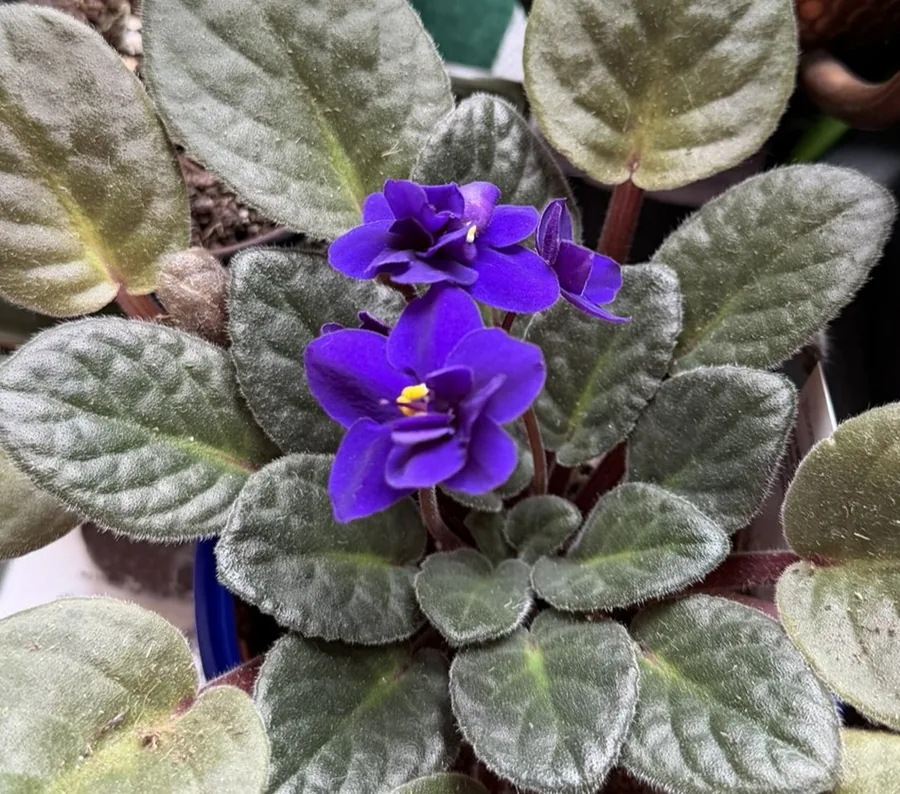
Its ornamental value rests on form. A compact rosette of fuzzy, rounded leaves grows tight to the substrate, and from its center emerge cymes of small flowers in purple, pink, white, or blue. The mature footprint remains modest at 6 to 9 inches (15 to 23 cm) in spread, small enough to occupy a saucer. Under suitable culture, bud initiation continues through nearly every month of the year.
The moderate difficulty rating derives from two physiological vulnerabilities rather than any general weakness. The pubescent leaves develop lesions where cold water contacts the surface, and the crown succumbs to rot under prolonged substrate saturation. Manage irrigation from below with tepid water and calibrate the light, and the plant sustains repeated flowering in return for that limited input.
Care
The short version: provide bright indirect light at an east or north window, hold the temperature between 60°F and 80°F (16°C to 27°C), and use a porous soilless substrate held evenly moist. Irrigate from below with room-temperature water, fertilize at a reduced rate during growth, and maintain a mild pot-bound condition to promote flowering.
Light
Position it in bright indirect light at an east or north exposure, where irradiance is ample yet the leaves escape direct midday radiation. The species tolerates medium light and partial shade, but photosynthate falls short of bloom demand once the site grows too dim. Under fluorescent or LED supplementation of 14 to 16 hours a day, the photoperiod sustains flowering through the low-light winter months.
Water
Hold the substrate evenly moist but not saturated, allowing the upper inch to dry between irrigations so the roots are never starved of oxygen. Sub-irrigate by standing the pot in warm or room-temperature water for roughly 30 minutes, then draining it completely. Because chilled water and surface droplets bleach the fuzzy leaves into pale rings, keep the foliage dry, and bear in mind that excess moisture is the principal driver of crown and root rot.
Soil
Grow it in a loose, porous, well-drained soilless medium rather than dense garden soil, since aeration at the root zone limits rot. A commercial African violet mix serves, as does a blend of 3 parts sphagnum peat moss, 2 parts vermiculite, and 1 part perlite with a little lime. The roots perform best across a mildly acidic pH band of 6.2 to 6.5.
Temperature
Maintain warm, stable interiors in the range of 60°F to 80°F (16°C to 27°C), the band that supports continuous metabolic activity. Cold drafts and depressed night temperatures suppress growth and arrest bud development. Site the plant away from chilled glazing and the desiccating output of heating vents.
Humidity
Ordinary indoor humidity satisfies it, with 40% to 60% representing the optimum. Driving humidity higher without adequate air movement creates the saturated boundary layer that favors powdery mildew and Botrytis. Spacing between specimens contributes more to plant health than routine misting.
Feeding
Apply fertilizer monthly through the active growth and flowering period from spring into fall, using a balanced product or one formulated for African violets. Dose it at a reduced quarter to half the label strength, because surplus nitrogen biases the plant toward foliage at the expense of flowers. Periodic leaching with plain water removes the soluble salts that otherwise accumulate at the root zone.
Pruning
Excise spent flowers and any senescent or yellowed leaves to maintain rosette form and limit Botrytis inoculum. Where a single-crown habit is preferred, remove offset suckers as they develop. No further cutting is warranted, as the species does not require hard renewal pruning.
Repotting
Replace the medium once a year to restore structure and purge accumulated salts. Retain a modest pot-bound state, using a container near half the width of the leaf spread, since restricted root volume favors flower production. As an older specimen develops an exposed neck, reset it lower in the new pot and bury the stem to the lowest leaf whorl.
Size & spacing
This is a diminutive, well-formed plant holding near 6 to 9 inches (15 to 23 cm) in both height and spread. Allow each specimen clearance on the sill so air circulates between them. Adequate spacing interrupts the spread of mildew and mite populations through a collection.
Troubleshooting
The majority of African violet disorders register first in the foliage or as a vegetative plant that withholds bloom. Reading those early indicators allows intervention before a minor fault progresses to crown rot or a stalled specimen. Identify the pattern below, then correct the underlying cause while remediation remains effective.
Soft, darkened crown with collapsing lower foliage
This indicates crown and root rot, almost invariably the consequence of overwatering or moisture retained against the crown. Lifting the plant reveals decayed roots and a soft, discolored base. A specimen at this stage rarely recovers, so discard it and re-establish in a sanitized pot of porous medium with the crown held above the substrate line.
Fix:
- Discard severely affected plants to prevent spread
- Use sterilized soilless mix and clean, sanitized containers (1:9 bleach soak)
- Plant with the crown above the soil surface and improve drainage
Distorted, hairy central growth with curled margins and aborted buds
The agent is the cyclamen mite, a pest below the threshold of unaided vision. It concentrates in the growing point, rendering new tissue grayish, curled, and stunted while developing buds abort. Isolate the plant immediately, discard it if heavily infested, and treat remaining specimens with a labeled miticide at roughly 3-day intervals.
Fix:
- Isolate infested plants immediately
- Discard badly affected plants
- Treat with a labeled miticide (insecticidal soap, sulfur, or tau-fluvalinate) at about 3-day intervals
Vigorous foliage with no flower production
The usual cause is insufficient light, since bud initiation requires bright indirect light or an extended photoperiod under lamps. Excess fertilizer compounds the problem by favoring vegetative growth, so reduce the feeding rate. Relocate it to an east or north window, or supply 14 to 16 hours of light daily, and hold the room warm.
Fix:
- Move to bright indirect light or add fluorescent/LED light for ~14-16 hours/day
- Reduce fertilizer to a low/dilute rate and flush accumulated salts with plain water
- Maintain warm temperatures (about 60-80°F) and improve air/soil conditions
Cottony deposits or silvered flecking on the leaves
Cottony masses in the leaf axils identify mealybugs, while silvered, rasped patches indicate thrips. Both deform and stunt the tissue on which they feed. Remove mealybugs with an alcohol-charged swab, apply insecticidal soap or a labeled systemic, and keep the plant isolated through treatment.
Fix:
- Remove mealybugs with an alcohol-soaked cotton swab
- Treat with insecticidal soap, or a soil-applied systemic (e.g., imidacloprid granules) per label
- Isolate the plant while treating
A powdery white deposit over leaves and blooms
This coating is powdery mildew, a fungus that establishes in stagnant, humid air. It colonizes foliage and flowers alike where specimens stand crowded. Improve air movement around the plant, remove the worst-affected leaves and blooms, and lower the ambient humidity.
Fix:
- Improve air circulation around the plant
- Remove affected flowers and leaves
- Reduce excess humidity
Gray-brown fuzzy mold on foliage or spent flowers
This is Botrytis blight, a fungus that colonizes dead or declining tissue and disperses in damp, still air. It typically initiates on a spent flower or a leaf underside before advancing. Remove the dead tissue, keep the foliage dry, and increase air circulation around the plant.
Fix:
- Remove and discard dead plant material and affected leaves/flowers
- Improve air circulation
- Keep foliage dry
Pale lesions or rings across the pubescent leaves
These mark where cold water has contacted the foliage, commonly a droplet that rested on a leaf and bleached the tissue beneath. The damage is purely cosmetic, yet it is permanent once formed. Adopt sub-irrigation or apply room-temperature water, keep the surface dry, and excise the most heavily marked leaves.
Fix:
- Switch to bottom (sub-irrigation) watering or use room-temperature water
- Keep foliage dry when watering
- Damaged leaves will not recover; remove the worst-affected ones
An exposed neck developing beneath the rosette
This reflects normal senescence, as the oldest basal leaves abscise and progressively expose the stem. The correction is straightforward and the plant tolerates it well. At repotting, set the specimen lower in the container and bury the bare neck to the lowest leaf set.
Fix:
- Repot and set the plant low in the container, burying the stem up to the lowest set of leaves
Toxicity
Households with pets and young children can take reassurance here: the African violet is non-toxic in every part. The ASPCA records it as safe for cats, dogs, and horses, and incidental ingestion produces nothing beyond mild, transient gastric irritation. The single meaningful caution concerns any pesticide or systemic insecticide a grower applies, so withhold such treatments from specimens accessible to pets or children.
Safe for
People · Cats · Dogs · Horses · Rabbits · Livestock · Birds
Cats Safe
Cats may occupy the same shelf without concern. The pubescent leaves are non-toxic, so an exploratory bite causes no injury.
Dogs Safe
Dogs are equally unaffected. A leaf mouthed by an inquisitive animal produces nothing worse than possible transient gastric upset.
Horses Safe
Horses incur no risk from this plant, which the ASPCA classifies as non-toxic to the species.
Rabbits Safe
Rabbits may consume an occasional leaf without harm, although any houseplant warrants treatment as a rare item rather than forage.
Livestock Safe
Cattle, goats, and sheep face no toxic exposure, though an indoor specimen seldom enters their environment.
Birds Safe
Caged birds and backyard poultry remain safe in its vicinity, as the plant contains no toxic constituents.
People Safe
Humans are likewise unaffected, which makes the species a sound selection for households with small children and inquisitive toddlers.
Although the plant itself is non-toxic, pesticides or systemic insecticides applied to the soil or foliage could be harmful, and chewing fibrous leaves may cause mild, non-toxic stomach upset
How to propagate
Few houseplants propagate as readily as the African violet, and a single detached leaf suffices to generate offspring. Division of an established multi-crowned clump at repotting offers a second route to additional plants.
Leaf cuttingsEasy
Any time during active growth · Plantlets form in 1-3 months
Leaf-cutting is the standard technique for clonal increase and proceeds at any point during active growth. Detach a healthy leaf with its petiole intact, insert the petiole into a moist medium, and hold it warm. Adventitious plantlets emerge at the base in 1 to 3 months, and each develops into a discrete plant suitable for individual potting.
DivisionEasy
At repotting · Several weeks
An established specimen that has produced several crowns can be partitioned into separate plants at repotting. Divide the clump and detach any rooted offset suckers, then pot each section independently. The divisions re-establish within a few weeks and resume growth without check.
Myths
The African violet is a true violet, allied to the wild Viola.
The common name has misled many, but the two carry no taxonomic relationship. African violets sit within the Gesneriads, the same group as streptocarpus, whereas the true violets belong to Viola. Their only point of resemblance is floral morphology.
No water may ever be allowed to touch the leaves.
The actual hazard is cold water on the pubescent surface, which bleaches the characteristic pale rings. Tepid, room-temperature water inflicts no such injury, and sub-irrigation removes the risk altogether. Water at warm temperatures and the foliage remains unmarked while the substrate holds moisture.
Its botanical name remains Saintpaulia ionantha.
Taxonomy has superseded that designation. Kew's Plants of the World Online now accepts Streptocarpus ionanthus following the transfer of the genus Saintpaulia into Streptocarpus. The 1893 epithet Saintpaulia ionantha persists as a synonym, so the two names resolve to a single taxon.
Sources
- NC State Extension Plant Toolbox
- Clemson Cooperative Extension HGIC
- Missouri Botanical Garden Plant Finder
- University of Wisconsin-Madison Division of Extension
- Iowa State University Extension and Outreach
- University of Minnesota Extension
- ASPCA Animal Poison Control
- Plants of the World Online, Royal Botanic Gardens Kew