Houseplant · Bromeliaceae
Air Plant
Tillandsia
No pot and no medium required. Supply an air plant with bright light and a weekly soak and its leaves manage the rest.
Bright indirect
Every 7–14 days
50–86°F · 10–30°C
USDA 9–11
Overview
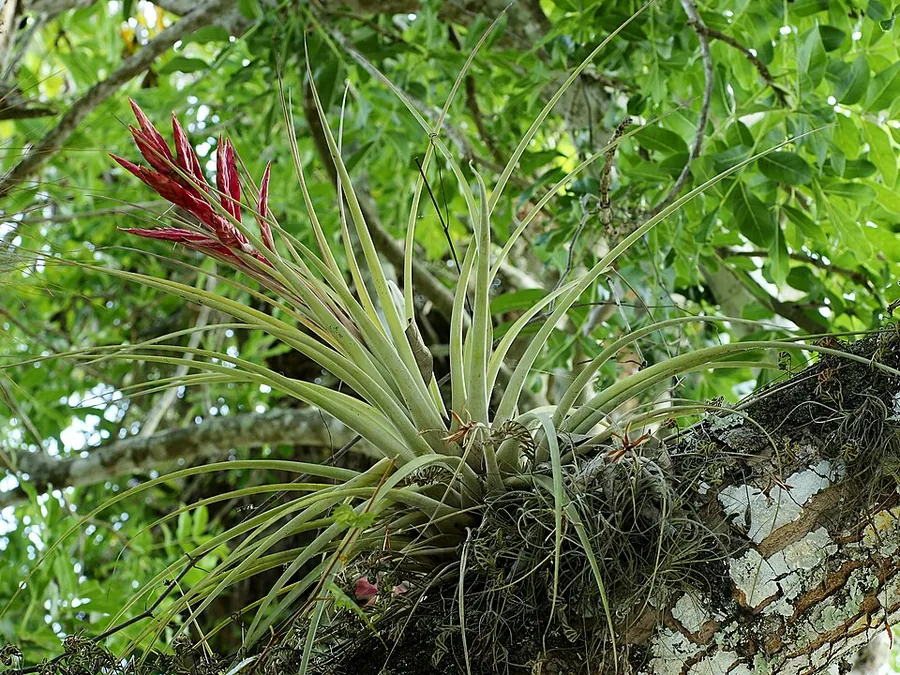
The Tillandsias are a large genus of bromeliads adapted to grow with no rooting medium whatsoever. In habitat they colonize tree limbs and exposed rock as epiphytes, using their roots chiefly for attachment and absorbing water and nutrients across the leaf surface. That soilless, epiphytic strategy is precisely what makes them undemanding indoors, because a specimen can be mounted on driftwood, displayed in a glass vessel, or simply set on a shelf without any pot.
In these plants the leaf has assumed the absorptive role that roots perform in most species. The surface is clad in minute silver scales called trichomes that capture moisture and deliver it inward, which is why a periodic soak governs health far more than any potting practice. Mature size spans small clumps a couple of inches across up to the broad, recurving rosettes of the larger species, and the slow growth rate means a single plant holds a compact form for years.
Each rosette builds toward one reproductive event. On reaching maturity it raises a colorful flower spike, blooms once, then enters a slow decline, leaving a ring of basal offsets to continue the line. With adequate light and water that succession persists over a long period, as each new pup matures and flowers in its own turn.
Care
The short version: provide bright, indirect light and a weekly soak in room-temperature water, then dry the plant thoroughly in moving air so moisture is never retained in the leaf base.
Light
Air plants perform best in bright, indirect light, positioned a few feet back from a window with good exposure. They tolerate limited direct sun or medium indirect light, whereas deep shade reduces vigor and slows them because photosynthetic input falls short. Conversely, prolonged harsh midday sun delivers enough heat to scorch the foliage.
Water
Watering is the decisive factor in survival. Submerge the entire plant in room-temperature water for 20 to 30 minutes about once a week, or mist it thoroughly several times a week as an alternative. The step that matters most follows: discharge the excess and allow complete drying within roughly 4 hours in moving air, because water retained in the leaf base creates the anaerobic, wet conditions that drive rot.
Soil
No rooting medium is involved at any stage. Air plants are cultivated as epiphytes, mounted on wood or bark or displayed bare, and must never sit in potting mix. Any substrate that holds moisture against the base predisposes the plant to rot, so keep it in open air.
Temperature
Their comfortable range is broad, approximately 50°F to 86°F (10°C to 30°C), which encompasses typical indoor conditions across the year. Maintain them above freezing, as the genus has no frost tolerance and cold injury is rapid.
Humidity
Ordinary indoor humidity in the 40% to 60% range serves them well. In hot, dry air transpiration accelerates and they need watering more frequently, whereas cool, humid rooms slow water loss and permit longer intervals.
Feeding
Fertilize sparingly during spring through summer, the period of active growth. Incorporate a dilute bromeliad or low-nitrogen feed at quarter strength into the soak or mist water about once a month, and withhold it through the cooler months when growth halts.
Pruning
Maintenance is minimal. Remove any dried or browned leaf tips and excise dead outer leaves at the base with clean scissors. Once a plant has bloomed and entered decline, the spent flower stalk may be cut away while the pups are left to develop.
Repotting
Not applicable - not potted; remount or rehome only if a display becomes crowded or a mount degrades
Size & spacing
Most air plants remain small, ranging from about 2 to 12 inches (5 to 30 cm) in height with a spread of 2 to 10 inches (5 to 25 cm). Because they are displayed rather than planted, the only spacing concern is leaving each specimen sufficient open room for air to circulate around the foliage.
Troubleshooting
The overwhelming majority of air plant disorders are water-mediated, arising from either a deficit or from excess held in the wrong location. The two presentations below account for most cases, so identify which one matches and intervene before the injury extends into the core.
Rotted, blackened crown with inner leaves releasing freely
A dark, softened core whose inner leaves release with no resistance is the classic presentation of crown rot, a base infection that follows moisture lingering in the leaf base after watering. Because the meristem at the center has already broken down, a plant in this state will not regenerate and belongs in the bin. Detected at onset it can occasionally be dried out and recovered, but the durable control is airflow brisk enough to evaporate trapped water before pathogens establish.
Fix:
- Discard plants that have rotted through the center, as they cannot be saved
- If caught very early, dry the plant completely and improve airflow
Desiccated, inward-rolling leaves with browned tips
Dry, papery foliage that rolls inward points to underwatering or insufficient humidity, since the leaf loses turgor as its water reserve drops, and excessive direct sun produces the same scorch through heat injury. A 20 to 30 minute soak restores turgor and the plant usually firms up again within a day. Move it from a steadier watering interval, shade it from intense midday exposure, and trim the desiccated tips for appearance.
Fix:
- Soak the plant in room-temperature water for 20-30 minutes, then dry fully
- Increase watering frequency and move out of harsh direct sun
- Trim off crispy tips for appearance
Toxicity
For households with animals the verdict is favorable: air plants contain no documented toxin and are absent from the lists of plants poisonous to cats, dogs, and other pets. The rigid leaves are not intended for consumption, yet an incidental bite will not produce poisoning. They can be displayed safely in any room.
Safe for
People · Cats · Dogs · Horses · Rabbits · Livestock · Birds
Cats Safe
Tillandsia does not appear on the ASPCA's roster of plants toxic to cats, so an exploratory bite carries no poisoning risk. The foliage is rigid and not a food source, and a cat that ingests a fragment may gag or cough it back up.
Dogs Safe
Dogs face no toxic principle from this group either. The leaves are fibrous, so a large mouthful can mechanically irritate a sensitive gut, which argues for siting displays beyond the reach of a persistent chewer.
Horses Safe
No toxic compound is recorded for the genus, so air plants present no poisoning hazard to horses.
Rabbits Safe
Rabbits are unaffected by air plants, which carry no toxin. The tough, fibrous leaves are not appropriate forage, so they should not feature in the diet.
Livestock Safe
Cattle, goats, and sheep are not at risk from air plants, as the group contains no documented toxin.
Birds Safe
Pet birds remain safe in the presence of air plants, with no toxic constituent to threaten one that examines the foliage.
People Safe
Air plants are non-toxic to people and may be handled and displayed in any room. They are cultivated as ornamentals rather than for consumption, so there is no reason to eat them.
Safe to keep around pets; the thin stiff leaves are not a poisoning hazard, though they are not intended for eating.
Varieties
The genus comprises hundreds of Tillandsia species, but a handful recur consistently in cultivation and retail. These are the ones worth identifying by name.
Tillandsia ionantha
A compact clustering species whose green leaves redden and whose center flushes violet as the inflorescence develops.
Tillandsia xerographica
The large, slow-growing standout of the genus, producing broad silvery-gray leaves that recurve into a markedly sculptural rosette.
Tillandsia usneoides (Spanish moss)
An atypical rootless species that grows as pendent chains of thread-fine gray foliage, draping over branches in place of any rosette.
How to propagate
An air plant collection is grown rather than purchased. A healthy specimen reproduces vegetatively once it has flowered, and raising the resulting pups is the principal method of increasing numbers.
Offsets & pupsEasy
After the mother plant flowers, when pups reach about one-third to one-half the parent's size · Several weeks to a few months once separated, as growth is slow
Tillandsia is monocarpic at the rosette level: a mature plant flowers a single time, and as that inflorescence senesces it initiates basal offsets termed pups. Allow each pup to attain roughly one-third to one-half of the parent's size before twisting it away to grow independently, or retain the intact cluster so it develops into a clump. Establishment is gradual given the genus's slow growth rate, so a detached pup typically requires several weeks to a few months to root in.
Myths
Tillandsias subsist entirely on air and can go without any water.
The common name overstates the case. Uptake of water and nutrients occurs through specialized leaf scales called trichomes rather than from atmospheric moisture directly. Without periodic soaking or misting the plant desiccates and dies, because the trichomes have no reservoir to draw on between waterings.
Lacking roots in soil, Tillandsias have no requirement for light.
Rootlessness in the soil sense is irrelevant to light demand. As a photosynthetic organism the plant requires bright, indirect light to fix the carbon it needs, exactly as any leafed plant does. Held in deep shade it loses vigor and gradually declines.