Houseplant · Bromeliaceae
Guzmania (Scarlet Star)
Guzmania lingulata
Water through the central tank and hold the light bright but indirect, and this epiphytic bromeliad sustains its scarlet star for months.
Bright indirect
Every 5–10 days
55–81°F · 13–27°C
USDA 10–12
Overview
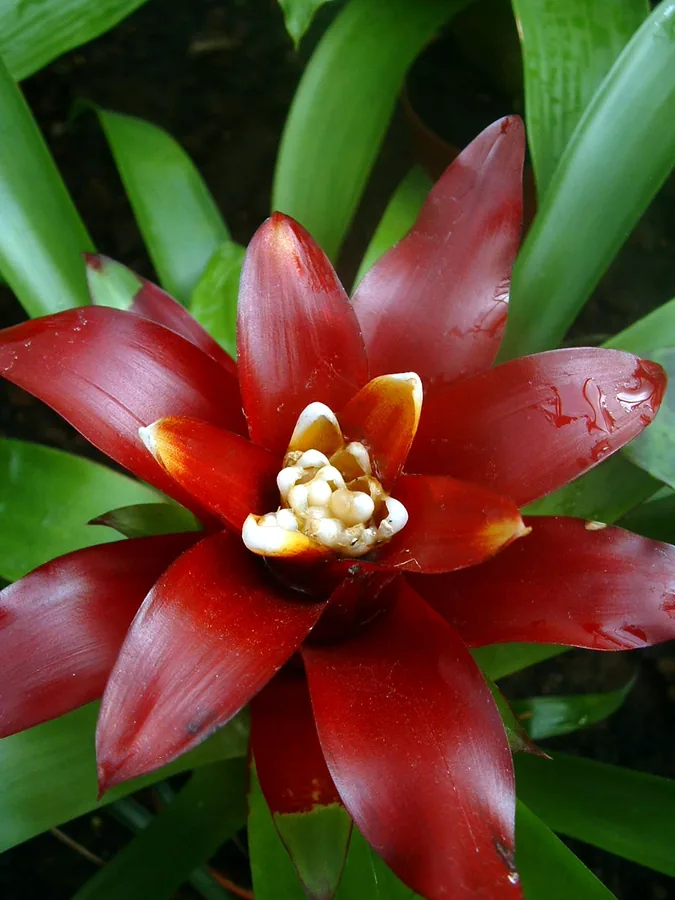
The guzmania, or scarlet star, is a bromeliad native to the rainforests of Central and South America, where it lives epiphytically on tree branches rather than rooted in the ground. Under cultivation it develops a symmetrical rosette of glossy, strap-shaped leaves whose overlapping bases funnel rainfall into a central tank. Its defining feature is the bright bract spike, commonly a vivid red, which arises from the rosette center and retains color for months.
The conspicuous display is a cluster of colored bracts, subtending true flowers that are small and short-lived within them. As an epiphyte the plant absorbs water and nutrients largely through the tank, so its root system functions mainly for anchorage rather than uptake, which explains why cultural success hinges on tank management. Once the watering regime is correct, the remaining requirements are undemanding.
One trait governs how the plant behaves over time. Each rosette is monocarpic, flowering once before senescing while producing pups at its base to continue the clone. The parent is not declining from ill health; it is completing its reproductive cycle, and those pups constitute the succeeding generation of plants.
Care
The short version: provide bright indirect light, keep the central tank charged with rainwater or distilled water, use a loose fast-draining mix whose surface is allowed to dry, and hold warm, humid air.
Light
Site the guzmania in bright indirect light, near a window but out of direct midday sun. It tolerates medium light and partial shade, yet insufficient light dulls the bract pigmentation and slows development, since the display depends on adequate irradiance. Direct sun, conversely, scorches the foliage.
Water
The tank governs irrigation. Maintain about 2 to 3 cm of water in it at all times, using rainwater or distilled water so dissolved minerals do not spot the leaves, and flush it every 1 to 2 weeks to prevent stagnation that invites rot. Allow the top few cm of the mix to dry between waterings, because the anchorage roots rot readily when kept saturated.
Soil
Grow it in a loose, fast-draining epiphytic mix of bark, perlite, and sphagnum, of the type formulated for orchids. Standard potting soil retains far more water than an epiphytic root system can tolerate. A slightly acidic pH of 5.0 to 6.0 matches its requirements.
Temperature
Ordinary interior warmth suits it, within 55°F to 81°F (13°C to 27°C). Protect it from cold drafts and chilled winter windowsills, and never let cold water stand in the tank, since low temperatures at the crown predispose it to rot.
Humidity
Reflecting its rainforest origin, the plant performs best when the air stays on the damp side, around 50% to 70%. Dry indoor air draws moisture from the leaf margins and browns the tips, so counter it by grouping plants, using a pebble tray, or running a humidifier nearby.
Feeding
Feed sparingly through spring and summer with a balanced liquid fertilizer diluted to quarter strength, applied to the soil and only lightly to the tank. The species is a light feeder, and higher concentrations accumulate and injure the tissue rather than help it.
Pruning
Pruning requirements are minimal. Remove browned leaf tips or spent outer leaves with clean scissors, and once the bract spike fades and the mother rosette begins to senesce, cut it out so its reserves redirect to the pups.
Repotting
Guzmania rarely warrants repotting and resents root disturbance. Intervene only to pot up rooted pups or to renew the medium every 2 to 3 years, transplanting when the plant wobbles, the mix has degraded, or pups crowd the container.
Size & spacing
A mature specimen stays compact, reaching only about 12 to 18 inches (30 to 45 cm) in height and a comparable spread. That restrained footprint accommodates a shelf, a desk, or a windowsill.
Troubleshooting
Most guzmania disorders resolve to water: either an excess held where it should not sit or a mineral-laden supply in the tank. The symptoms present at the rosette center, along the leaf margins, or in the bracts. Match the presentation below and intervene before rot advances through the crown.
Central crown turning soft, brown, and foul
A softening, sour center points to crown rot, which develops when water stagnates in the tank or a cold, saturated mix denies the roots oxygen. The diagnostic sign is central leaves that release with little resistance over a brown, malodorous base. Drain the cup, withhold water from the mix, and relocate the plant to warmer, brighter conditions with air movement to slow the pathogens. Where the mother is already senescing after bloom, abandon the rosette and establish its healthy pups, which carry the plant forward.
Fix:
- Empty the cup and stop watering the mix
- Move to a warmer, brighter spot with airflow
- If the mother is already declining post-bloom, separate and pot up any healthy pups instead of trying to save the rosette
Post-bloom bract fading with gradual rosette decline
A fading spike followed by gradual decline is the plant expressing its monocarpic life cycle, not a disorder. Each rosette flowers a single time and then senesces while initiating pups from the leaf axils at its base. Permit the mother to translocate reserves into those offsets, excise her once fully spent, and grow the pups on under bright indirect light to prime future flowering. A plant that has not yet bloomed but shows dull bracts is signaling a light deficit rather than disease.
Fix:
- Allow the mother to fuel the pups, then remove it once spent
- Grow on the pups and give bright indirect light to encourage future blooming
- If unbloomed and dull, move to brighter indirect light
Crispy brown leaf tips and edges
Desiccated tips reflect either insufficient atmospheric moisture or a mineral and fluoride buildup deposited in the leaf margins by hard tap water. The condition confines itself to the tips and edges while the tank and base remain firm and green, which distinguishes it from rot. Correct the humidity by grouping plants, using a pebble tray, or running a humidifier, and change the water source to rainwater or distilled water to stop the deposition. Cut the dead tissue with clean scissors, following the leaf's contour so the cut reads naturally.
Fix:
- Raise humidity with grouping, a pebble tray or a humidifier
- Switch to rainwater or distilled water for the cup and mix
- Trim dead tips with clean scissors following the leaf's natural shape
Toxicity
For pet-owning households the verdict is straightforward: the guzmania is entirely safe. The ASPCA classifies the scarlet star as non-toxic to cats and dogs, and it contains nothing harmful to other animals or to people. Elevating it out of reach protects the specimen, not the animal.
Safe for
People · Cats · Dogs · Horses · Rabbits · Livestock · Birds
Cats None
The species carries no compounds toxic to cats, so ingestion poses no poisoning risk. In practice the rigid leaf tips tend to deter sustained chewing.
Dogs None
No toxic principle is present for dogs, meaning a chewed leaf carries no chemical hazard. The likely outcome is cosmetic plant damage and, at most, transient gastrointestinal upset from the fiber.
Horses Safe
Nothing in the tissue is harmful to horses. Given its status as an indoor epiphyte, contact with a horse is improbable in any case.
Rabbits Safe
The foliage holds no toxin that would affect a grazing rabbit. Its tough, fibrous texture also makes it an unappealing forage.
Livestock Safe
No compounds present would trouble cattle, goats, or sheep. As a tender houseplant it remains outside their environment regardless.
Birds Safe
Pet birds may perch on and pick at the plant without chemical risk. Neither the foliage nor the colored bracts contain a toxic agent.
People Safe
No part is poisonous to children or adults. The plant is cultivated as an ornamental rather than a food crop, so it is displayed and not consumed.
No special handling required; stiff leaf tips can be mildly scratchy but pose no chemical hazard.
Varieties
Nearly all guzmanias in the houseplant trade are selections or hybrids of the scarlet star, separated chiefly by the color and form of their bracts. The following are the ones most frequently encountered.
Guzmania lingulata var. minor
A smaller, more compact form whose bright red-orange bract star accounts for most of the material offered in the retail trade.
Guzmania 'Rana'
A hybrid distinguished by broad, two-toned yellow-and-red bracts that open into a flattened rosette of color.
Guzmania 'Ostara'
Characterized by a tall, slender inflorescence of bright red bracts carried well clear of the green foliage.
How to propagate
There is no need to buy additional plants, since the guzmania reproduces itself through the pups the parent leaves behind. This vegetative route is the reliable means of perpetuating the bromeliad, given that each rosette flowers only once.
Offsets & pupsEasy
After the mother flowers and the pups reach about one-third to one-half the mother's size · Pups root in a few weeks but typically take 2-3 years to reach blooming size
Guzmania propagates vegetatively through pups, the basal offsets the mother generates after flowering. Allow each pup to attain roughly a third to a half of the mother's size and develop its own roots before severing it with a clean cut or a gentle twist, which gives it the reserves to establish. Pot each offset into a fast-draining epiphytic medium, maintain water in the central cup, and hold it in warmth under bright indirect light. Rooting follows within a few weeks, though a pup generally requires 2 to 3 years to reach blooming size.
Myths
Guzmania carries the same pet toxicity as most tropical foliage plants.
The scarlet star appears on the ASPCA's non-toxic listing for cats and dogs, and it contains no compounds known to injure pets. On that evidence it can be housed alongside companion animals without concern.
Post-flowering leaf browning and collapse indicate disease or terminal failure.
This represents no pathology. It is the expected monocarpic cycle, in which a rosette flowers once and then senesces while provisioning the pups that succeed it.