Houseplant · Bromeliaceae
Pineapple
Ananas comosus
Give it strong light, warmth, and a pot that drains fast, and a grocery-store crown turns into a houseplant that fruits.
Full sun
Every 7–14 days
55–90°F · 13–32°C
540–720 days
Overview
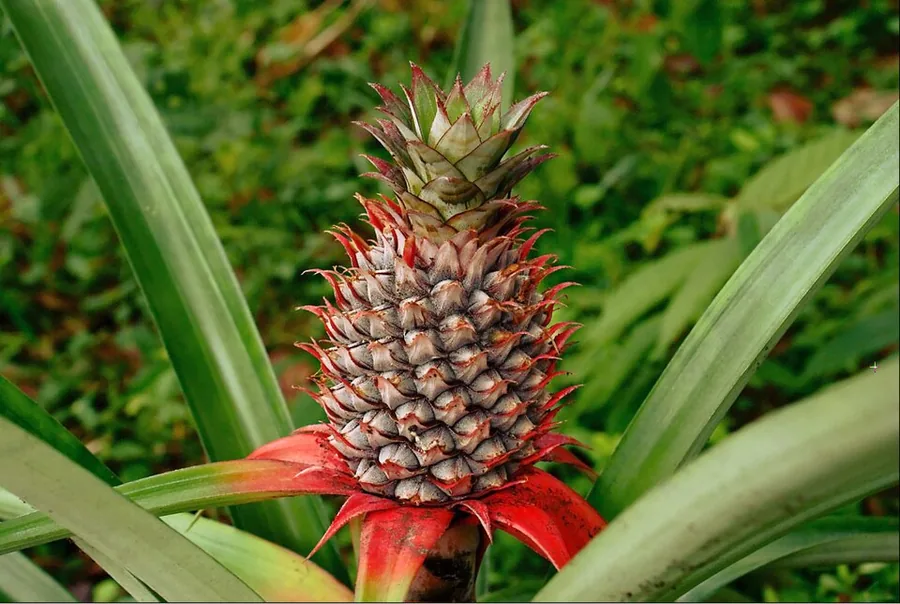
The pineapple is a bromeliad native to tropical South America, valued for its bold rosette of arching leaves as much as for the terminal fruit. It draws water and nutrients through both the roots and the central cup of the rosette, and that dual uptake is why it tolerates a missed watering yet suffers where the roots stay wet. Under indoor conditions it remains a slow, sculptural plant that demands little once the light regime is correct.
Fruiting is a long process. A plant needs 18 to 24 months to carry a crown to a ripe pineapple, and each rosette accomplishes this only once because the flowering shoot terminates that rosette before growth passes to its offsets. Most growers keep it for the foliage and regard fruit as incidental, though under strong light and with patience a windowsill crown can indeed fruit.
As a houseplant it holds its own on foliage alone. The leaves are stiff and architectural, the ornamental forms carry cream, green, and pink variegation, and the plant withstands neglect better than most. The one liability is the marginal spination, which is why it belongs where no one brushes past the leaf edges.
Care
The short version: provide as much bright light as possible, ideally full sun, water only after the top half of the pot has dried, and grow it in a light, fast-draining mix. Hold it warm, feed monthly through the growing season, and never allow water to stand in the central cup.
Light
Pineapple performs best under the maximum light available, full sun where practical and a bright window at minimum, because its pigment and vigor depend on that light budget. Deprive it and the foliage turns pale and lax, and fruiting becomes improbable.
Water
Allow the top half of the pot to dry before watering again, on a cycle of roughly every 7 to 14 days. As a bromeliad it withstands a dry interval far better than saturated roots, so err toward waiting. Do not leave water standing in the central rosette, particularly in cool weather, since that pooling is what initiates crown rot.
Soil
Grow it in a light, fast-draining mix, sandy or loamy and rich in organic matter, so excess water clears quickly and the roots are never held wet. It favors acidity, a pH of 4.5 to 6.5, consistent with its bromeliad root system.
Temperature
Maintain warmth between 55°F and 90°F (13°C to 32°C), treating 13°C as the effective floor. Cold combined with wet is what pushes a sound plant toward rot, so a steady warm position matters more than any single set point.
Humidity
Ordinary room humidity of 40% to 60% is sufficient, and no misting regime is required. The plant accepts normal indoor air without difficulty.
Feeding
Apply a balanced soluble fertilizer monthly through spring and summer while growth is active. Mature plants respond to a more nitrogen-rich feed when the aim is to drive vegetative growth.
Pruning
Intervention is minimal. Remove the dead and spent lower leaves at the base, and after fruiting cut away the old fruiting stalk, since that rosette has completed its cycle and will not fruit again.
Repotting
Pot on every 2 to 3 years, or sooner where roots emerge from the drainage holes, the plant becomes top-heavy, or water runs straight through without uptake. Its slow growth rate rarely calls for more frequent handling.
Size & spacing
Indoors it attains roughly 3 to 4 feet (90 to 120 cm) in height with a spread of 24 to 35 inches (60 to 90 cm). Allow the rosette enough clearance that no one contacts its spiny leaf margins.
Troubleshooting
Nearly every indoor pineapple problem resolves to water and light. Excess moisture, a light deficit, and an abrupt rise in heat account for most of the disorders that appear. Match the symptom below and correct the underlying cause before it progresses.
A collapsing, malodorous center with central leaves that release under light tension
This presents as crown or heart rot, the most serious disorder indoors, and it develops where water pools in the central cup or the substrate stays saturated during cool spells, since the low temperatures slow drying and favor rot organisms. Reduce watering, shift the plant into a fast-draining mix so the root zone is not held wet, and relocate it to a warm, bright position with air movement. Once the core has turned brown and slimy the growing point is destroyed and recovery is unlikely, so detach healthy basal pups and propagate them to continue the line.
Fix:
- Reduce watering and improve drainage immediately
- Move to a warmer, brighter location with good airflow
- If rot is advanced the plant is usually unsalvageable; harvest any healthy offsets/pups to start over
Foliage shifting toward yellow or a pale, chlorotic green
Loss of color points first to insufficient light, because a plant kept below its needs cannot hold full pigment, and an underfed plant fades in the same way from lack of nutrients. Relocate it to the brightest window or full sun to restore the light budget, and begin a monthly balanced feed through the growing season to correct the deficiency. Inspect drainage as well, since roots held in wet substrate are stressed and lose function, which reads on the leaves as the same fading.
Fix:
- Move to the brightest available spot or full sun
- Begin a regular balanced feeding schedule in the growing season
- Check that soil drains freely and is not constantly wet
Scorched brown tips and bleached patches on the exposed foliage
This is sunburn, and it appears when tissue adapted to a window is exposed to intense direct sun before it has acclimated, so the leaf cannot yet dissipate the added light load. Low humidity together with dry soil compounds the injury by limiting the plant's ability to cool itself. Raise the light over one to two weeks so the foliage adapts in step, and hold the substrate evenly moist through hot weather to support that cooling.
Fix:
- Acclimate gradually to stronger light over one to two weeks
- Maintain even soil moisture and moderate humidity
Toxicity
For a household with pets and children the assessment is favorable: pineapple is non-toxic, and the ASPCA lists it as safe for cats and dogs. The ripe fruit is edible for people and an acceptable treat for many animals. The genuine cautions are purely mechanical, the sharp spines along the leaf margins and the tingle of bromelain in unripe fruit, and neither amounts to poisoning.
Safe for
People · Cats · Dogs · Horses · Rabbits · Livestock · Birds
Cats None
The plant poses no poisoning risk to cats, so a curious animal is in no chemical danger. The only hazard is mechanical, since the stiff, toothed leaf margins can prick a nose or paw, which argues for a position out of batting range.
Dogs None
Dogs face no toxic risk, and a bite of the fruit causes no harm. The worst a chewer encounters is the bromelain tingle in unripe flesh and the sharp marginal spines, neither of which is poisoning.
Horses Safe
The plant is non-poisonous to horses, and it falls entirely outside a horse's normal diet. The rigid, spiny foliage further deters grazing, so the plant is left alone in practice.
Rabbits Safe
Rabbits can share the ripe fruit as an occasional small treat with no toxic concern. The tough, spiny leaves are best avoided, though their rigidity means a rabbit has no reason to browse them.
Livestock Safe
Cattle, goats, and sheep face no poisoning from the plant. The coarse spiny leaves are not worth eating, so the only real consideration is injury from the sharp edges.
Birds Safe
Birds are unaffected, and many will take a little of the ripe fruit without issue. Nothing in the plant is toxic beyond the firm, prickly foliage.
People Safe
The ripe fruit is a kitchen staple and entirely safe to eat. Unripe fruit and its bromelain can leave the mouth tingling, and the spiny leaves can scratch, so a little care in handling is warranted.
Leaf margins of many varieties bear sharp, recurved spines that can scratch or prick skin; unripe fruit and the bromelain enzyme can irritate the mouth if chewed, but neither constitutes pet poisoning.
Varieties
A limited set of pineapple cultivars recurs in cultivation, from the smooth commercial standard to the variegated forms grown for ornament. These are the ones worth recognizing.
Smooth Cayenne
The dominant commercial cultivar, distinguished by nearly spineless leaf margins and large cylindrical fruit that together make it straightforward to grow and handle.
Red Spanish
A Caribbean type marked by spiny leaves and squarish, aromatic fruit whose firm flesh withstands shipping and storage.
Queen
A compact, spiny cultivar favored for home culture, producing smaller fruit of high sweetness with deep yellow flesh.
'Variegata' / ornamental forms
Selected for cream-and-green striped foliage that often flushes pink, these forms are cultivated as ornamentals rather than for their fruit.
How to propagate
Pineapple is among the more rewarding plants to propagate, since the crown of a fruit already purchased supplies everything needed to raise a new plant.
Offsets & pupsEasy
Any time during warm active growth; pups are best taken once they are several inches tall · 6 to 12 weeks to root well
Detach the leafy crown from a store-bought fruit, or separate the slips and suckers borne at the base of a mature plant once they have reached several inches. Allow the cut surface to dry for a few hours so it can callus, then set the piece in a light, fast-draining mix and hold it warm and bright while roots form over roughly 6 to 12 weeks. Confining this to warm, active growth keeps metabolism high and lifts the strike rate.
Myths
A single pineapple plant fruits over and over from the same rosette.
A given rosette is monocarpic in effect: it flowers and fruits a single time, then declines. Subsequent crops arise from the offsets produced at the base, namely the pups, slips, and suckers, each of which matures and fruits in its own succession.
You have to start pineapple from seed to ever get fruit.
Seed is rarely the route to fruit. Pineapple is propagated vegetatively from the leafy crown or from offsets, which root faster and reproduce a known plant true to type, whereas seed is reserved for breeders developing new varieties.