Houseplant · Bromeliaceae
Blushing Bromeliad
Neoregelia carolinae
Keep the central cup charged with fresh water and site it in bright, indirect light, and the blushing bromeliad colors up indoors with minimal input.
Bright indirect
Every 7–14 days
50–90°F · 10–32°C
USDA 10–11
Overview
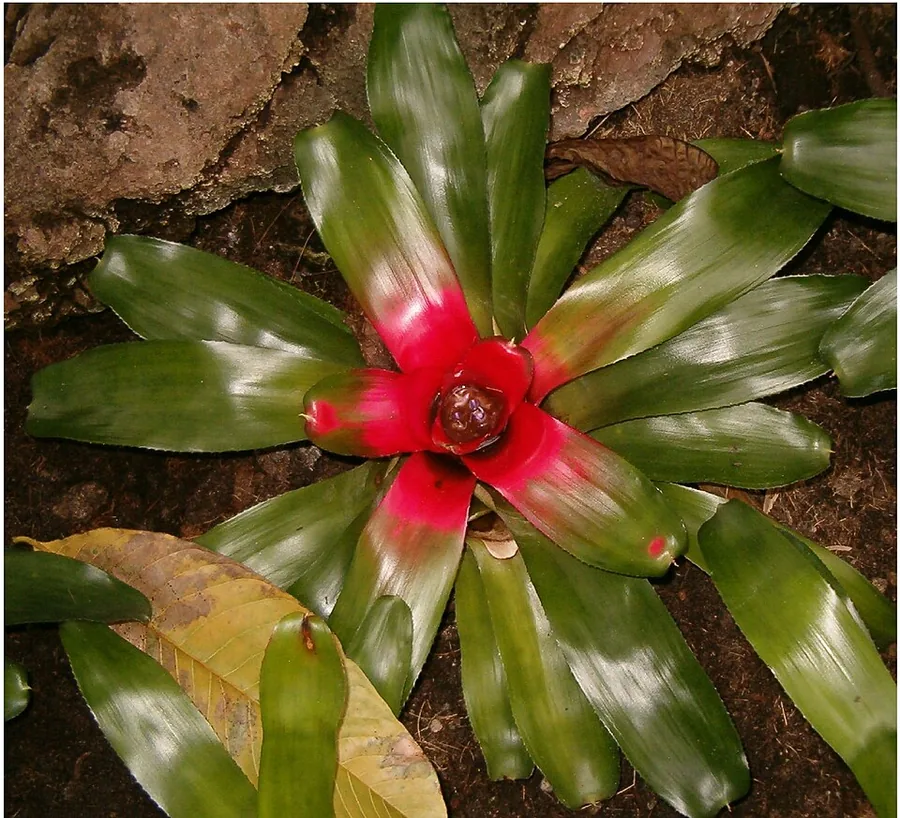
Neoregelia is a bromeliad grown chiefly for its rosette of broad, glossy foliage rather than a conspicuous inflorescence. At maturity the innermost leaves blush bright red or pink, and small flowers open low in the central cup. Because that coloration persists for months, the plant holds its display far longer than a typical flowering houseplant.
In habitat it grows as an epiphyte, anchored on tree branches and taking up water and nutrients through the leaves and the central tank rather than an extensive root system. That biology dictates its culture. The roots function mainly for attachment, which is why it needs a loose, fast-draining medium and a cup maintained with fresh water.
It performs as an easy houseplant because its requirements are modest and consistent. Provide warmth, humidity, and light that is bright yet never harsh, and it demands little else. Each rosette is monocarpic, flowering once before it slowly declines, but it produces pups that continue the clone for years.
Care
The short version: bright indirect light, a central cup kept charged with fresh water, and a loose bark mix that dries slightly between waterings, all in a warm, humid position.
Light
Site it in bright, indirect light, which keeps the rosette compact and drives the central coloration. It tolerates partial shade and gentle morning sun, but harsh midday radiation scorches the leaf tissue, while too little light causes the rosette to elongate and the blush to fade for want of energy.
Water
The functional core of watering is the central cup. Keep the tank at the center of the rosette filled with fresh water, ideally rainwater or distilled, and flush it weekly so it does not turn stagnant. Let the bark mix dry slightly between waterings, every 7 to 14 days, because the limited roots rot when the medium stays saturated and airless.
Soil
Use a loose, fast-draining epiphyte mix, such as equal parts peat, bark, and coarse sand, or a proprietary orchid bark medium. It prefers a slightly acidic pH of 5.0 to 6.5, and the open structure lets water drain quickly past the shallow roots so they stay aerated.
Temperature
It grows well in ordinary interior warmth, roughly 50°F to 90°F (10°C to 32°C). Keep it clear of cold drafts and chilled winter glass, since it has no tolerance for a hard chill and tissue damage follows quickly.
Humidity
It favors humid air, around 50% to 70%, in keeping with its epiphytic origins. Most interiors sit below that, so group it with other plants, stand it over a humidity tray, or run a humidifier where the air is dry.
Feeding
Feed lightly through spring and summer during active growth, about once a month. A dilute balanced liquid fertilizer at quarter to half strength, applied to the mix or misted on the leaves, suits its low nutrient demand, and feed poured into the cup is best avoided because it accumulates and fouls the water.
Pruning
Pruning need is minimal. Remove spent flowers and dead outer leaves for tidiness. Because the rosette is monocarpic and declines after flowering, cut the exhausted mother plant away once the pups are established and self-supporting.
Repotting
Repotting is seldom required given the small root system. Move it on only when the pups crowd the pot or the plant becomes top-heavy and unstable, stepping up to a slightly larger container with fresh bark mix.
Size & spacing
It stays compact, reaching about 6 to 12 inches (15 to 30 cm) tall with a spread of 12 to 20 inches (30 to 50 cm). That modest, spreading rosette accommodates a shelf or tabletop without crowding neighboring plants.
Troubleshooting
Nearly every disorder in this bromeliad traces to water or light. A waterlogged medium rots the base, excessive direct sun bleaches the foliage, and low light stretches the rosette and dulls the color. Match the symptom below to its cause and correct the condition before the problem advances.
Softened, rotting base with a failing rosette
This presents as crown or root rot, which develops once the mix holds water too long or the cup water sours, both of which starve the limited roots of air. Withhold water from the mix and let it dry, then empty the central cup and refill it with fresh water to halt the anaerobic conditions. Where the rot is confined to the roots, repotting into a loose, fast-draining bark medium restores airflow around the roots and the plant can pull through.
Fix:
- Stop watering the mix and let it dry
- Empty and flush the central cup with fresh water
- Repot into a loose, fast-draining bark mix if rot is limited to roots
Minute larvae writhing within the central tank
The standing water in the tank gives mosquitoes a breeding site once it sits undisturbed too long. Flush the cup with fresh water to carry the larvae out. For a persistent case, add Bacillus thuringiensis israelensis (Bti) granules, a larvicide that targets the larvae, and keep the water turning over through regular flushing so it never stagnates.
Fix:
- Flush the cup with fresh water to dislodge larvae
- Apply Bacillus thuringiensis israelensis (Bti) granules to the cup for larval control
Tacky residue, cottony deposits, or small nodes on the leaves
These signs point to mealybugs, scale, or spider mites, sap-feeding pests that read as cottony masses, brown bumps, or fine webbing and stippling on the foliage. Remove them by hand with a cloth or cotton swab, then treat with insecticidal soap or horticultural oil, which smother the soft-bodied stages. Quarantine the plant until the infestation clears to interrupt spread to nearby specimens.
Fix:
- Wipe pests off with a cloth or cotton swab
- Treat with insecticidal soap or horticultural oil
- Isolate the plant until the infestation clears
Bleached or brown patches on the leaves
These marks are sun scorch, the damage direct, intense light does to leaf tissue that is adapted to filtered light. Relocate the plant to bright indirect light or partial shade so the foliage is no longer overexposed, and trim the worst burned tips if the appearance bothers you. The chief hazard is harsh midday sun.
Fix:
- Move to bright indirect light or partial shade
- Trim badly burned leaf tips if desired
Elongated, lax foliage and faded central pigment
Insufficient light drives this: the rosette stretches as it reaches toward a weak source, and the central blush, which depends on strong light, fails to color up. Move the plant to a brighter position with ample indirect light. Adequate light keeps the rosette compact and the central pigment saturated.
Fix:
- Move to a brighter spot with more indirect light
Toxicity
For a household with animals, this is a non-toxic plant. The ASPCA lists the blushing bromeliad as safe for cats and dogs, and NC State Extension extends that to horses. The leaf tips are stiff and the cup water should be kept fresh, but no toxin is involved.
Safe for
People · Cats · Dogs · Horses · Rabbits · Livestock · Birds
Cats None
The ASPCA classifies this bromeliad as non-toxic to cats, so an exploratory nibble carries no chemical risk. Any pet that ingests a large volume of houseplant material can still show a transient gastrointestinal upset from the fiber alone.
Dogs None
Dogs face no toxic compounds in either the leaves or the cup water. The stiff leaf margins are a mechanical rather than a chemical concern, so a persistent chewer is worth monitoring.
Horses Safe
NC State Extension records it as non-toxic to horses, so a specimen in a barn or paddock presents no poisoning hazard.
Rabbits Safe
No toxin documented in this plant would injure a rabbit. It is not a forage species, however, so it should not be treated as part of a rabbit's ration.
Livestock Safe
Grazing stock such as cattle, goats, and sheep encounter no poisoning risk from this plant.
Birds Safe
The foliage contains nothing toxic to pet birds. The single point of hygiene is the water held in the central cup, which should be kept clean and fresh.
People Safe
It is safe to keep around children and to handle without gloves. The plant is not cultivated for consumption, and only the stiff leaf tips warrant any caution.
No special handling precautions for pets; the plant is non-toxic.
Varieties
A few Neoregelia selections appear most often in cultivation, distinguished chiefly by their leaf markings and coloration. These are the ones worth identifying by name.
Neoregelia carolinae 'Tricolor'
Its foliage carries longitudinal stripes of green, cream, and pink, with the central leaves reddening to bright red as the plant approaches flowering.
Neoregelia carolinae 'Blushing Bromeliad'
The type form, named for the central leaves that flush bright red and pink in the period just before flowering.
Neoregelia spectabilis (Fingernail Plant)
Each leaf terminates in a bright red apical tip resembling a painted fingernail, underlaid by felty silver banding on the abaxial surface.
How to propagate
Neoregelia propagates clonally through pups, so increasing your stock is largely a matter of waiting for the offsets to develop and potting them on.
Offsets & pupsEasy
After the mother rosette flowers and the pups reach about one-third the size of the parent · Several weeks to a few months
Following flowering, the mother rosette senesces and produces offsets, or pups, at its base as part of its natural monocarpic cycle. Allow each pup to reach about a third of the parent's size, at which point it carries enough tissue to sustain itself, then twist it free and pot it into a loose, fast-draining bark mix. Establishment and rooting take several weeks to a few months.
Myths
Bromeliads are parasitic plants that drain the trees they sit on.
Neoregelia are epiphytes, not parasites. A host tree supplies only physical support, while the plant absorbs its water and nutrients through the leaves and the central cup. It extracts nothing from the host and causes it no harm.
The tank water can be left untouched permanently without issue.
Undisturbed, that water stagnates and becomes a mosquito breeding site, a risk that rises outdoors. Flush the cup with fresh water on a regular cycle, and introduce Bti granules should larvae appear.