Houseplant · Bromeliaceae
Earth Star
Cryptanthus bivittatus
Match bright indirect light to steady humidity, and the earth star holds its pigment year round.
Bright indirect
Every 5–7 days
61–84°F · 16–29°C
USDA 10–12
Overview
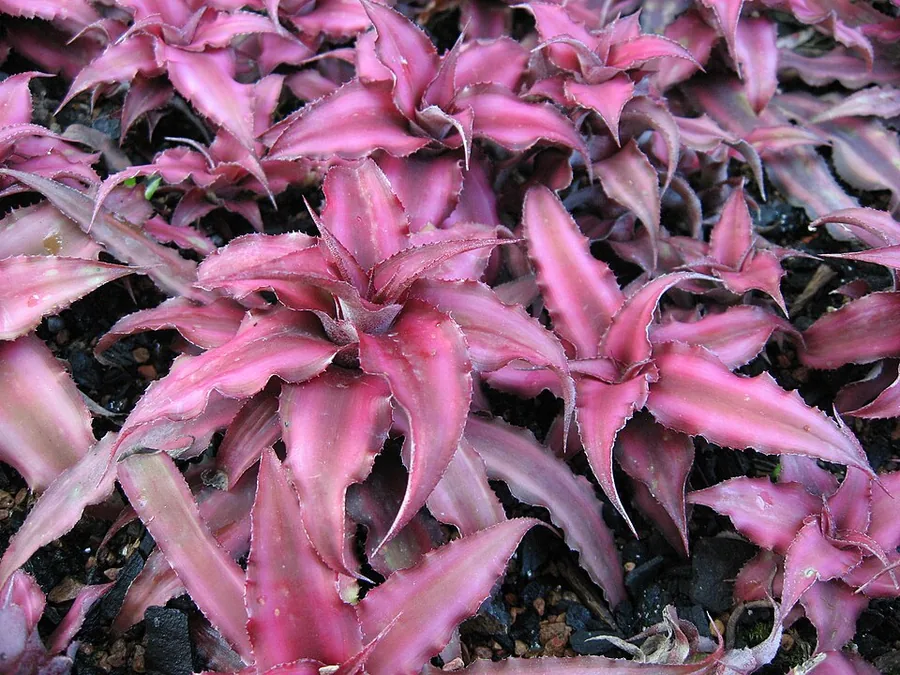
Cryptanthus bivittatus forms a low, flat rosette of stiff, wavy leaves arranged in the star shape that gives the plant its common name. It departs from the familiar tank bromeliads in one key respect: it roots in the ground rather than impounding water in a central cup, which is why growers class it as a terrestrial bromeliad. The green, pink, and red banding holds its intensity year round under indoor conditions.
Mature size stays modest, 3 to 6 inches (8 to 15 cm) tall and somewhat wider, a footprint that suits a small pot, a dish garden, or a terrarium. The plant grows slowly and is monocarpic in habit, so each rosette flowers a single time, lifting small white blooms from its center, then senesces as it diverts its resources into the pups that succeed it.
The care is straightforward once you account for its origins in warm, humid, partly shaded conditions. Direct sun overheats and bleaches the foliage, while deep shade starves the pigment that gives the leaves their color. Hold it between those extremes and the bright striping develops as it should.
Care
The short version: bright indirect light, a rich organic mix kept lightly moist but never waterlogged, warmth, and high humidity. Feed monthly through the growing season at reduced strength, and let each rosette raise the pups that replace it.
Light
Site the earth star in bright, indirect light, which matches the partly shaded conditions it evolved under. It tolerates medium light or partial shade, but pigment production falls off there, and harsh direct sun overheats and bleaches the foliage. A window screened by a sheer curtain delivers the right intensity.
Water
Hold the rich organic mix lightly moist but well drained, irrigating about every 5 to 7 days once the surface has dried slightly. Because the plant has no central tank to buffer it, the roots resent both full drought and a saturated crown, so do not let it dry out completely and do not pour water into the center, where standing moisture invites rot.
Soil
Use a rich, organic, well-drained mix, peat- or sphagnum-based rather than a dense standard potting soil that compacts and holds water. The plant prefers an acidic root zone, a pH of 5.0 to 6.0, and performs poorly in heavy media where drainage fails and the roots stay wet.
Temperature
Standard interior temperatures suit it, a range of 61°F to 84°F (16°C to 29°C). The species has no cold tolerance, so keep it clear of cold drafts and the chilled air against winter glass, both of which can check growth or damage the foliage.
Humidity
This bromeliad performs best at 50% to 70% relative humidity, above the level most heated or air-conditioned rooms hold. A pebble tray, a cluster of plants, or a terrarium raises the local moisture, and the leaf tips brown first when air movement from a vent dries them out.
Feeding
Feed monthly from mid-spring through early fall with a balanced water-soluble fertilizer diluted to roughly half strength. The slow growth rate means low nutrient demand, so suspend feeding once growth stalls in the cooler months to avoid salt buildup the plant cannot use.
Pruning
Pruning needs are minimal. Remove dead or damaged outer leaves as they occur, and once a rosette has flowered and entered decline, cut away the spent mother plant after its pups have established, since the parent will not recover.
Repotting
Repot every 2 to 3 years, or sooner if pups crowd the container, the mix dries unusually fast, or the rosette begins lifting out of the soil. The slow root development means the plant seldom outgrows its pot quickly, so frequent moves are unnecessary.
Size & spacing
It reaches only 3 to 6 inches (8 to 15 cm) in height and spreads 6 to 12 inches (15 to 30 cm) across at maturity. That compact, low-profile habit makes it well suited to shallow dishes, terrariums, and confined windowsill positions.
Troubleshooting
Nearly every earth star complaint resolves to a single cultural factor, light, water, or humidity, and the foliage registers the imbalance before it becomes serious. Identify the symptom below, correct the underlying condition, and the damage stops spreading. Pests are infrequent on this plant, but periodic inspection is sound practice.
Waxy white masses, hard scale bumps, or honeydew on foliage
Cottony tufts, hard bumps, or sticky residue indicate mealybugs or scale, whereas fine webbing in dry air points to spider mites instead. Examine the leaf bases and undersides, then wipe the insects away with a cotton swab dipped in isopropyl alcohol. Treat with insecticidal soap or horticultural oil as a follow-up, and isolate the plant until the infestation clears.
Fix:
- Wipe off pests with a cotton swab dipped in isopropyl alcohol
- Treat with insecticidal soap or horticultural oil and repeat as needed
- Isolate the plant until the infestation clears
Sun-bleached lesions on the leaves catching the most light
Excess light is the cause when the brightest leaves bleach or scorch, and harsh midday sun does the most damage. Direct radiation overheats the rosette and bleaches the most exposed leaves until the margins shrivel. Relocate the plant to bright but diffused light and limit it to gentle morning or evening sun.
Fix:
- Move to bright but diffused/indirect light
- Provide only gentle morning or evening sun and shield from intense midday sun
Muted pigmentation and pink striping turning flat
Insufficient light explains a muted, flattened look, because deep shade suppresses the pigments behind the bright pink and red striping. Move the plant to a brighter position with bright indirect light. Pigmentation recovers in the new growth that follows.
Fix:
- Move to a brighter spot with bright indirect light
Brown, desiccated leaf tips and margins on healthy foliage
Low humidity drives brown, crispy tips, particularly where the plant sits near a heat or air vent that pulls moisture from the foliage. The tips desiccate while the rest of the rosette stays sound. Move it clear of the air current, raise humidity with a pebble tray or by grouping plants, and keep the mix evenly moist.
Fix:
- Move away from heating/cooling vents
- Raise humidity with a pebble tray or grouping plants and keep the mix evenly moist
Toxicity
For pet-keeping households the verdict is favorable: the earth star is non-toxic. The ASPCA lists Cryptanthus as safe for cats and dogs, having identified no toxic principles in any part of the plant. The one physical consideration is the stiff, wavy leaf margin, which can lightly abrade skin but presents no chemical risk.
Safe for
People · Cats · Dogs · Horses · Rabbits · Livestock · Birds
Cats None
Safe in feline company. The ASPCA identifies no toxic principles, so a cat that bats at or chews a leaf is in no danger, though a large mouthful may produce minor stomach upset.
Dogs None
No hazard to dogs. The plant contains nothing poisonous to them, and the most a persistent chewer encounters is a brief, mild digestive upset from the fibrous leaves.
Horses None
Harmless to horses. With no toxins present, a nibble causes nothing worse than the mild upset any unfamiliar forage can provoke.
Rabbits None
Suitable around rabbits. No toxic compound is present, and the leaves carry no chemical risk should one sample them.
Livestock None
No risk to grazing stock. As a non-toxic bromeliad it contains nothing capable of harming cattle, goats, or sheep.
Birds None
Safe for pet birds. The plant holds no toxic compounds, so a bird that pecks at the rosette is unharmed.
People None
Non-toxic to people. The only point to note is the stiff, wavy leaf margin, which can lightly scratch small hands, while the plant is otherwise free of chemical hazard.
Leaves are stiff with wavy, sometimes finely toothed edges that can lightly scratch; no chemical hazard. As with any plant, nibbling may cause mild stomach upset.
Varieties
The species and its selections span a useful range of color and size, and a few forms recur often enough in cultivation to merit recognition. The following are the ones worth knowing.
Cryptanthus bivittatus var. atropurpureus
A darker color form of the species bearing deep reddish to purple-bronze foliage, recognized as a distinct variety in Kew's Plants of the World Online.
'Minor' (Dwarf Rose-Stripe Star)
A compact dwarf selection marked by rose-pink stripes along the leaves, included by the ASPCA among the non-toxic earth stars.
'Pink Starlite'
A widely grown cultivar with broad creamy-pink and green banded leaves whose pink deepens as light intensity rises.
How to propagate
Propagation is largely self-directed in this plant: each rosette generates a cohort of pups as it completes flowering, supplying the next generation without intervention.
Offsets & pupsEasy
After the mother rosette flowers and produces pups, typically anytime in the warm growing season · 4 to 8 weeks
Earth stars reproduce through offsets, or pups, that emerge at the center and base of the parent once it has flowered, generally within the warm growing season. Detach a pup carefully, set it into a moist organic potting mix, and maintain consistent moisture and humidity. Under those conditions it roots and establishes within 4 to 8 weeks.
SeedDemanding
Warm season under controlled humidity · Several months
Seed propagation is possible but slow and rarely attempted at home. Sown in the warm season under controlled humidity, the seedlings require several months to reach usable size, which is precisely why vegetative offsets remain the standard method.
Myths
As with tank-type bromeliads, earth stars are meant to be watered through a central reservoir.
Cryptanthus are terrestrial bromeliads whose flat rosette holds no water tank, unlike the cup-forming epiphytes. Water them at the roots in soil and keep the organic mix lightly moist, because pouring water into the center only risks rotting the crown.
As a bromeliad, the earth star is toxic to household animals.
The ASPCA classifies earth star (Cryptanthus) as non-toxic to cats and dogs, having identified no toxic principles. That makes it a sound selection for a household with animals that investigate plants.