Houseplant · Bromeliaceae
Flaming Sword
Vriesea splendens
As an epiphytic tank bromeliad, it feeds from its central cup, so keep that reservoir fresh and the color persists for months.
Bright indirect
Every 7–14 days
59–77°F · 15–25°C
USDA 10–12
Overview
Vriesea splendens is an epiphytic bromeliad from the Brazilian rainforest, where it grows lodged on tree branches rather than in ground soil. It gathers moisture and nutrients in the central cup formed by its overlapping leaf bases, a tank habit that dictates how it is watered and fed indoors.
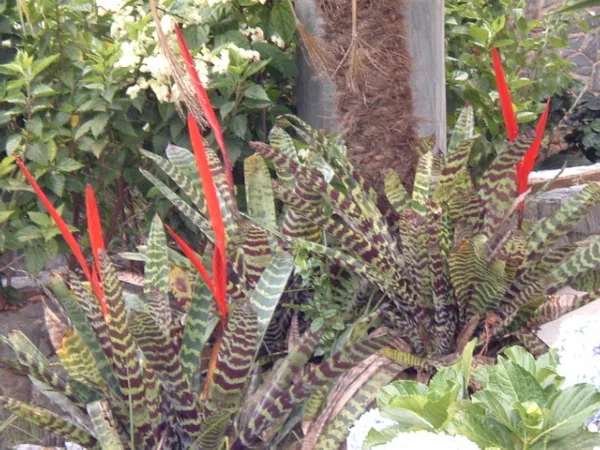
The ornamental draw is the flat, sword-shaped red bract rising from a rosette of strap leaves, the type form marked with purple-brown crossbands. That bract holds color for months while the true flowers, which are short-lived, emerge and fade in sequence. Growth is slow and the mature plant stays compact.
The genus is monocarpic at the rosette level: each rosette flowers once and then declines. Before senescing, it produces basal offsets, or pups, which succeed the parent. A single plant is therefore the start of a clonal succession rather than a one-time bloom.
Care
The short version: bright indirect light, a central cup kept topped with fresh water, warm stable temperatures, high humidity, and dilute feeding through spring and summer.
Light
Provide bright indirect light, the level found just off a window out of the direct beam. It tolerates partial shade or medium indirect light, though pigment develops best under brighter conditions. Harsh midday sun exceeds what the foliage can dissipate and bleaches it, so keep the plant back from the glass.
Water
Maintain the central cup filled with fresh, room-temperature water and flush it every week or two, since standing water in the tank turns anaerobic and invites rot. Allow the overflow to moisten the roots, then let the surface of the mix dry between waterings, because the shallow roots do not tolerate saturation. Use rainwater or tap water rested a few hours to shed chlorine.
Soil
Grow it in an airy, fast-draining bark mix formulated for orchids or bromeliads rather than dense soil. As an epiphyte its roots serve mainly to anchor, so a pH of 5.0 to 6.0 and free drainage matter more than fertility.
Temperature
Hold warm, stable conditions between 59°F to 77°F (15°C to 25°C), consistent with its tropical origin. It has little cold tolerance, so exposure to drafts, cold windows, or vents causes chilling injury.
Humidity
Keep humidity high, in the 50% to 70% range that matches its rainforest habitat. In dry indoor air transpiration outpaces uptake and the leaf tips brown, so grouped plantings, a pebble tray, or a winter humidifier all help.
Feeding
Feed through spring and summer at roughly monthly intervals with a half-strength balanced liquid fertilizer delivered to the cup. Avoid high-nitrogen formulas, which deposit soluble salts that accumulate on the foliage and scorch it.
Pruning
Pruning is minimal. Remove the flower spike once it fades and cut away dead or damaged leaves, then take out the spent mother rosette at the base after its pups are established, since the rosette will not regrow.
Repotting
Repotting is seldom needed, as the small root system prefers to be snug and rot risk rises in oversized pots. The usual reason is to establish pups individually in small, heavy, well-drained containers once they are self-supporting.
Size & spacing
Mature height runs 18 to 35 inches (45 to 90 cm) with a spread of 18 to 24 inches (45 to 60 cm), compact for a flowering bromeliad. A single rosette occupies its own pot and needs no additional spacing.
Troubleshooting
Most disorders in Vriesea are cultural, traced to water handling and light. Water left to stagnate in the cup drives rot, excess direct sun bleaches the foliage, and over-concentrated fertilizer scorches the tips. Identify the symptom below and correct the underlying condition.
Soft, malodorous crown with leaves that detach from the rosette
The presentation indicates crown and root rot, the principal cause of death in cultivated Vriesea. It develops when cold or stagnant water persists in the cup and the mix remains saturated, creating anaerobic conditions the tissue cannot withstand. Empty and flush the cup, extend the drying interval for the mix, and where the mother is beyond recovery, propagate on from its unaffected pups.
Fix:
- Empty and flush the central cup, then refill with fresh tepid water
- Let the potting mix dry out more between waterings
- If the mother is severely rotted it cannot be saved -salvage and pot up healthy pups
Cottony white colonies or brown limpet-like scale with sticky residue
White cottony masses are mealybugs and the fixed brown limpets are scale, both sap-feeding insects that shelter at the leaf-cup junction and excrete honeydew. Remove them with a cotton swab charged with isopropyl alcohol, rinse the foliage, and re-inspect weekly, since residual crawlers re-establish quickly.
Fix:
- Wipe pests off with a cotton swab dipped in isopropyl alcohol
- Rinse the foliage and improve air circulation
- Repeat weekly until clear; avoid pesticides not labeled safe for bromeliads
Discrete dark lesions enlarging across the leaf surface
These lesions point to fungal or bacterial leaf spot, which establishes under stagnant, humid air when free water sits on the foliage. Excise the affected leaves, increase ventilation to dry the surfaces, and keep the tank water moving rather than static to limit spread.
Fix:
- Remove affected leaves
- Improve air circulation and avoid wetting foliage in low light
- Keep water moving through the cup rather than stagnant
Bleached, desiccated patches concentrated on the illuminated side
The pale, dry patches are sun scorch, photobleaching from light intensity beyond what the leaf can process, and they localize on the side facing the source. Relocate the plant to bright indirect light or partial shade and trim the necrotic tips, which will not recover pigment.
Fix:
- Move to bright indirect light or partial shade
- Trim badly scorched leaf tips
Crusty white residue with tip necrosis following fertilization
This is fertilizer salt accumulation, typically from over-concentrated or high-nitrogen feeding whose soluble salts crystallize on the foliage and desiccate the tips. Flush the cup and mix thoroughly with clean water to leach the salts, then resume feeding only at half strength and sparingly.
Fix:
- Flush the cup and potting mix with clean water
- Feed only dilute (half-strength) fertilizer sparingly
Toxicity
For households with animals, Vriesea is reassuring: the ASPCA lists the flaming sword and bromeliads generally as non-toxic to cats and dogs, and no toxic principle is reported. The leaves are smooth, spineless, and free of irritant sap, so there is no exposure risk to manage.
Safe for
People · Cats · Dogs · Horses · Rabbits · Livestock · Birds
Cats None
The ASPCA classifies the flaming sword as non-toxic to cats, so an exploratory nibble carries no toxic risk. A cat that consumes a large quantity may vomit, a mechanical response any fibrous plant can provoke rather than a poisoning.
Dogs None
Dogs are likewise unaffected, as the smooth foliage contains no toxic compound. The most a persistent chewer would experience is transient, mild gastrointestinal upset from the ingested fiber.
Horses Safe
This bromeliad poses no toxicological hazard to horses. As a tender houseplant it rarely enters their environment, and an incidental mouthful would be tolerated without harm.
Rabbits Safe
Rabbits may sample a leaf without risk, since the plant contains no toxic constituent. Their intake should remain centered on hay and greens, with this treated as an occasional novelty.
Livestock Safe
Cattle, goats, and sheep would sustain no injury from ingestion. Contact is improbable given its status as an indoor plant, but a bite would nonetheless be safe.
Birds Safe
Pet birds may perch in or nibble the foliage without consequence, as no part is poisonous. The spineless, sap-free leaves make it well suited to placement near an aviary or cage.
People Safe
The flaming sword is safe in a household with children and can be handled without gloves, having no irritant sap or spines. It is cultivated ornamentally rather than for consumption, so ingestion serves no purpose.
Spineless, smooth-leaved bromeliad with no irritant sap -safe to handle and keep around pets.
Varieties
The flaming sword label covers several related Vriesea, some selected for the inflorescence and others for foliar banding. The following are the forms most often offered.
Vriesea splendens 'Flaming Sword'
The type species that lends the group its name, bearing dark green leaves crossed by purple-brown bands beneath a flat, sword-shaped red bract held erect.
Vriesea carinata (Lobster Claw)
Its plain green foliage provides a foil for a branched, boat-shaped inflorescence marked in red and yellow.
Vriesea fosteriana
Selected primarily as a foliage plant, its broad leaves carry bold maroon banding valued above the bloom.
Vriesea 'Christiane'
A compact hybrid that produces a branched yellow-and-red inflorescence, suited to limited space.
How to propagate
Vriesea is propagated almost entirely by the basal pups it sets after flowering, the reliable method. Seed is feasible but slow and best confined to specialist growers.
Offsets & pupsModerate
After flowering, once the mother plant produces basal pups · Several months to over a year to reach blooming size; Vriesea pup more slowly than most other bromeliads
Division of basal pups is the standard means of increasing Vriesea. Allow an offset to reach roughly a third the size of the mother and form a few roots of its own, then separate it with a twist and pot it into a small, well-drained bromeliad or orchid mix. Expect a slow interval afterward, as Vriesea offset more slowly than most bromeliads and require several months to over a year to reach blooming size.
SeedDemanding
Rarely used; spring · Several years to reach maturity
Seed propagation is a specialist undertaking. It is slower and less reliable than pup division, and seedlings need several years to reach maturity, so it is rarely attempted in the home.
Myths
Bromeliads must be watered through the central cup alone and never through the soil.
The cup should stay filled, but it is anatomically built to overflow and conduct water down to the roots. The mix still requires occasional irrigation and, above all, free drainage so the roots are never held saturated. Irrigate both the cup and the mix, and keep drainage decisive.
The plant is dying and should be discarded once the flower bract fades.
Each rosette is monocarpic, flowering once and then declining as a matter of its biology, not a fault in culture. Before it senesces it produces basal pups that mature into full replacements. Retain the plant and grow on the pups to sustain the clone indefinitely.
The flaming sword is hazardous to cats and dogs.
The ASPCA lists Vriesea and the flaming sword as non-toxic to both cats and dogs, with no toxic principle on record. It ranks among the safest flowering plants for a pet household.