Houseplant · Araceae
Alocasia 'Polly'
Alocasia × amazonica 'Polly'
Supply warmth, humidity, and bright indirect light, and the African mask plant returns striking arrowhead foliage.
Bright indirect
USDA 10–12
1–4 ft · 0.3–1.2 m
Overview
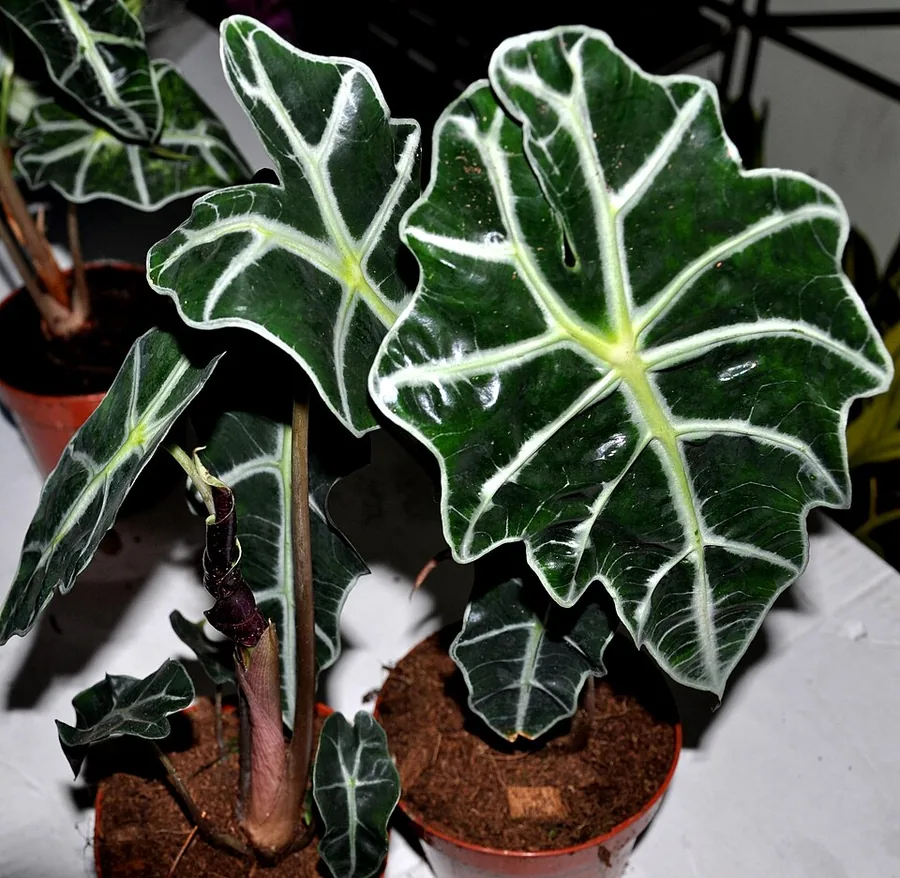
Alocasia 'Polly', marketed as the African mask plant, is cultivated for foliage rather than flowers. Each leaf is a glossy arrowhead in deep bronze-green, finished with a softly waved margin and cut through by thick white veins that read almost as paint. It holds a compact habit at roughly 2 feet tall, which suits a bright corner or a shelf.
It belongs to the Araceae family and is a hybrid selected for indoor growing, adapted to the warm, humid, bright conditions of its tropical parentage. Those origins also explain why it asks more than the average houseplant. It needs steady moisture without ever standing wet, humidity above typical room levels, and warmth through the year, so matching the site to those requirements before you acquire one pays off.
The behavior that misleads most growers is the winter rest. As light declines, the plant enters semi-dormancy and may shed most of its foliage, presenting as a dead plant. It is not. Cut back the water, hold it warm, and it produces new leaves when spring returns.
Care
The short version: bright indirect light, soil held evenly moist but never soggy, warmth above 60°F (15.6°C) year-round, and humidity above the average room. Reduce watering through winter while the plant rests.
Light
Position it in bright, indirect light, such as the illumination at an east window or back from a stronger exposure. Partial shade and mild sun are tolerated, yet unfiltered sun burns the foliage and heavy shade weakens it into thin, stretched growth.
Water
During active growth, maintain soil that is evenly moist but never soggy, allowing the top to firm up a little before the next drink. Scale watering back hard once the plant rests in winter, since standing moisture suffocates the roots and brings on the rot of root and stem that is the leading cause of death here.
Soil
Use rich, loamy soil that retains moisture yet drains freely, amended with ample organic matter. It accepts a wide acidity range, anywhere from pH 5.5 to 7.5, but it will not tolerate a mix that stays waterlogged.
Temperature
Warmth matters throughout the year. Hold it above 60°F (15.6°C) and away from cold drafts and chilled windows. Temperatures below about 50°F (10°C) trigger early dormancy and can injure the plant.
Humidity
This is a high-humidity tropical, and dry indoor air produces brown, crispy leaf edges as transpiration outpaces uptake. Raise ambient moisture with a humidifier, a pebble tray, or a cluster of plants, and keep it away from heating vents.
Feeding
Apply a balanced houseplant fertilizer through spring and summer during active growth. Stop completely in winter, when the dormant plant is not taking up nutrients and excess can build up in the soil.
Pruning
Cut away yellowed, damaged, or spent leaves at the base as they appear. Entering winter indoors, you can reduce the plant to the top one or two leaves as it goes dormant.
Repotting
Move it up every 1 to 2 years, advancing the schedule if roots wrap the rootball, offsets fill the surface, or watering intervals shorten noticeably. Leave it in its container through all seasons instead of lifting it for storage as a bare corm.
Overwintering
Bring it indoors before the first fall frost and expect semi-dormancy, frequently with leaf drop. Keep it on the drier side, reduce it to the top leaf or two, and resume watering and feeding when growth restarts in spring.
Size & spacing
Indoors it remains compact at 1 to 4 feet (30 to 120 cm) tall with a spread of 12 to 24 inches (30 to 60 cm). Allow it space to hold its leaves clear without crowding a shelf or neighboring plants.
Troubleshooting
Nearly every problem on this plant traces to water, humidity, or pests. The leaves and the stem base are your earliest indicators of whether watering is excessive, the air is too dry, or something is feeding on the foliage. Match the case below and intervene before it advances.
Wilting leaves and a soft, mushy stem base
This is root and stem rot, and it follows directly from overwatering or soil that fails to drain. Waterlogged soil starves the roots of oxygen, so the tissue dies and pathogens move in, turning firm white roots brown and slimy and softening the base of the stem. Withhold water, remove the plant, excise every rotted root back to clean tissue, and repot into fresh, free-draining mix in a container with a working drainage hole.
Fix:
- Stop watering and allow the soil to dry appropriately
- Remove the plant, cut away rotted roots/tissue, and repot into fresh, well-drained mix
- Ensure the pot has drainage and discard standing water
Speckled or webbed leaves and sticky or cottony patches
Sap-feeding pests are draining the foliage. Webbing paired with pale flecking points to spider mites, whose populations climb fastest in dry indoor air; white woolly tufts wedged into the leaf joints mark mealybugs, and soft bodies massed under a tacky residue mark aphids. Hose down the leaves, remove the pests by hand, follow with insecticidal soap or horticultural oil, and quarantine the plant until no trace remains.
Fix:
- Rinse foliage and wipe off pests
- Treat with insecticidal soap or horticultural oil, repeating as needed
- Isolate affected plants to limit spread
Leaves dropping as the days get shorter
What you are seeing is winter semi-dormancy, a survival strategy rather than a decline. Falling light and cooler rooms slow photosynthesis, so the plant withdraws resources into the rhizome and sheds the foliage it can no longer support, while the rhizome itself stays firm below the surface. Reduce watering to match the lower demand, cut down to a leaf or two, hold it warm and bright, and resume normal watering once active growth returns in spring.
Fix:
- Reduce watering and keep the plant on the drier side while semi-dormant
- Cut back all but the top one or two leaves
- Keep in a warm, bright location and avoid cold drafts
- Resume regular watering and fertilizing when growth resumes in spring
Brown, crispy edges while the leaf center stays green
Dry air is the typical cause, because this is a high-humidity tropical and low humidity drives transpiration faster than the roots can replace water at the leaf margins. The damage concentrates at edges and tips and shows worst near heat vents or through winter, when indoor air loses moisture. Raise humidity with a humidifier, a pebble tray, or grouped plants, hold the soil evenly moist, and move it clear of drafts and radiators.
Fix:
- Raise ambient humidity (group plants, use a humidifier or pebble tray)
- Keep soil evenly moist during active growth
- Move away from heating vents and cold drafts
Toxicity
Treat this as a truly poisonous plant. Throughout its tissue sit insoluble calcium oxalate crystals, needle-shaped raphides that pierce soft tissue and sting on chewing, while the sap can leave bare skin inflamed. Keep pets, livestock, and children away from it, and rinse your hands once you have handled it.
Toxic to
Cats · Dogs · Horses · Rabbits · Livestock · Birds · People
Cats Moderate
When a cat bites a leaf, the calcium oxalate crystals embed in the soft tissue and burn the mouth at once. Watch for heavy drooling, pawing at the face, vomiting, and difficulty swallowing.
Dogs Moderate
A dog that chews any part meets intense oral pain, drooling, and vomiting within moments. The mouth, tongue, and lips may swell, which interferes with swallowing.
Horses Moderate
The same crystals inflame a horse's mouth and throat, producing drooling and painful, swollen lips and tongue. Horses cannot vomit, so the irritation persists until it resolves on its own.
Rabbits Toxic
The crystals make the foliage a painful mouthful for a rabbit, triggering oral irritation, drooling, and refusal to feed. Site the plant well out of reach.
Livestock Toxic
Cattle, goats, and sheep that browse the leaves develop a burning mouth, heavy salivation, and a swollen, painful tongue. The irritation discourages further feeding.
Birds Toxic
A bird that pecks at the leaves encounters the same stinging crystals, with oral irritation and drooling the probable result. There is no reason to allow a bird access to it.
People Caution
Nothing on this plant should be eaten; chewing it produces a sharp burning sensation through the mouth and throat. Even contact with the sap can redden and itch the skin, so rinse your hands afterward and site it beyond the reach of young children.
All parts contain insoluble calcium oxalate crystals; sap can cause contact dermatitis. Wash hands after handling and keep away from pets and children
Helpline numbers

United States
ASPCA Animal Poison Control: (888) 426-4435 (fee applies)
Poison Control: (800) 222-1222



Canada
Poison Centres: 1-844-764-7669
Varieties
The plant traded under the 'Polly' name represents a single cultivar drawn from one hybrid, and a closely related selection of the same parentage occasionally turns up. The names below are the ones to recognize.
Alocasia × amazonica 'Polly'
The compact cultivar in widest cultivation, topping out near 2 feet tall, with leathery, wavy-margined arrowhead leaves in dark bronze-green and prominent white to silvery veins.
Alocasia × amazonica 'Boa'
A distinct cultivar of the same hybrid, documented in the Missouri Botanical Garden Plant Finder alongside 'Polly'.
How to propagate
Home propagation is not done from seed. Instead you divide the plant, working with the pups it forms around the base, which is most straightforward at repotting during the warmer months.
DivisionModerate
Spring to summer, at repotting · Several weeks
The most reliable method is division at repotting in spring or summer. The plant grows from a rhizome and produces small pups around the base, so separate the clump and pot each section that carries its own roots. Allow the divisions several weeks of warmth and consistent moisture to establish before new growth appears.
Offsets & pupsModerate
Spring to summer · Several weeks
Another option is to remove single rooted offsets from the parent in spring or summer and grow each in its own container. A pup takes several weeks to anchor and settle, so hold it warm and lightly moist across that stretch.
Myths
A leafless Alocasia 'Polly' that has dropped its foliage over winter is dead.
This plant enters semi-dormancy each winter and routinely sheds most or all of its leaves as a seasonal response. Unpot it and inspect the rhizome before discarding it. A rhizome that remains firm will generate new leaves once warmth and watering resume in spring.