Houseplant · Araceae
Arrowhead Plant
Syngonium podophyllum
Vigorous and quick to establish, the arrowhead plant climbs or trails to suit its support, provided it receives bright indirect light.
Bright indirect
64–81°F · 18–27°C
USDA 10–12
3–6 ft · 0.9–1.8 m
Overview
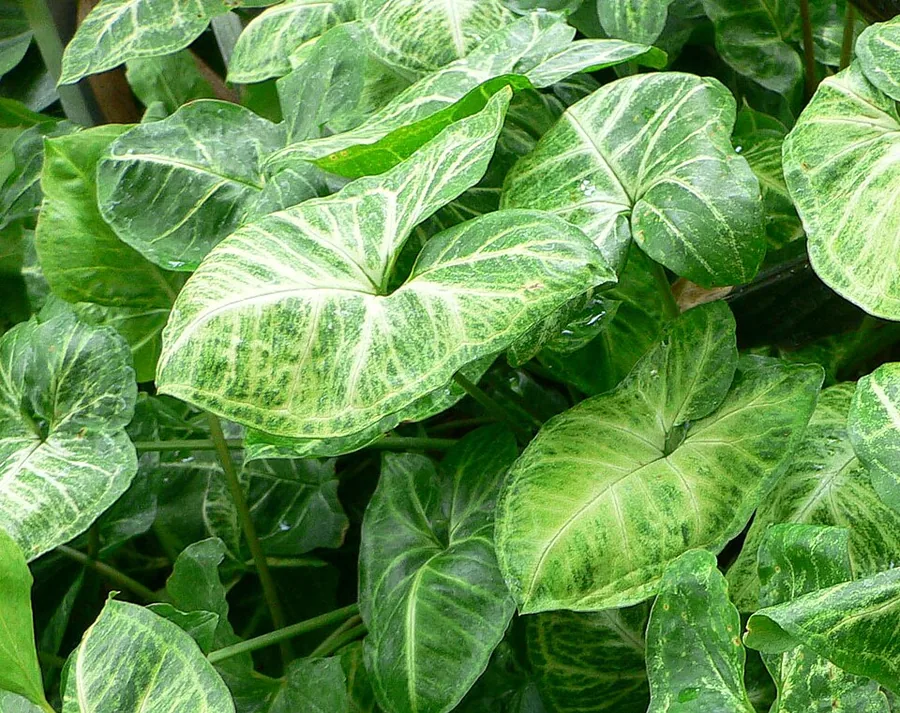
The arrowhead plant takes its name from the sagittate young leaves it produces on a low, shrubby juvenile. As a member of the arum family native from Mexico through tropical America, Syngonium podophyllum carries the broad environmental tolerance typical of understory aroids, which is why it forgives the irregular conditions of indoor culture. Selection has produced green, variegated, and pink-veined forms, so leaf character varies widely across the trade.
Its habit shifts with maturity, and understanding that shift explains much of its care. The compact juvenile transitions to a climbing vine, the internodes lengthening and the foliage developing into compound leaves of several leaflets as the plant reaches for vertical support. That climbing drive is what you are managing: route it up a moss pole, let it descend from a hanging basket, or pinch the growing tips to redirect energy into a dense, branched mound.
Its demands are modest because its native niche is forgiving. Bright indirect light, an evenly moist root zone, and warm air satisfy it, and stored reserves in its fleshy stems buffer the occasional lapse in watering. The exception is the sap, which contains calcium oxalate crystals that mechanically irritate mucous membranes and skin, so site the plant beyond the reach of pets and small children.
Care
The short version: provide bright indirect light, hold the root zone evenly moist but never saturated, and keep the air warm and humid. Reduce watering as growth slows in winter, and supply a pole or basket once the vining habit asserts itself.
Light
Provide bright, indirect light to drive the best leaf color and the densest growth, since adequate light supports the variegation and compact internodes you want. It persists in medium and even low light, though growth thins, but direct sun scorches the leaves because the foliage is not adapted to high irradiance, so keep it off a hot window.
Water
Hold the soil lightly moist but never soggy through active growth, watering once the surface dries to admit air to the roots. Reduce watering from fall through late winter, because the plant's lowered demand means saturated soil lingers and progresses quickly to root rot.
Soil
Use a light, well-draining potting mix built on a soil base. Drainage is the decisive factor here, since the roots respire poorly in standing water and a waterlogged medium is the most reliable way to lose this plant.
Temperature
It performs across ordinary room warmth, roughly 64°F to 81°F (18°C to 27°C), the band that matches its tropical origin. Shield it from cold drafts and chilled winter glass, since it carries no frost tolerance and chilling injury sets in below its range.
Humidity
As a tropical species it favors high humidity, ideally 60% or more, which reduces transpirational stress and keeps leaf margins intact. It endures average household air, but the foliage holds its quality near a humidifier or in the elevated moisture of a bathroom or kitchen.
Feeding
Fertilize only during active growth in the warmer months with a balanced foliage-plant fertilizer, matching input to the period of nutrient uptake. A few applications across the growing season meet its needs, and feeding should cease once growth slows in fall to avoid salt accumulation.
Pruning
It tolerates hard cutting back because dormant nodes break readily into new shoots. Pinch and prune to shape it, whether the goal is a compact mound, a trailing basket, or a vine trained up a moss pole or trellis, since each cut redirects growth to lower buds.
Repotting
Repot only when the plant outgrows its container and root mass crowds the pot, since this species shows no benefit from disturbance on a calendar. There is no fixed schedule; step it up one pot size when the root system signals constraint.
Size & spacing
Indoors it attains roughly 3 to 6 feet (91 to 183 cm) as a climbing or trailing vine, with a spread near 1 to 2 feet (30 to 61 cm). Allow room for the vining stems or provide a support to climb, and maintain air movement around the canopy to limit foliar disease.
Troubleshooting
Arrowhead plants are resilient, and the great majority of their disorders resolve to a fault in light or moisture. Diagnose from the early expression on the leaves and stems, match it to the entries below, and correct the underlying cause before secondary damage follows.
Softening, decaying stems and roots at the base
Saturated, poorly aerated soil predisposes the plant to soft rot, a bacterial decay that liquefies stem and root tissue. Excise the affected tissue, then correct the predisposing condition: move to a light, well-draining mix and ensure the pot drains freely. Curtail watering through fall and winter, when reduced transpiration leaves the medium wet far longer.
Fix:
- Remove affected tissue
- Improve drainage and avoid waterlogged soil
- Reduce watering, especially from fall through late winter
Faded, sun-scorched patches on the foliage
Excess direct sun exceeds the photoprotective capacity of these shade-adapted leaves, bleaching pigment and scorching tissue where irradiance is highest. Relocate the plant to bright indirect light or dappled shade, and the subsequent foliage will emerge undamaged.
Fix:
- Move plant out of direct sun to a bright indirect or part-shade location
Dark necrotic spots advancing across the foliage
Discrete necrotic lesions typically indicate bacterial leaf spot, which disseminates in films of water on the foliage. Remove the marked leaves and keep the foliage dry thereafter to deny the pathogen its dispersal medium. Adequate air movement around the plant accelerates drying and does most of the work of containing it.
Fix:
- Remove affected leaves
- Avoid wetting foliage and improve air circulation
Webbing, cottony masses, and deformed sticky shoots
Several common arthropods colonize arrowhead plants, each diagnosable by its signs. Spider mites produce stippling and fine webbing as they feed, mealybugs form white cottony masses, aphids aggregate on soft new growth, and scale fixes to stems as hard immobile bumps. Isolate the plant on detection to halt spread, dislodge the pests by washing, and follow with an appropriate insecticidal control.
Fix:
- Inspect and isolate the plant
- Wash off pests and treat with an appropriate insecticidal control
Elongated stems trailing, foliage thinning out
This is the ontogenetic shift of the arrowhead plant, not a culture fault. The juvenile is bushy and compact, but on maturity it expresses its natural vining habit, the internodes elongating so the stems stretch and trail in search of support. Provide a moss pole or trellis to climb, allow it to cascade from a hanging basket, or pinch the stems back to force lateral branching and hold a fuller form.
Fix:
- Provide a moss pole or trellis for the plant to climb
- Grow in a hanging basket to let stems cascade
- Prune or pinch stems to keep the plant compact and bushy
Toxicity
Treat this as a plant to site out of reach. Every tissue carries insoluble calcium oxalate crystals, raphides that release on chewing and produce immediate oral irritation. The sap irritates skin on the same mechanism, so handle cuttings with care and position the plant where pets and children cannot access the foliage.
Toxic to
Cats · Dogs · Horses · Rabbits · Livestock · Birds · People
Cats Moderate
A cat that bites a leaf experiences the irritation almost immediately, as the raphides embed in oral tissue. Anticipate heavy drooling, pawing at the mouth, and a sore, swollen tongue and lips, frequently followed by vomiting and difficulty swallowing.
Dogs Moderate
Dogs respond on the same mechanism as cats. The mouth is irritated on contact, so expect drooling, swelling about the lips and tongue, vomiting, and reluctance to swallow.
Horses Moderate
The crystals irritate the equine mouth and throat, producing drooling, swelling, and difficulty swallowing. Horses are physiologically unable to vomit, so the signs remain confined to the mouth and gut.
Rabbits Toxic
Site the arrowhead plant well beyond a rabbit's reach. The calcium oxalate crystals that affect cats and dogs irritate a rabbit's sensitive mouth and gut on the same basis, and it is not a safe forage to offer.
Livestock Toxic
Grazing animals that chew the foliage take in a painful load of oxalate crystals, with drooling and oral swelling the typical outcome. Exclude the plant from any livestock liable to browse it.
Birds Toxic
The sap presents the same hazard to birds. A pet bird that samples the leaves can develop equivalent oral irritation and swelling, so keep cages and perches away from the plant.
People Caution
No part of this plant is edible. Chewing a leaf produces a sharp burning in the mouth, and the sap irritates skin on contact, so wash the hands after taking cuttings and keep it from small children.
All parts contain insoluble calcium oxalate crystals; sap can irritate. UF/IFAS notes the toxic sap makes mechanical handling (e.g., string trimming) inadvisable outdoors
Helpline numbers

United States
ASPCA Animal Poison Control: (888) 426-4435 (fee applies)
Poison Control: (800) 222-1222



Canada
Poison Centres: 1-844-764-7669
Varieties
Breeders have selected the arrowhead plant chiefly for leaf color and pattern, a range running from near-white through bright green to deep pink venation. The cultivars below are among those you will encounter in cultivation.
'White Butterfly'
Its greenish-white blades carry creamy white-yellow venation against a dark green margin, the lightest coloration in the group.
'Pink Allusion'
A Florida selection, it runs deep pink venation down the midline of light olive-green leaves, and the pigmentation persists rather than fading with leaf age.
'Robusta'
A named cultivar maintained in the commercial Syngonium trade under UF/IFAS production guidelines.
'Neon'
A further commercial selection cited in the UF/IFAS production guidelines for interiorscape Syngonium.
'Lemon Lime'
A production cultivar from the same UF/IFAS guidelines, designated for its bright green leaf color.
How to propagate
Few aroids clone as readily. The nodes carry latent root initials, so a cutting taken in the warm season roots with little intervention, while a longer stem can be air-layered when a more developed new plant is wanted.
Stem cuttingsEasy
Spring to summer · Roots in a few weeks
This is the straightforward method, and the plant's nodal biology does most of the work. Take a tip or nodal cutting in spring or summer so long as a node is included, and any aerial roots already present on the stem advance establishment. Set it in water or moist potting mix and roots form within a few weeks.
Air layeringModerate
Spring to summer · Several weeks
Air layering demands more time but reliably yields a larger plant, and it is the technique commercial growers use to bulk up Syngonium. Wound a stem and wrap the site in spring or summer, then allow several weeks for adventitious roots to develop before severing the new plant.
Myths
This arrowhead plant is nothing more than a philodendron variety.
Shared membership in the arum family drives the confusion, yet the arrowhead plant is Syngonium podophyllum, a separate genus from Philodendron. The foliage settles it: juvenile leaves hold the arrowhead form behind the common name, then mature into compound leaves of 3 to 11 leaflets, a developmental progression Philodendron does not show.
Sources
- Plants of the World Online, Royal Botanic Gardens Kew
- NC State Extension Gardener Plant Toolbox
- Missouri Botanical Garden Plant Finder
- ASPCA Animal Poison Control
- Atlas of Florida Plants, Institute for Systematic Botany, University of South Florida
- UF/IFAS Plant Directory
- UF/IFAS EDIS (EP244, Cultural Guidelines for Commercial Production of Interiorscape Syngonium)