Houseplant · Araceae
Anthurium
Anthurium andraeanum
Supply warmth, even moisture, and humid air, and the anthurium will push its glossy spathes for months on end.
Bright indirect
65–85°F · 18–29°C
USDA 11–12
12–18 in · 30–46 cm
Overview
Anthurium evolved in the warm, perpetually wet forests of Colombia and Ecuador, growing as an epiphyte that anchors to tree bark instead of soil. That origin explains its indoor preferences: bright filtered light, air that holds moisture, and a pot that sheds water quickly, because roots adapted to open bark drown in dense, soggy media. It sits in the same family as the peace lily and philodendron and shares their calcium oxalate, which is what makes it a hazard around pets.
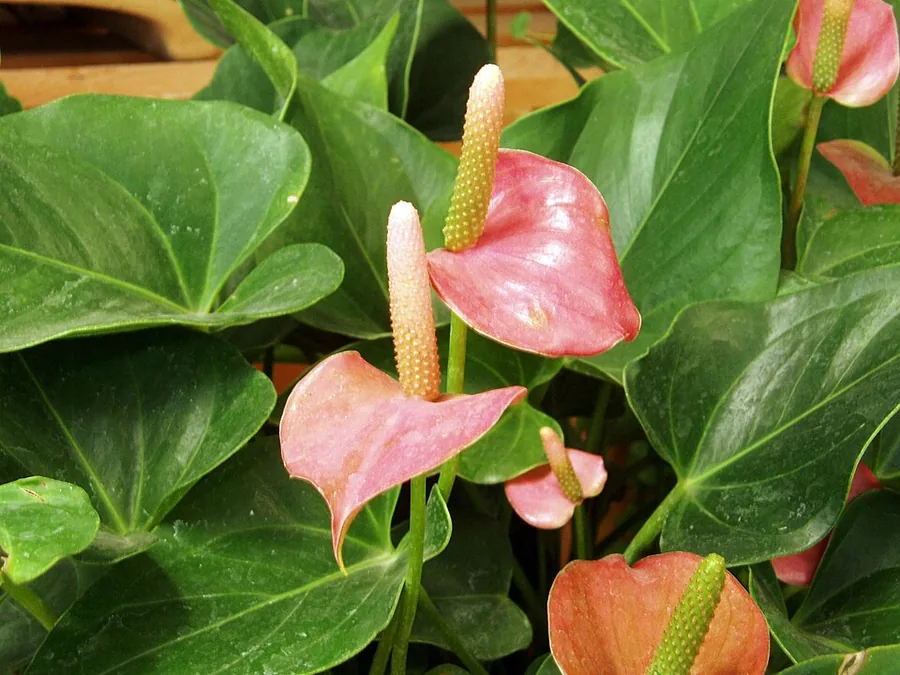
The showy part is widely misread as the flower. The waxy heart you notice, red, pink, orange, or white, is actually a spathe, a modified leaf, while the genuine flowers are the small bumps studded along the pale spadix that rises from it. Kept content, the plant produces fresh spathes across much of the year, earning it labels like flamingo flower and painter's palette.
Treat this as a plant for an attentive grower rather than a first one. It responds well to consistency and declines under neglect, growing miserable in dry rooms and rotting in waterlogged pots. Dial in the light, water, and humidity, however, and it holds its sheen and stays in flower well past the run of most houseplants.
Care
The short version: filtered bright light, a mix held evenly damp without ever reaching saturation, temperatures above 65°F (18°C), and humidity in the 60% to 80% range. A weekly liquid feed across the growing season and a fresh pot every other year cover the rest.
Light
Position it in bright, indirect light beside a window but outside the path of direct rays. Direct sun burns the foliage, while heavy shade gives you leaves and no flowers because the plant cannot fuel blooming, so a bright filtered spot strikes the balance.
Water
Water once the top inch of soil dries and hold the mix evenly moist through the year, never baking it out and never standing it in water. Overwatering is the fastest path to losing one, since waterlogged soil starves the roots of air and rots them. Rainwater or filtered water serves it better than hard tap water.
Soil
Set it in a light, peaty mix with free drainage, the airy medium that suits its epiphytic roots, which expect bark-like openness rather than dense ground. A slightly acidic pH of 6.0 or just below is ideal, and the sharp drainage is what holds root rot off.
Temperature
Hold it warm, between 65°F and 85°F (18°C to 29°C), and keep it from dipping under 60°F (16°C) over winter. It has no margin for cold drafts or a chilled windowsill.
Humidity
Here is where most growers fall short. Anthurium calls for high humidity, around 60% to 80%, well beyond what a typical heated room supplies, and dry air browns the leaf tips quickly as moisture pulls from the margins. A pebble tray, a humidifier, or a steamy bathroom each help close the gap.
Feeding
Across spring and summer, feed it weekly with a liquid fertilizer. A high-phosphorus formula drives more blooms. Scale it back through the darker months as growth slows.
Pruning
Cut off spent blooms to steer the plant into producing more, and wipe the broad leaves occasionally so dust does not dull their surface. Keep gloves on, as the sap can irritate skin.
Repotting
Repot every two years into a marginally larger pot. Fresh mix carries off the mineral salts that accumulate from feeding, and it opens up room for the roots before they begin circling the pot.
Size & spacing
Indoors it remains compact, reaching 12 to 18 inches (30 to 46 cm) in height and 9 to 12 inches (23 to 30 cm) across. That restrained size makes it a comfortable fit on a shelf or tabletop.
Troubleshooting
Anthurium problems are easy to diagnose once you know which part of the plant reports each one. Low humidity registers at the leaf tips, weak light registers as missing blooms, and excess water registers in the root system. Find the symptom below, then correct the underlying condition driving it.
Yellowing foliage and wilt with persistently wet soil
Persistently wet soil paired with yellow, drooping leaves usually signals that the root system is failing. Overwatering and poor drainage sit behind it, suffocating the roots until they go brown and soft underground. Water less, move the plant into a light, fast-draining mix in a pot that drains, and cut away the rotted roots.
Fix:
- Reduce watering and allow excess water to drain
- Repot into a light, well-drained mix, removing rotted roots
- Use a pot with drainage
Stippling, sticky deposits, or webbing across the leaves
The common indoor sap-suckers find anthuriums readily: aphids, spider mites, mealybugs, scale, whitefly, and thrips. Look for stippled foliage, a sticky film, thin webbing, or small cottony clusters. Separate any infested plant from the rest, wipe the pests away, and treat promptly before the population builds.
Fix:
- Inspect plants regularly and isolate affected plants
- Wipe leaves and remove pests
- Treat with appropriate control measures
Discolored spots, blight, or decayed tissue across the foliage
Spotting and rotted patches on the leaves generally point to fungal or bacterial disease, which establishes where the air is stagnant and the conditions stay too wet. Improve airflow around the plant, move it into a light, well-drained mix, and remove the diseased leaves.
Fix:
- Improve air circulation
- Use light, well-drained soil mixes
- Remove affected foliage
Plenty of leaves but few or no flowers
Leafy growth with no spathes nearly always traces back to too little light, since the plant lacks the energy to set flowers in shade. Relocate it to a bright position shielded from direct sun, take off the old spent spathes, and feed a high-phosphorus formula to drive new flowering.
Fix:
- Move to a spot with bright, indirect light, out of direct sun
- Remove spent blooms
- Apply a high-phosphorus fertilizer to encourage flowering
Browned leaf tips while the blade remains green
Crisp brown tips against healthy green tissue are the signature of dry air, the most frequent grievance in a heated home. Lift the humidity in the immediate area and shift the plant clear of vents and drafts, both of which pull moisture from the foliage and burn the margins.
Fix:
- Raise humidity around the plant
- Move away from drafts and dry-air locations such as heating vents
Bleached areas on foliage receiving direct sun
Bleached, scorched patches tell you the foliage is taking direct sun, which anthurium leaves are not built to withstand. Move it where the light is bright but filtered, and keep it away from drafts and parched corners that compound the damage.
Fix:
- Move out of direct sunlight to bright, indirect light
- Relocate away from drafts and very dry spots
Toxicity
Keep this plant out of reach. Every tissue carries sharp insoluble calcium oxalate crystals, the same irritant running through the arum family, and a bite into any part triggers burning and swelling in the mouth. The sap can also irritate exposed skin, so put on gloves before pruning and site the plant well clear of pets and children.
Toxic to
Cats · Dogs · Horses · Rabbits · Livestock · Birds · People
Cats Moderate
One bite registers immediately for a cat: a burning mouth, drooling, and a paw clawing at the face. Swollen lips and tongue tend to follow, along with vomiting and difficulty swallowing.
Dogs Moderate
A dog that chews a piece responds the same way, drooling heavily and turning away from food. Its mouth, tongue, and lips swell and grow painful, and vomiting commonly comes next.
Horses Moderate
On contact the crystals inflame a horse's mouth, producing pain, swelling, and copious drooling that interferes with swallowing. Since horses cannot vomit, the irritation stays confined to the mouth and throat.
Rabbits Toxic
Those same oxalate crystals sear a rabbit's delicate mouth and digestive tract, so position the plant entirely beyond reach and offer no part of it.
Livestock Toxic
A grazing animal that samples the leaves takes in a load of stinging crystals, which brings on drooling, mouth pain, and digestive upset. Fence the plant away from any spot stock can reach.
Birds Toxic
A bird that pecks at the leaves or sap encounters the same irritant crystals, which inflame the mouth and crop. Keep it out of any room where birds fly loose.
People Caution
No part of an anthurium belongs in the mouth, and a bite produces burning and swelling there. Contact with the sap can leave skin red and itchy as well, so wear gloves to handle it and keep children at a distance.
Sap and tissue contain insoluble calcium oxalate crystals (raphides) that can cause skin/contact dermatitis; consider wearing gloves when handling or pruning
Helpline numbers

United States
ASPCA Animal Poison Control: (888) 426-4435 (fee applies)
Poison Control: (800) 222-1222



Canada
Poison Centres: 1-844-764-7669
Varieties
Anthurium andraeanum is sold under a number of named cultivars, mostly distinguished by spathe color. The following are a handful documented by NC State Extension.
'Acropolis'
A named Anthurium andraeanum cultivar recognized in NC State Extension's records.
'Baron'
One more A. andraeanum selection appearing on the NC State Extension cultivar list.
'Cheers'
An Anthurium andraeanum cultivar documented by NC State Extension.
'Florida'
An A. andraeanum cultivar entered in NC State Extension's named selections.
'Midori'
An Anthurium andraeanum cultivar catalogued in the NC State Extension listing.
'Rosee Choco'
Another A. andraeanum cultivar named among NC State Extension's selections.
How to propagate
Anthurium is increased either by dividing an existing plant or by rooting a cutting, and both work best on a well-established specimen rather than a young one.
DivisionModerate
Best done at repotting (every 2 years) · Unknown
The most reliable route to new plants is to divide a mature specimen at repotting time, which falls roughly every two years. Pull the clump apart gently so every section retains its own roots, then plant each division on its own.
Stem cuttingsModerate
During active growth · Unknown
Rooting a stem cutting taken during active growth is another option. NC State Extension records this method alongside seed for propagating anthurium, with cuttings being the more workable choice in a home setting.
Myths
The vivid red structure an anthurium produces is a genuine flower.
That glossy heart, whether red, pink, orange, or white, is a spathe: a modified leaf, not a bloom. The true flowers are the minute bumps packed along the spadix, the pale white or cream column rising from the middle of the spathe.