Houseplant · Araceae
Glorious Philodendron
Philodendron gloriosum
Match its warmth, humidity, and bright indirect light and this velvet-leaf crawler unfurls one heart-shaped leaf after another.
Bright indirect
65–85°F · 18–29°C
USDA 10–12
Overview
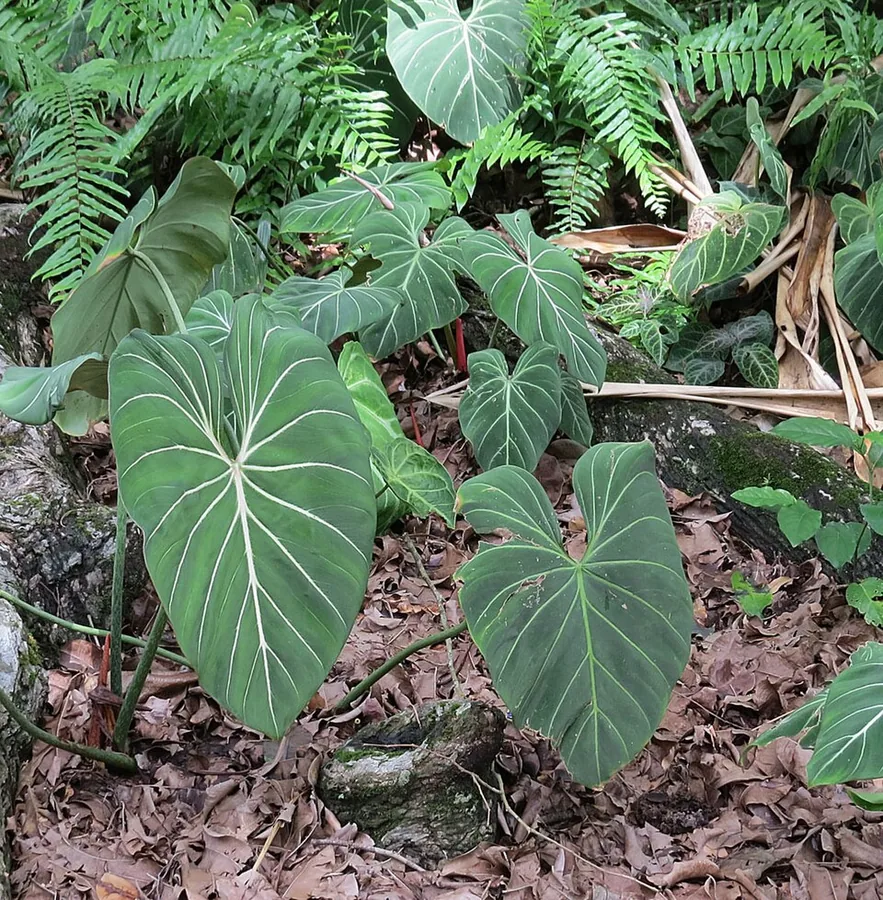
Philodendron gloriosum is prized for broad, heart-shaped leaves in deep green velvet, veined with pale silver. It departs from the climbing philodendrons in habit: a crawler, it advances a thick rhizomatous stem horizontally along the soil surface rather than scaling a support. Its native Colombian rainforest sets its requirements, namely warmth, consistent moisture, and humid air.
The collector reputation overstates the difficulty, because this species responds predictably once its cues are understood. Drainage governs success more than any other factor, since the fleshy roots decay quickly when the medium stays saturated. Resolve the soil and the watering and the plant settles into steady production, advancing a new leaf every few weeks through the growing season.
All tissue carries calcium oxalate crystals, the same principle that makes the genus an irritant to people and pets. Its value lies entirely in the foliage, never in consumption. Site it where inquisitive cats, dogs, and small children cannot reach the leaves.
Care
The short version: bright indirect light, a loose free-draining medium, and water withheld until the top of the soil dries. Maintain warmth and humidity, feed at dilute rates through the growing season, and never leave it standing in water.
Light
Provide bright indirect light, positioned near a window but off the sun's direct line. It tolerates medium light or dappled shade at the cost of slower growth. Exclude direct summer sun, whose intensity bleaches and scorches the velvety leaf surface.
Water
Water only after the top of the soil has dried, then irrigate thoroughly and let the surplus drain. The fleshy roots decay in a medium that holds water, so bias toward the dry side and never let the pot stand in a saucer of water.
Soil
Grow it in a loose, free-draining aroid mix of peat or coir amended with bark and perlite or sand. Keep the medium acidic, near a pH of 5.0 to 6.0, so the roots stay oxygenated between waterings.
Temperature
Hold it within its accustomed 65°F to 85°F (18°C to 29°C). It has no cold tolerance, so keep it clear of drafty doorways and cold winter glass.
Humidity
As a high-humidity plant of the rainforest floor, it produces its strongest growth in moist air. It accepts ordinary room humidity, but grouping plants together or standing it on a pebble tray raises the local moisture around it.
Feeding
Feed monthly through the growing season, spring into early autumn, with a balanced houseplant fertilizer applied at dilute strength. Withhold feed in winter as growth slows, and periodically leach the medium to clear accumulated salts.
Pruning
Pruning amounts to sanitation. Remove dead, damaged, or yellowing leaves as they arise, and where a stem elongates, cut just after a leaf node in spring. Wear gloves, since the sap can irritate skin.
Repotting
Repot every 2 to 3 years, or once the roots fill the pot, working in spring. Because the stem crawls laterally, a wide, shallow container accommodates the habit far better than a deep one.
Troubleshooting
Most disorders in this plant resolve to two variables, water and light. Yellowing foliage, softened roots, and bleached patches each map to a specific imbalance. Match the sign below to its cause and correct the condition before it progresses.
Drooping foliage, mushy stems, and a sour odor rising from the pot
The wilt and the sour smell signal root rot, which sets in when saturated media excludes the oxygen the roots need and the fleshy tissue breaks down. Slide the plant from its pot and grade the roots by feel, keeping the firm, pale ones and cutting out the brown, soft ones. Repot into fresh free-draining mix and reduce watering so the medium can breathe between drinks.
Fix:
- Remove from the soggy medium and cut away rotten roots
- Repot into fresh free-draining mix
- Reduce watering frequency and empty saucers
Yellowing concentrated on the lowest, oldest leaves
Yellowing confined to the oldest, lowest leaves reflects overwatering or insufficient light, the two stresses that first sap the leaves a plant can most afford to shed. Test the mix for lingering moisture and judge whether the light reaching it is genuinely bright. Extend the interval between waterings so the medium dries, and relocate the plant into bright indirect light.
Fix:
- Allow the medium to dry appropriately between waterings
- Move to a brighter spot with bright indirect light
Faded, sun-bleached patches on the leaves nearest the light
Faded, bleached patches are sunburn, the result of direct sun overloading the leaf tissue past what a shade-adapted aroid can dissipate, and summer glass concentrates the effect. The damage falls on whichever leaves face the light most directly. The scorched tissue will not recover, but returning the plant to bright indirect light lets clean new growth follow.
Fix:
- Move out of direct sun into bright indirect light
Honeydew, strands of webbing, or small crawling insects on the plant
Honeydew, fine webbing, or moving specks betray sap-sucking pests, among them mealybugs, spider mites, scale, and aphids that feed on plant fluids and excrete the sticky residue. They congregate on the sheltered leaf undersides and in the axils where leaf meets stem, so inspect there first. Dislodge them by wiping or washing, then treat with insecticidal soap or horticultural oil and repeat, since successive generations hatch after the first pass.
Fix:
- Wipe off or wash off pests
- Treat with insecticidal soap or horticultural oil and repeat as needed
Browning tips and crisped margins advancing across the foliage
Necrosis that advances from the tips and margins indicates soluble salt build-up, the residue that accumulates in the medium after heavy feeding. A white crust on the soil surface or pot rim confirms the excess. Suspend feeding, leach the salts out by flushing the medium with ample plain water, and resume only at dilute rates.
Fix:
- Stop fertilizing and flush the medium thoroughly with water
- Resume feeding only at dilute rates during the growing season
Toxicity
This is a specimen to observe, not to ingest. All tissue holds insoluble calcium oxalate crystals that irritate the mouth and throat on chewing, and the sap can inflame exposed skin. It is toxic to cats, dogs, and horses, and unsafe for people, so keep it beyond the reach of pets and small children and glove up before pruning.
Toxic to
Cats · Dogs · Horses · Rabbits · Livestock · Birds · People
Cats Moderate
The insoluble crystals embed in the oral lining when a cat chews any part, producing a burning mouth, heavy drooling, and a swollen tongue and lips. A cat will paw at its face, refuse food, and may vomit or find swallowing difficult.
Dogs Moderate
The same crystals discharge on the first bite, so a dog feels the sting at once and shows pawing at the mouth, drooling, and swelling of the lips and tongue. Vomiting and difficulty swallowing commonly follow.
Horses Moderate
The crystals irritate a horse's mouth and throat, leaving it drooling with painful swelling and impaired swallowing. Because equine anatomy prevents vomiting, the irritation is confined to the mouth and gut.
Rabbits Caution
The oxalate crystals irritate a rabbit's mouth and gut by the same mechanism they affect larger animals, so the plant belongs well out of reach. Regard any chewed leaf as grounds to consult a vet.
Livestock Caution
Grazing animals that mouth the foliage sustain the same burning irritation and drooling from the crystals. Ingestion is improbable indoors, but the plant warrants fencing off if it is moved outside.
Birds Caution
A bird that nibbles a leaf exposes its oral tissue to the same irritation and swelling. Keep pet birds away from the foliage entirely.
People Caution
No part of this plant is edible. Chewing a leaf releases the crystals and burns the mouth and lips, while the sap can provoke contact dermatitis, so wear gloves when pruning and keep it away from small children.
Plant sap can cause skin irritation / contact dermatitis; wear gloves when cutting stems and wash hands afterward (genus-level)
Helpline numbers

United States
ASPCA Animal Poison Control: (888) 426-4435 (fee applies)
Poison Control: (800) 222-1222



Canada
Poison Centres: 1-844-764-7669
How to propagate
This philodendron propagates readily by three routes: dividing the creeping rhizome, rooting a stem cutting in water, or air layering a stem before detachment.
DivisionModerate
Spring to summer, during active growth · Roots in a few weeks
The creeping rhizome, a thick surface stem, makes division the logical method for this species. During active growth in spring or summer, sever the rhizome into segments that each retain at least one node, the point from which new roots and shoots arise. Potted up, the segments root within a few weeks.
Stem cuttingsEasy
Spring to late summer · Roots in about 2 weeks in water
A stem cutting is the most straightforward option. Between spring and late summer, remove a piece about 4 inches (10 cm) long, cutting just below a leaf node so the cut sits at the zone where root primordia form. Held in a glass of water, it roots in about two weeks.
Air layeringModerate
Any season · Several weeks
Air layering induces roots on a stem still attached to the parent, which sustains the developing section until it can stand alone. In any season, wound a node, enclose it in damp moss, and hold that moisture while roots form over several weeks. Sever below the new roots and pot the section on.
Myths
Philodendrons carry no toxicity and pose no risk to household pets.
The ASPCA classes philodendron as toxic to cats, dogs, and horses, because every part contains insoluble calcium oxalate crystals. On chewing, those crystals irritate the oral lining and produce a burning, swollen mouth and drooling, which is why the plant belongs out of reach of pets and children.
A philodendron requires full, direct sun to grow well.
As a shade-adapted rainforest aroid, it performs best in bright indirect light rather than full sun. Direct exposure, particularly through summer glass, delivers more radiation than the leaf can dissipate and scorches the velvety surface into pale patches.