Houseplant · Araceae
Chinese Evergreen
Aglaonema commutatum
Forgiving, shade-friendly, and reliably warm-loving, Chinese evergreen is a low-demand aroid built for understory conditions.
Bright indirect
60–80°F · 16–27°C
USDA 10–12
12–20 in · 30–51 cm
Overview
Chinese evergreen is among the most adaptable foliage aroids in cultivation. The species sits in the arum family and is native to the understory of forests in the Philippines and Sulawesi, where light is filtered, temperatures stay warm, and humidity runs high. Those origins explain its tolerance for the dim, steadily heated interiors that defeat sun-adapted plants.
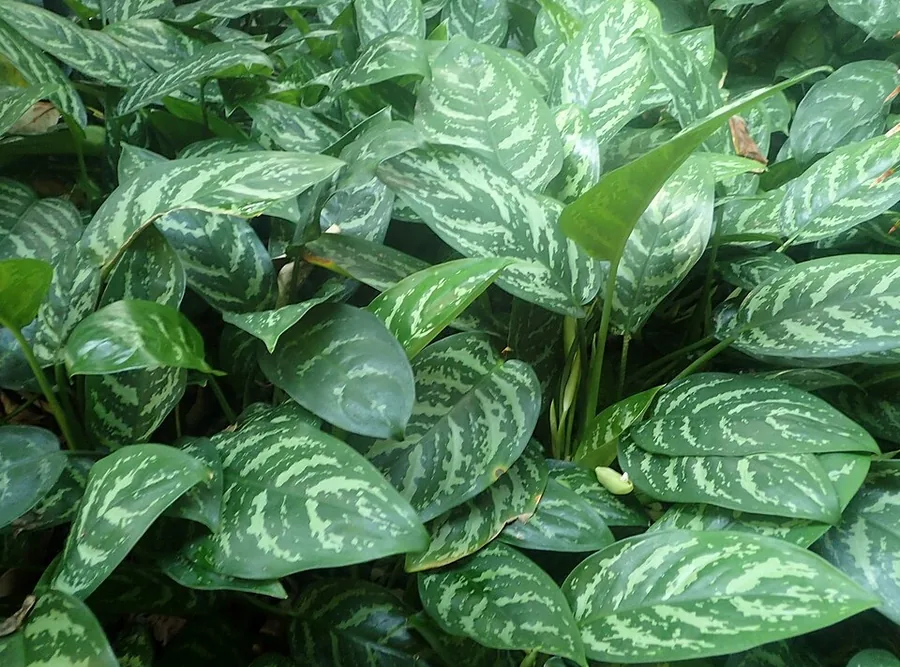
Its ornamental value lies entirely in the foliage, which appears marbled, streaked, and splashed in silver, green, cream, and deep red. Pigment distribution governs light demand: the solid-green forms carry enough chlorophyll to function in deep shade, whereas the red and heavily variegated cultivars have less photosynthetic leaf area and hold their coloration only under brighter indirect light.
Growth is moderate and the habit compact, typically 12 to 20 inches (30 to 51 cm) tall. Sustained warmth, restrained watering, and protection from cold cover nearly all of its requirements. One caveat governs placement: the entire plant is toxic to pets and irritating to people, a direct consequence of the calcium oxalate it carries throughout its tissue.
Care
The short version: supply bright indirect light to the colored cultivars and low light to the green ones, water only after the top inch or two of soil dries, hold it warm above 60°F (16°C), and feed sparingly.
Light
Provide the colored and variegated cultivars bright indirect light, since their reduced chlorophyll cannot sustain pigmentation in shade. The plain green forms are the exception, carrying enough chlorophyll to perform in low light and even deep shade. Exclude all of them from direct sun, whose intensity scorches the foliage.
Water
Let the top 1 to 2 inches (about 3 to 5 cm) of soil dry between waterings, holding the mix lightly moist from spring through fall when growth is active. Reduce watering from early fall to late winter to match lower demand, but never desiccate the mix. Apply room-temperature water, because cold water shocks the roots, and recognize that persistently soggy soil is the mechanism behind root rot.
Soil
Grow it in a well-drained peaty or soilless mix amended with extra humus, in a container fitted with drainage holes, so excess water moves through rather than pooling at the roots. The plant favors slightly acidic conditions, with a pH at or below 6.0.
Temperature
Maintain warmth, ideally 68°F to 80°F (20°C to 27°C). The plant tolerates roughly 55°F (13°C) but sustains chilling damage below 50°F (10°C), so enforce a 60°F (16°C) winter minimum and keep it clear of cold drafts that drive localized chilling.
Humidity
Average household humidity is adequate, so no target figure applies. The condition to avoid is very dry air, which desiccates the leaf margins and produces progressive browning at the tips.
Feeding
Fertilize lightly during the spring-through-fall growing period only. Excess fertilizer accumulates as salts that burn the leaf edges, so err toward underfeeding when uncertain.
Pruning
Maintenance is minimal: remove spent flowers and developing fruit to redirect energy into foliage rather than reproduction. Age produces a leggy habit, and once the lower leaves abscise, the bare apex can be severed and re-rooted to renew the plant.
Repotting
Repot infrequently, only when the plant becomes rootbound or the soil structure degrades. Roots circling the surface or emerging from the drainage holes, along with a top-heavy, leggy form, signal that the root zone has outgrown its container.
Size & spacing
Anticipate a compact specimen, 12 to 20 inches (30 to 51 cm) in height and 12 to 18 inches (30 to 46 cm) in spread. Allow sufficient clearance for free air movement around the foliage.
Troubleshooting
Most disorders in Chinese evergreen originate at the roots or present along the leaf margins, and the root cause is almost always water or temperature. Identify the symptom below, understand the mechanism, and correct the condition before it progresses.
Softened, mushy stem bases below yellowing leaves
This is root rot, the predictable outcome of soil that remains saturated. As the roots turn brown and slimy they lose the ability to conduct water, so the canopy wilts despite a wet root zone. Unpot the plant, excise the rotted roots, and replant into fresh well-drained mix in a container that genuinely drains.
Fix:
- Stop watering and let the soil dry appropriately
- Unpot and remove rotted roots; repot into fresh well-drained mix
- Ensure the container has working drainage holes
Leaf blotching, discoloration, and curling after chilling
As a tropical species, Chinese evergreen incurs chilling damage below about 50°F (10°C), and the discoloration and curling manifest after the exposure rather than during it. Cold drafts and irrigation with cold tap water induce the same response. Return the plant to a warm position within the 68°F to 80°F (20°C to 27°C) range and hold it well above 55°F (13°C) thereafter.
Fix:
- Move the plant to a warmer spot in the preferred 68-80°F range
- Keep above 60°F, ideally well above 55°F
- Avoid cold drafts and use room-temperature water
Webbing, cottony masses, or bumps on foliage and stems
Three sap-feeding pests are diagnostic by their evidence: fine webbing with stippled foliage indicates spider mites, white cottony deposits in the leaf axils indicate mealybugs, and small brown limpet-like bumps indicate scale. Remove them by wiping or washing, isolate the affected plant, and treat with insecticidal soap or horticultural oil, repeating until the population is eliminated.
Fix:
- Wipe off or wash off pests; isolate the affected plant
- Treat with insecticidal soap or horticultural oil, repeating as needed
- Raise humidity to discourage spider mites
Browned, desiccated leaf tips and margins
Marginal browning indicates moisture loss at the leaf edges, most often from dry air, though a cold draft or excess fertilizer salts produce the same scorch. Relocate the plant away from vents and chilly windows, reduce feeding, and trim damaged tips for appearance. A green, intact leaf center confirms the root system remains sound.
Fix:
- Move the plant away from drafts, heating/AC vents, and cold windows
- Raise ambient humidity or avoid very dry air
- Flush the soil and reduce fertilizer if over-fed
- Trim off badly browned tips for appearance
Color loss and etiolation in variegated cultivars under low light
Colored and variegated cultivars demand more light than commonly assumed, because their limited chlorophyll cannot maintain pigment or compact growth in shade, so they fade and etiolate toward the window. Solid-green forms remain healthy under the same conditions, making this a cultivar-to-light mismatch. Move the colored selections into brighter indirect light and reserve the deepest shade for the plain green forms.
Fix:
- Move variegated and red cultivars to brighter indirect (low-to-moderate) light
- Keep solid-green cultivars for the darkest spots
- Avoid direct sun, which scorches foliage
Toxicity
Treat this as a plant to site beyond reach. Every tissue contains insoluble calcium oxalate crystals, and mechanical disruption by chewing releases them, producing intense burning, swelling, and salivation in pets, livestock, and people. No part is edible, and the sap can irritate skin, so wash your hands after handling.
Toxic to
Cats · Dogs · Horses · Rabbits · Livestock · Birds · People
Cats Moderate
In cats, biting the foliage triggers immediate oral burning, followed by salivation, facial pawing, and sometimes emesis. Swelling of the tongue and lips can impair swallowing.
Dogs Moderate
The crystals sting the moment a dog chews, producing heavy drooling, pawing at the mouth, and vomiting. Swelling of the tongue and throat can follow.
Horses Moderate
Chewing induces intense oral burning, a swollen mouth and tongue, and steady drooling. Because horses cannot vomit, the irritation and difficulty swallowing are the observable signs.
Rabbits Toxic
The same calcium oxalate crystals irritate a rabbit's sensitive mouth and gut, leaving it drooling and off its feed. The plant should be kept well out of reach.
Livestock Toxic
Cattle, goats, and sheep that browse the foliage develop a burning, swollen mouth and drool heavily, and they typically withdraw after the first painful bite.
Birds Toxic
A pet bird that nibbles the leaves sustains the same oral burning and irritation. Given their small body mass, even a small exposure warrants a veterinary call.
People Caution
No portion of it is fit to eat; chewing a leaf produces oral burning and can cause swelling of the tongue and lips. The sap may also cause skin irritation, so hands should be washed after handling and the plant kept from young children.
All parts contain calcium oxalate crystals and sap can cause skin/mucous-membrane irritation in people; wash hands after handling and keep away from pets and young children
Helpline numbers

United States
ASPCA Animal Poison Control: (888) 426-4435 (fee applies)
Poison Control: (800) 222-1222



Canada
Poison Centres: 1-844-764-7669
Varieties
Chinese evergreen circulates under dozens of cultivar names, classified chiefly by leaf coloration and the corresponding light requirement. The selections below are the ones most commonly encountered.
'Maria'
Bears dark green leaves streaked with silver and ranks among the more shade tolerant cultivars, suiting it to a dim corner.
'Silver Bay'
Displays green foliage overlaid with silver variegation concentrated down the central axis of each leaf.
'Siam Aurora' (also sold as 'Red Aglaonema')
Carries deep crimson along the veins and margins and, as a colored selection, requires brighter indirect light than the plain green forms.
'Silver Queen'
Combines dark green leaves with heavy silver-gray variegation extending across most of the leaf surface.
'Crete'
Marks its green leaves with burgundy-red splashing and edging, complemented by pale pink stems.
How to propagate
Propagation is straightforward and most efficiently timed to coincide with repotting or with the natural decline of an aging, leggy specimen.
DivisionEasy
Spring at repotting · Several weeks
Division is the most efficient method: at spring repotting, separate an established clump into sections that each retain their own root mass, pot them individually, and allow several weeks for reestablishment.
Stem cuttingsEasy
Spring to summer · Several weeks to root
When an aging plant becomes leggy and sheds its lower leaves, retain the apex rather than discarding it. Sever the bare top in spring or summer and re-root it, allowing several weeks for new root initiation before active growth resumes.
SeedModerate
When fresh seed is available · Slow
Seed propagation is feasible when fresh seed is available but proceeds slowly and demands more patience than either vegetative method, which is why division and cuttings remain the standard choices.
Myths
A Chinese evergreen measurably filters and purifies household air.
A 2020 review of the literature concluded that potted plants do not measurably alter indoor air quality at any density a person would realistically live with. Equaling the contribution of ordinary building ventilation would require somewhere between 10 and 1,000 plants per square meter. Value this one as an ornamental, not as an air purifier.