Houseplant · Araceae
Alocasia Zebrina
Alocasia zebrina
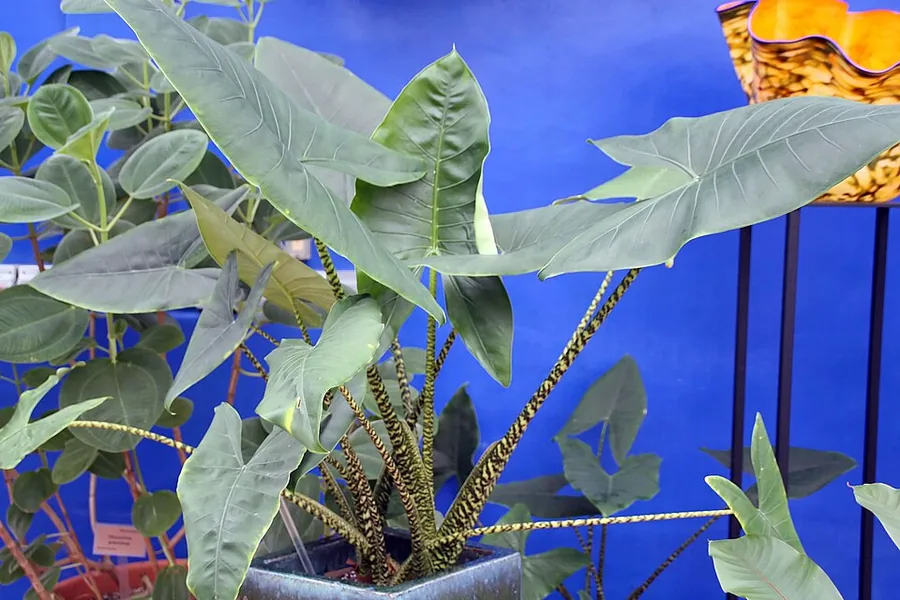
Each arrow-shaped blade rides a petiole banded in zebra-like markings, a foliage plant built like a sculpture.
Bright indirect
68–77°F · 20–25°C
USDA 10–12
3 ft · 0.9 m
Overview
The epithet zebrina names the banded petioles, dark over pale, that carry every glossy, arrow-shaped blade. The species is endemic to the Philippines, where it grows as a subshrub on the warm, humid forest floor, and that habitat dictates almost all of its indoor requirements. It is cultivated for foliar architecture, since the inflorescence is incidental.
Its demanding classification is well founded. The plant has narrow tolerances for soil moisture, a high humidity requirement, and acute sensitivity to anaerobic, waterlogged roots. Supply bright indirect light and disciplined irrigation, and growth is fast, with new leaves emerging through spring and summer before the plant enters its winter rest.
One fact governs placement: all tissues are toxic, to pets and to people, owing to the calcium oxalate crystals distributed throughout. The plant merits a position chosen as much for safety as for display, beyond the reach of cats, dogs, and small children.
Care
The short version: bright indirect light, sustained high humidity, and a temperature band of 68°F to 77°F (20°C to 25°C). Allow the upper half of the soil to dry between waterings, reduce irrigation in winter, and keep the roots from standing in water.
Light
Site zebrina in bright indirect light, near a window but shielded from direct midday sun on the lamina. It persists in partial shade or medium light, but reduced irradiance triggers etiolation that lengthens and weakens the petioles. Direct sun scorches the lamina, so diffuse a strong exposure through a sheer curtain.
Water
Allow the upper half of the profile to dry before rewatering, then irrigate thoroughly and let the medium drain. The roots will not tolerate standing water, and overwatering is the principal cause of rot and the leaf spotting that follows. Reduce the rate through winter, when the resting plant transpires far less.
Soil
Use an organically rich, free-draining medium that retains some moisture without remaining saturated. The genus accepts a range of textures, clay, loam, or sand, and tolerates a wide pH from 5.5 to 8.0.
Temperature
Maintain 68°F to 77°F (20°C to 25°C). As a tropical species it has no cold tolerance, so exclude it from drafty windows and unheated rooms, and return any plant summered outdoors before night temperatures drop.
Humidity
The plant requires high humidity, above the level most interiors hold. A pebble tray, a humidifier, or a naturally humid bright bathroom each raise it. Low humidity stresses the foliage and, by favoring spider mites, predisposes the plant to infestation.
Feeding
Fertilize only during the growing season, spring into summer, when active growth can take up the nutrients. A regular fertilizer on a seasonal interval suffices. Withhold feed in winter, since the dormant plant cannot assimilate it.
Pruning
Formal pruning is unnecessary. Simply excise dead, yellowing, or damaged leaves at the base as they arise. Removing senescent foliage maintains appearance and eliminates the refugia where pests shelter.
Repotting
No verified interval exists for zebrina, so let the plant signal need and repot once it exceeds its container or the medium degrades. Potting up one size in spring, at the onset of growth, gives the roots the least disruptive transition.
Overwintering
Zebrina is maintained indoors year-round as a houseplant. If it summers outside, bring it in before the first autumn frost and hold it cool, near 60°F to 65°F (16°C to 18°C), and humid, irrigating sparingly through its winter rest.
Size & spacing
Indoors the plant attains roughly 3 feet (91 cm) in height and a comparable spread, so allocate floor or table space that lets the arching laminae and upright petioles develop without contact.
Troubleshooting
The majority of zebrina disorders resolve to a water or light fault. Diagnose from the leaves and stems early, and because a single symptom can have opposite causes, verify soil moisture first and let that reading direct the correction.
A soft base and wilting while the soil stays saturated
Wilting in saturated soil signals root rot: standing water starves the roots of oxygen until they die and can no longer move moisture up to the foliage. Sound roots stay firm and white, so brown, soft, slimy tissue confirms the diagnosis. Cut watering back, repot into fresh free-draining medium with the dead roots excised, and use a container that sheds water cleanly.
Fix:
- Reduce watering frequency
- Repot into fresh, well-draining mix and remove rotted roots
- Ensure the container drains freely
Elongated, weak petioles bending toward the light
Long, lax petioles and a plant that tips toward the glass are classic etiolation, the response when light falls below what the foliage needs. The cure is more bright indirect light, since stronger illumination shortens the internodes and firms the stems. Turn the pot a quarter each week to even out the phototropic pull and keep the rosette balanced.
Fix:
- Move to a brighter spot with bright indirect light
- Rotate the plant periodically for even growth
Stippling, bronzing, and fine webbing across the leaves
Spider mites flourish in low humidity, feeding on cell contents until the surface stipples and bronzes and fine webbing appears beneath the leaves. Rinse the foliage to dislodge the colony and raise ambient humidity, which suppresses their reproduction. Apply insecticidal soap or horticultural oil to label, and quarantine the plant so the mites do not migrate to neighbors.
Fix:
- Rinse foliage and increase humidity
- Treat with appropriate insecticidal soap or horticultural oil per label
- Isolate the plant to limit spread
Honeydew and clustered insects along stems and leaves
Cottony white deposits identify mealybugs and dense groups of soft-bodied insects identify aphids, both sap feeders that excrete the sticky honeydew you find on the tissue. Remove the visible insects by hand, then apply insecticidal soap or horticultural oil to label. Quarantine the plant and repeat the treatment, since successive generations hatch after the first application.
Fix:
- Wipe off insects and treat with insecticidal soap or horticultural oil per label
- Isolate the plant and repeat treatment as needed
Leaf loss and arrested growth through the cold season
Reduced leaf count and a stall in growth over winter reflect semi-dormancy, the rhythm a rhizomatous Alocasia keeps as photoperiod and temperature fall, not pathology, provided the rhizome stays firm. Lower the watering rate and suspend feeding, since the plant draws little water and uses no nutrients while resting. Hold it warm and bright, and growth resumes as the spring flush begins.
Fix:
- Reduce watering and stop heavy feeding during dormancy
- Keep the plant warm (cool but not cold) and in good light
- Resume normal care as growth restarts in spring
Foliage losing its green and turning yellow
Chlorosis here most often traces to a watering fault, with insufficient light a secondary driver. The diagnostic difficulty is that excess and deficit water produce the same yellow, so assess soil moisture before correcting anything. Hold the medium evenly moist but never saturated, and place the plant in bright indirect light to keep photosynthesis adequate.
Fix:
- Adjust watering to keep soil evenly moist but not saturated
- Correct light levels to bright indirect light
Toxicity
This is a verifiably toxic species. Throughout its tissues sit needle-shaped calcium oxalate crystals that injure and inflame the mouth and throat on contact when chewed. Place it beyond the reach of pets and children, and wash your hands after handling.
Toxic to
Cats · Dogs · Horses · Rabbits · Livestock · Birds · People
Cats Moderate
When a cat bites the foliage, the raphides embed in the oral mucosa and release their irritant, which is why drooling, pawing at the mouth, and a swollen, painful tongue and lips appear. Vomiting and impaired swallowing commonly develop next.
Dogs Moderate
A dog presents the same way a cat does, because the toxin acts identically on canine tissue. The mouth, tongue, and lips inflame within minutes of chewing, and copious drooling, vomiting, and difficulty swallowing tend to follow.
Horses Moderate
In horses the same crystals inflame the oral lining, producing pain and swelling of the lips and tongue, drooling, and difficulty swallowing. Because the equine anatomy prevents vomiting, the reaction stays localized to the mouth and throat.
Rabbits Toxic
The oxalate raphides irritate a rabbit's mouth and digestive tract as they do in any herbivore, so the plant is not a safe browse. Site it where a free-ranging rabbit has no access.
Livestock Toxic
Grazing cattle, goats, and sheep sustain the same oral burning and swelling, with drooling and reduced feed intake as the animal avoids further contact. Exclude the plant from any paddock or pasture stock can enter.
Birds Toxic
A bird that mouths a leaf takes the same oxalate injury to the beak and oral cavity. No tissue of the plant is suitable for them, so keep it entirely apart from companion birds.
People Caution
No part is edible, and chewing any of it provokes immediate burning and swelling of the mouth and throat. The sap is a contact irritant to skin and eyes as well, so wash after handling and keep the plant beyond the reach of young children.
Sap and chewed tissue release needle-like calcium oxalate raphides; keep away from pets and children and wash hands after handling
Helpline numbers

United States
ASPCA Animal Poison Control: (888) 426-4435 (fee applies)
Poison Control: (800) 222-1222



Canada
Poison Centres: 1-844-764-7669
How to propagate
Zebrina does not root from stem cuttings, since the growing point sits on a rhizome rather than along the stem. Increase it instead by dividing that rhizome and separating the offsets it generates.
DivisionModerate
Spring to summer · Several weeks
Propagation is vegetative, by division of the rhizome or corm. Working in spring or summer while the plant is in active growth, unpot it and detach the offsets, the pups, that arise from the storage organ, then pot each separately. Each division needs several weeks to root and establish before it puts out new foliage.
Myths
All elephant ears are a single plant, and any one of them suits the garden safely.
The label is applied across multiple genera with markedly different behavior. UF/IFAS recommends ornamental Alocasia in preference to the invasive elephant ears Colocasia esculenta and Xanthosoma sagittifolium, and cautions against siting any of them near natural waterways. Confirm the genus and species in hand before committing it to the ground.