Houseplant · Araceae
Black-gold Philodendron
Philodendron melanochrysum
Supply it warm, humid air and a pole to climb, and this velvet-leaved philodendron develops deep, glittering foliage.
Bright indirect
65–85°F · 18–29°C
USDA 10–12
Overview
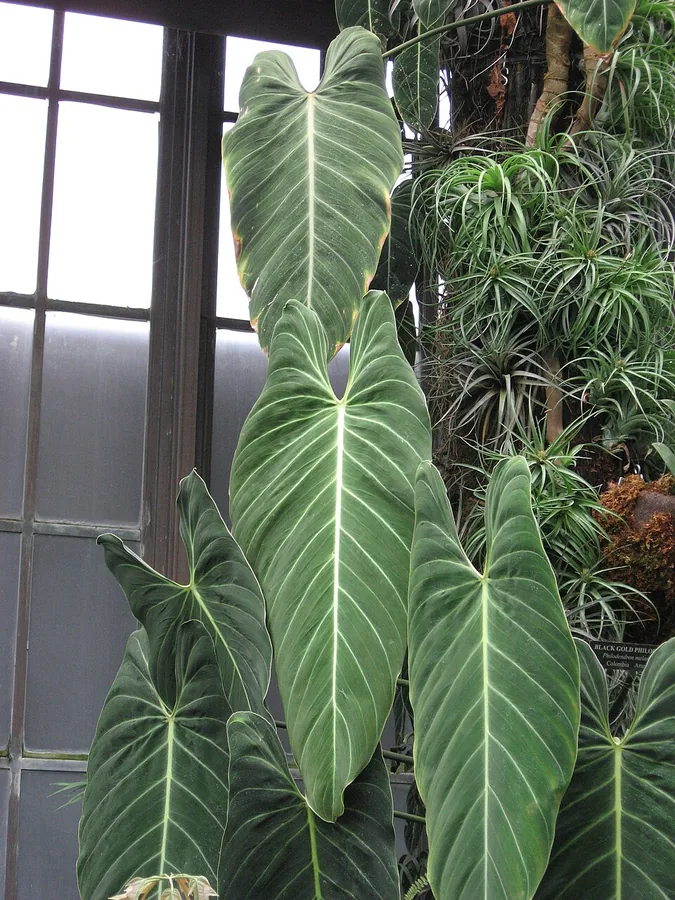
The black-gold philodendron is cultivated for its long, pendent leaves, which emerge coppery bronze and mature to a near-black velvet traced with gold venation. It sits within the arum family and, in habitat, climbs the wet forests of Colombia by ascending tree trunks toward the light. That behavior carries over indoors, which is why a moss pole or slab matters: the climbing surface lets the plant orient upward and drive its leaves to full expansion.
This species is a climbing aroid rather than a self-heading tabletop plant. Its stems extend rapidly in warm conditions, and leaf size increases as the plant gains height on its support, so the support directly governs how large the foliage becomes. Bright indirect light, consistent warmth, and humid air together produce one of the more distinctive leaf textures among cultivated houseplants.
Its requirements exceed those of the average philodendron chiefly in humidity and even moisture. Meet those and it tolerates most other conditions well. Allow the air to dry or the root zone to remain saturated, however, and the velvet leaves register the stress quickly through browning and decline.
Care
The short version: bright indirect light, warmth in the 65°F to 85°F (18°C to 29°C) range, high humidity, and a well-draining mix kept evenly moist but never soggy, with a pole to climb.
Light
Site it in bright indirect light, comparable to a window diffused by a sheer curtain. It withstands medium light and, for a period, low light, but direct sun scorches the velvety leaf surface, so hold it back from the glass.
Water
Maintain the medium evenly moist but never soggy, and never leave the pot standing in water. Saturated roots lose access to oxygen, and the resulting root rot is the fastest cause of loss, so let the surface dry slightly between waterings.
Soil
Grow it in a well-draining potting mix high in organic matter so excess water passes through rather than pooling at the roots. It favors acidic conditions, with a pH at or below 6.0, and bark and perlite in a chunky aroid blend hold air pockets around the root system.
Temperature
Hold it in the warm range it prefers, between 65°F and 85°F (18°C to 29°C). It has no tolerance for cold drafts or chilled windowsills, so position it clear of doors and vents through winter.
Humidity
It requires high humidity, a reflection of its wet-forest origins. As ambient air dries, brown tips and spider mites become more likely, so grouping plants or running a humidifier raises the moisture around the foliage.
Feeding
Feed monthly across the spring and summer growing season with a dilute water-soluble fertilizer, near a 3:1:2 or 3:1:3 ratio, or a slow-release formulation. Keep the rate low, since surplus fertilizer accumulates as salts and curls and browns the leaf tips.
Pruning
Train and prune the climbing stems to govern size and form. Above all, furnish a moss pole or slab, because the climbing habit is the mechanism that drives the leaves to their largest and most fully developed size.
Repotting
Repot when growth outpaces the container and the roots begin to fill it, an operation that can be done in any season. Advance the plant by a single pot size into fresh well-draining mix rather than into a much larger container.
Troubleshooting
Most disorders in this plant originate in watering and humidity, and the foliage registers them early. Reading the first browned tip or stippled leaf lets you intervene before the problem advances. Match the symptom below, then correct the underlying condition while intervention still helps.
Yellowing foliage over soft, darkened roots
Yellow, wilting leaves above brown, mushy roots indicate root rot, which develops when the medium stays saturated and the roots are starved of oxygen. Waterlogged tissue cannot support the canopy, so the leaves yellow and collapse. Cut back the watering interval, discard any water held in the saucer, and repot into fresh well-draining mix after excising the softened roots.
Fix:
- Reduce watering frequency and empty standing water from the saucer
- Repot into fresh well-draining mix and trim away rotted roots
Bronzed, stippled leaves under fine webbing
Fine stippling and thin webbing on the leaf undersides point to spider mites, which thrive in dry air and pierce the cells to feed, draining the chlorophyll that gives the bronzed cast. Rinsing and wiping the foliage removes much of the population outright, and insecticidal soap or horticultural oil clears the rest. Because dry air favors them, raising the humidity makes conditions far less suitable for reinfestation.
Fix:
- Rinse foliage and wipe leaves
- Treat with insecticidal soap or horticultural oil
- Raise humidity
Cottony masses, honeydew, or bumps on stems
Cottony masses signal mealybugs, soft clustered insects indicate aphids, and firm or waxy bumps mark scale, all of them sap feeders that excrete the sticky honeydew you find on the foliage. An alcohol-dipped swab breaks down the protective coating and lifts them off, and insecticidal soap or horticultural oil follows up on what remains. Isolating the plant prevents these mobile pests from crossing to the rest of the collection.
Fix:
- Wipe pests off with an alcohol-dipped swab
- Treat with insecticidal soap or horticultural oil
- Isolate the affected plant
Silvery flecking with dark frass on leaves
Silvery flecking accompanied by minute black frass is diagnostic of thrips, slender insects that rasp the leaf surface and feed on the released cell contents, leaving the reflective scarring behind. Removing the heavily fed leaves takes out the densest populations, and insecticidal soap or an appropriate insecticide treats the mobile stages that remain. Isolating the plant contains the infestation while the numbers are brought down.
Fix:
- Remove heavily infested leaves
- Treat with insecticidal soap or an appropriate insecticide
- Isolate the plant
Browned, curled tips and dry leaf margins
Scorched tips most often reflect an accumulation of fertilizer salts in the medium, though dry air and direct sun produce a similar margin burn. Leaching the pot with plain water carries the excess salts out of the root zone, and easing the feeding rate stops them rebuilding. Lifting the humidity and holding the plant in bright indirect light, away from direct sun, addresses the other two causes.
Fix:
- Flush the soil to leach excess fertilizer salts and reduce feeding rate
- Raise humidity (group plants, pebble tray or humidifier)
- Move to bright indirect light out of direct sun
Defined brown to black lesions on leaves
Discrete spots, at times bordered by a yellow halo, are fungal or bacterial leaf spot, and the pathogens establish where surface moisture lingers on the leaf. Removing the marked leaves eliminates the inoculum already present, and better air movement dries the foliage faster to slow further infection. Watering at the soil line keeps water off the leaves and denies the pathogen the film it needs to spread.
Fix:
- Remove affected leaves
- Avoid wetting the foliage and improve air circulation
Toxicity
This is a toxic plant. All tissue contains insoluble calcium oxalate crystals, the characteristic irritant of the arum family, and chewing any part inflames the mouth and throat. Keep it out of reach of cats, dogs, horses, and small children, and wash the hands after pruning or taking cuttings.
Toxic to
Cats · Dogs · Horses · Rabbits · Livestock · Birds · People
Cats Moderate
When a cat bites into a leaf, the ruptured cells release calcium oxalate crystals that penetrate the oral tissue at once. The result is heavy drooling, pawing at the face, swelling of the tongue and lips, and difficulty swallowing, occasionally with vomiting.
Dogs Moderate
Chewing drives the same crystals into the mouth, tongue and lips, producing burning, swelling and a sudden surge of salivation. Many dogs respond by gagging, vomiting, or pawing at the muzzle as the irritation develops.
Horses Moderate
The crystals inflame the equine mouth and throat, leaving the animal drooling and unwilling to eat. Since horses are physiologically unable to vomit, the discomfort and impaired swallowing tend to persist.
Rabbits Toxic
The leaves and stems hold the same irritant crystals, so they are unsafe for a rabbit to browse. Ingestion can leave the mouth sore and swollen and prompt the animal to refuse food.
Livestock Toxic
In grazing species such as goats, sheep and cattle, the calcium oxalate produces oral pain, drooling, and irritation along the digestive tract. The plant should be sited well beyond any area stock can access.
Birds Toxic
A bird that pecks the foliage sustains the same burning irritation across the beak and mouth. Pet birds are best excluded from the plant entirely.
People Caution
No part of this plant is edible. Chewing a leaf burns the mouth and throat, and contact with the cut stems can leave the skin itchy or inflamed, so wash the hands afterward and keep the plant away from small children.
Sap and cell contents contain calcium oxalate raphides; chewing or sap contact can irritate the mouth, throat and skin (contact dermatitis)
Helpline numbers

United States
ASPCA Animal Poison Control: (888) 426-4435 (fee applies)
Poison Control: (800) 222-1222



Canada
Poison Centres: 1-844-764-7669
How to propagate
This philodendron propagates readily, either by rooting a stem cutting or by air-layering one of the thicker climbing stems.
Stem cuttingsModerate
Any season (active growth in spring-summer is most vigorous) · Buds break in about 3-5 weeks and roots form in about 4-6 weeks
Take a cutting bearing at least one node and an attached leaf, since the node holds the meristematic tissue from which new roots and shoots emerge, then hold it in a moist medium. Any season works, though the response is strongest during spring and summer growth. Expect buds to break in about 3 to 5 weeks and roots to develop in roughly 4 to 6 weeks.
Air layeringModerate
Any season · Several weeks for roots to form before severing
On thick climbing stems, air-layering is the more dependable method because the shoot stays attached and nourished while it roots. Enclose a node in moist sphagnum moss and hold it there for several weeks until roots emerge, then sever the stem just below the new roots and pot it up.
Myths
Philodendrons are harmless, pet-safe houseplants.
The ASPCA classes philodendron as toxic to cats, dogs and horses, and every part holds insoluble calcium oxalate crystals. When a pet chews a leaf, those crystals irritate the tissue and bring on a burning, swollen mouth, heavy drooling, and difficulty swallowing. The correct assumption is a plant to keep out of reach, not a safe one.
This philodendron needs direct sun to keep its color.
Its true preference is bright, curtain-filtered indirect light, because direct sun scorches the velvety leaf surface. Most philodendrons will even persist in low light, so exposing it on a hot windowsill serves no purpose.
Heavier feeding makes a philodendron grow faster and lusher.
Excess fertilizer accumulates as salts in the medium and burns the tissue, so the leaf tips curl and brown. Dilute, regular feeding is the whole requirement, and an underfed plant recovers far more readily than one damaged by overfeeding.