Houseplant · Gesneriaceae
Lipstick Plant
Aeschynanthus radicans
Supply warmth, bright indirect light, and humid air, and Aeschynanthus radicans trails red flowers from a hanging basket across much of the year.
Bright indirect
Every 5–10 days
55–81°F · 13–27°C
USDA 10–11
Overview
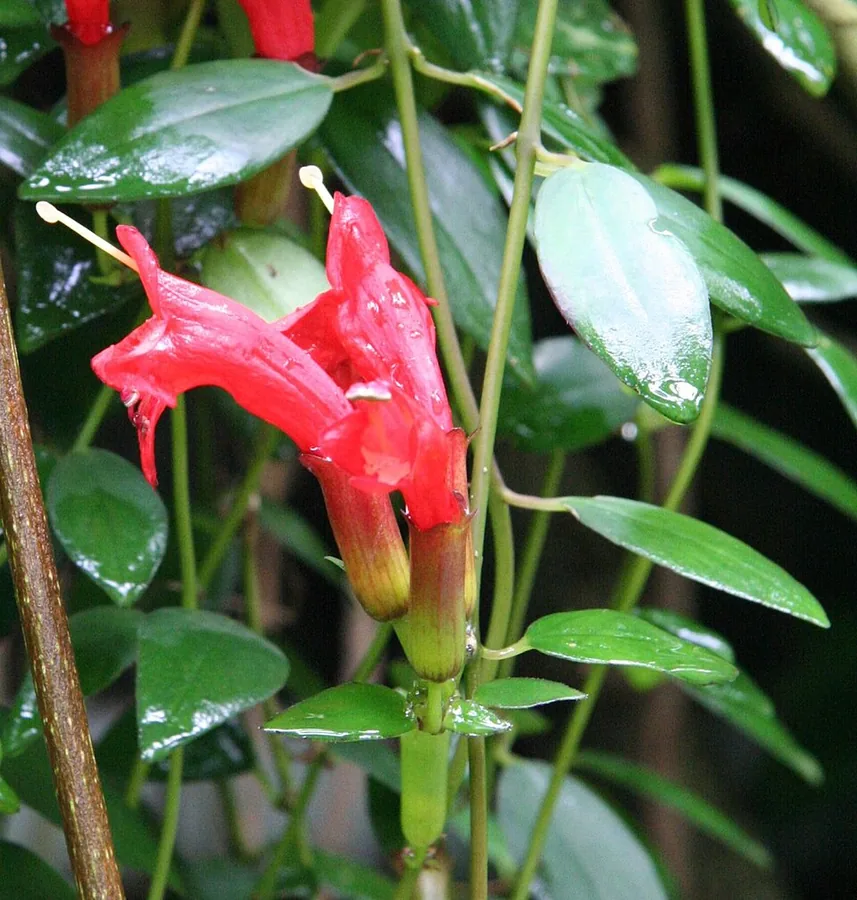
The common name records a floral detail: the red corolla emerges from a dark tubular calyx in the manner of a lipstick advancing from its case. The species is a trailing epiphyte in the gesneriad family, allied to Saintpaulia and the other African violets, and in habitat it anchors to bark on trees through Southeast Asia rather than rooting in soil. Under cultivation the pendent stems reach 12 to 35 inches (30 to 90 cm), which is why a hanging basket suits it.
The requirements follow directly from that ecology. Its tropical origin sets the demand for warmth and humidity, and its epiphytic habit explains why a snug, well-drained rootball favors flowering. Meet those conditions and it produces successive flushes from spring into the cooler part of the year.
For a household with animals or children, the safety profile is unambiguous. The ASPCA records the plant as non-toxic, so a specimen positioned within reach of a cat or a small child presents no toxicological risk.
Care
The short version: bright indirect light, warmth above 55°F (13°C), and elevated humidity govern its health. Allow the surface of the mix to dry between waterings, reduce water in winter to induce bud set, and apply dilute feed through spring and summer.
Light
Site it in bright, indirect light at a window but shaded from direct midday sun, whose intensity scorches the foliage. It persists in medium light and partial shade, yet flower production scales with the light received, so a brighter position yields more blooms.
Water
Allow the top inch (3 cm) of mix to dry before rewatering, on a roughly 5 to 10 day interval, and never leave the pot standing in water where the roots would suffocate. Baskets dry faster and warrant more frequent checks. Reduce watering in winter, because the cooler, drier root zone is what cues bud initiation.
Soil
Grow it in a light, fast-draining medium, such as an African violet mix opened up with sphagnum moss and a little crushed charcoal. As a bark-dwelling epiphyte its roots are adapted to air exchange, so free drainage matters more than sustained moisture.
Temperature
Hold it between 55°F and 81°F (13°C to 27°C) and away from cold glass. Exposure into the mid-50s initiates leaf drop, and a pronounced chill causes a lasting setback, which is the physiological basis for keeping it warm and stable.
Humidity
The plant requires high humidity to hold condition. Cluster it with other plants, stand it on a pebble tray, or run a humidifier, but couple the added moisture with air movement, since still humid air favors the fungal problems noted above.
Feeding
Feed at two-week intervals through spring and summer with a balanced liquid houseplant fertilizer at half strength, matching supply to active growth. Withhold feed in fall and winter while the plant is dormant and nutrient demand falls.
Pruning
Once a flush of bloom finishes, cut the stems back to about 6 inches (15 cm) to stimulate branching and denser growth. Reduce any straggly stems to roughly 2 inches (5 cm) to maintain form rather than allowing bare, leggy growth.
Repotting
Repot only every 2 to 3 years, or once roots crowd the drainage holes. Because flowering is best when the plant is slightly pot-bound, avoid overpotting into a much larger container.
Size & spacing
The pendent stems extend 12 to 35 inches (30 to 90 cm) with a spread of 12 to 24 inches (30 to 60 cm). A hanging basket or elevated shelf accommodates the cascading habit.
Troubleshooting
The common disorders of this species resolve to its atmosphere: chilling, stagnant humid air, or inconsistent moisture. Reading the early symptom lets you correct the underlying condition before significant abscission occurs. Identify the sign below, then adjust siting or irrigation accordingly.
Leaf drop concentrated on the lower stems
This species abscises leaves in response to cold stress, so the likely trigger is a draft, contact with cold winter glass, or an air conditioning vent driving temperatures below its tolerance. Erratic moisture compounds the loss, since both a bone-dry rootball and a waterlogged one impair uptake. Return it to a stable position above 55°F (13°C) and water on an even cadence so the medium never swings between extremes.
Fix:
- Move to a warm spot away from drafts and cold glass
- Keep temperatures above about 13°C (55°F)
- Water consistently so the medium stays evenly moist but not soggy
Gray sporulation or defined spotting on foliage
A gray fuzzy coating indicates botrytis blight, whereas discrete dark lesions indicate leaf spot, and both fungi establish where humid air stagnates and moisture lingers on the tissue. Excise the colonized foliage to remove the inoculum, then raise air movement so the leaf surface dries faster than spores can germinate. Keeping foliage dry and clear of the mix removes the film of water these pathogens need.
Fix:
- Remove affected foliage
- Improve air circulation
- Keep leaves dry and off the potting medium
Honeydew, webbing, or insects on stems and foliage
The residue and webbing are diagnostic of sap-feeding pests, specifically aphids, mealybugs, scale, or spider mites, which congregate on stems and leaf undersides where they draw phloem sap. Dislodge them mechanically by washing or wiping, since disrupting the population early limits the honeydew that fouls the leaves. Reinforce with insecticidal soap or horticultural oil, and isolate the specimen so any survivors do not disperse to neighbors.
Fix:
- Wipe off or wash off pests
- Treat with insecticidal soap or horticultural oil
- Isolate the plant until controlled
Toxicity
For owners and parents the verdict is clear: the lipstick plant is safe. The ASPCA records it as non-toxic to cats, dogs, and horses, and neither the foliage nor the red flowers contain a toxic principle that would harm an animal or a child. Position it wherever suits the room.
Safe for
People · Cats · Dogs · Horses · Rabbits · Livestock · Birds
Cats None
The ASPCA classifies this species as non-toxic to cats. Ingestion carries no toxic principle; at most a nibble yields transient gastric irritation from the fiber, as with most foliage.
Dogs None
It is documented safe for dogs on the ASPCA roster. Chewing produces no poisoning, and any effect is limited to minor digestive upset from the plant material itself.
Horses None
The ASPCA extends the non-toxic status to horses. Equine exposure is improbable for a tropical houseplant, and in any case the tissue contains no toxin.
Rabbits Safe
No toxic constituent affects rabbits, so an incidental bite of the lipstick plant presents no toxicological concern.
Livestock Safe
The plant poses no toxic hazard to grazing stock, though as a tender epiphyte it seldom enters a pasture or feed setting.
Birds Safe
Aviary and companion birds may share its airspace without issue, as the foliage holds no recognized avian toxins.
People Safe
It is safe in households with children. No part is cultivated for consumption, yet an exploratory taste introduces no poisoning risk.
Varieties
A small number of named forms circulate in the houseplant trade, distinguished mainly by foliage or floral color. The two below are the ones most often encountered.
'Variegatus' (variegated lipstick plant)
This cultivar departs from the typical uniform green by bearing foliage marked with cream to yellow variegation.
Aeschynanthus radicans var. lobbianus
Marketed as the red bugle vine for its dark red calyces borne against a red corolla, this taxon is now subsumed under A. pulcher in current classification.
How to propagate
The species propagates readily from cuttings, so a single established basket yields multiple clones. Take material during the warm growing period, when root initiation proceeds fastest.
Stem cuttingsEasy
Spring to summer during active growth · Roots in about two weeks
Propagate from stem cuttings in spring or summer, when active growth and warmth accelerate root initiation. Select a softwood stem bearing three nodes, remove all but the top 2 to 4 leaves to limit transpiration, and treat the cut end with rooting hormone. Insert it into equal parts vermiculite and perlite held lightly moist, and adventitious roots typically form in about two weeks.
Myths
The lipstick plant is poisonous and hazardous to cats and dogs.
The assumption stems from the lipstick-red corollas, whose color is read as a chemical warning it does not carry. No toxin is present. The ASPCA records the plant as non-toxic to cats, dogs, and horses, confirming it as a verified pet-safe houseplant suitable for hanging within animal reach.