Tree · Fagaceae
American Beech
Fagus grandifolia
Provide rich, acidic, moist soil and ample room to spread, and the American beech matures into a shade tree that persists for generations.
Full sun
Every 7–14 days
USDA 3–9
60–80 ft · 18.3–24.4 m
Overview
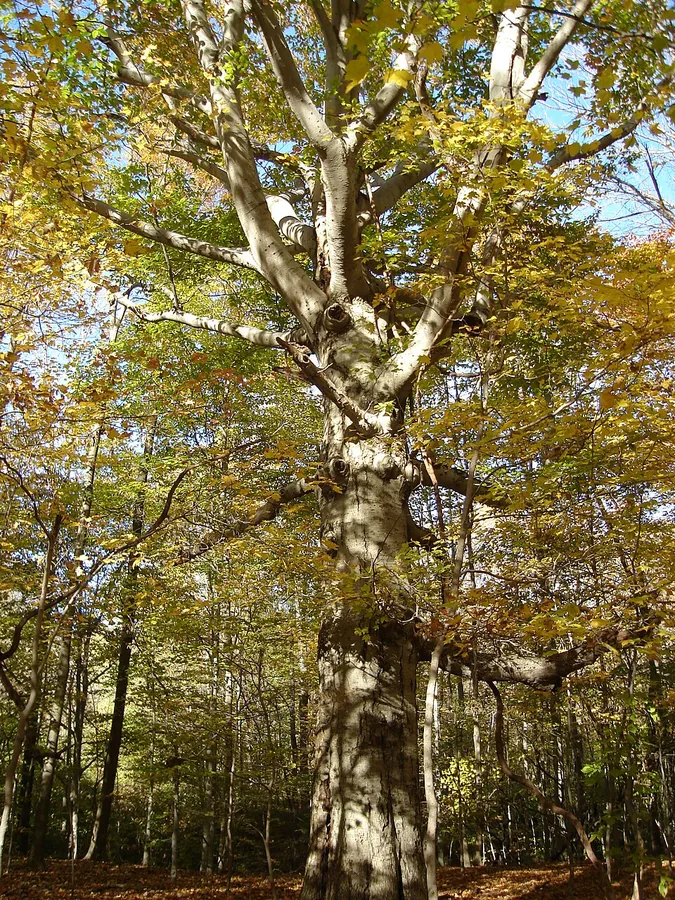
The American beech is a slow-growing climax hardwood of the eastern deciduous forest, identified at a distance by its smooth, silver-gray bark, which stays unfissured at maturity where most associated species develop coarse, furrowed plates. Taxonomically it sits in the Fagaceae alongside the oaks and chestnuts. On a favorable site it attains 60 to 80 feet (18 to 24 m), casts dense shade, and may persist for centuries.
Its value lies in longevity rather than rapid yield. Juvenile and lower-canopy trees retain coppery senesced leaves through winter, a trait termed marcescence that brightens the dormant forest, and reproductively mature trees provision wildlife with small triangular beechnuts at intervals. The species suits a large, open site rather than a confined lot, because the shallow root plate extends widely and the crown spreads to roughly the height of the tree.
Beech is exacting about site. It demands deep, rich, moist, acidic soil and unpolluted air, and it declines under compaction, drought, heat, or road salt. Two introduced disorders, beech leaf disease and beech bark disease, now threaten established trees throughout the native range, which makes correct siting and sustained vigor more consequential than at any earlier point.
Care
The short version: establish it in deep, rich, moist, acidic, well-drained loam with abundant room to spread, irrigate young trees through dry periods until they are established, and keep the thin bark free of wounds and sunscald.
Light
American beech performs in full sun yet tolerates deep shade more completely than nearly any other tree, which explains its capacity to occupy the forest understory and subsequently ascend into the canopy. Open-grown specimens develop a low, wide branching architecture, while suppressed individuals elongate toward available light.
Water
Maintain evenly moist soil, since the species has little tolerance for drought, heat, or saturated ground. Established trees on suitable native soil are largely self-sufficient, but a juvenile tree benefits from deep irrigation during dry intervals, roughly every 7 to 14 days, until its root system is established.
Soil
The species requires deep, rich, moist, well-drained loam of acidic reaction, optimally a pH of 5.0 to 6.5. It will not tolerate compaction or road salt, so the root zone should be kept loose and undisturbed to preserve gas exchange and fine-root function.
Temperature
Beech is fully cold-hardy, withstanding winter minima near -40°F (-40°C) and summer maxima around 100°F (38°C), a range that corresponds to USDA zones 3 to 9. It endures cold considerably better than it endures drought or an exposed, heat-loaded position.
Humidity
Ambient outdoor humidity is sufficient, so no target value applies. The more material variables are consistent soil moisture and good air quality around the canopy.
Feeding
On suitable native soil a beech rarely requires fertilization. Where growth is deficient, a balanced slow-release fertilizer applied in spring, or simply a layer of leaf-litter mulch over the shallow root zone, supplies a measured response without forcing flush growth.
Pruning
Beech requires little pruning. Excise dead, damaged, or crossing branches in late winter to early spring and do no more. The thin, smooth bark scars and sunscalds readily, so each cut foregone is one fewer wound the tree must compartmentalize and seal.
Repotting
This is a landscape tree rather than a container subject, and its shallow, spreading root system makes transplanting difficult once established. Relocate a beech only while young, and monitor any nursery transplant for circling roots, suppressed new growth, or dieback indicating transplant failure.
Size & spacing
Allow for a tree attaining 60 to 80 feet (18 to 24 m) in height and spreading 40 to 80 feet (12 to 24 m) in width. Position it on a large, open site well clear of structures, paving, and competing trees, because both the crown and the surface root plate extend a considerable distance.
When to plant
Establish beech in its juvenile stage, because the shallow, wide-ranging root plate makes the relocation of an older tree problematic. Plant in spring or autumn, irrigate through the first few dry intervals until the roots take hold, and then permit the tree to develop at its inherently slow rate. The yellowish-green flowers appear March to May, and the nuts mature September to October once the tree reaches reproductive age.
Northern hemisphere
Southern hemisphere
Typical months for a temperate climate: start earlier in warm zones, later where spring frosts linger.
- Plant: Spring or fall, while young; transplanting is difficult once established.
- Harvest: Yellowish-green flowers March to May; triangular beechnuts ripen September to October.
Hardiness
USDA hardiness zones: 3–9
Temperature: down to -40°C
Troubleshooting
Most disorders of beech present on the foliage or the bark, and the two of greatest current concern are recent introductions that reward early detection. Interpret the signs that follow, and where a serious pathogen is implicated, retain a certified arborist rather than attempting empirical treatment.
Interveinal dark banding with thickened, cupped foliage
The pattern is diagnostic of beech leaf disease, in which the nematode Litylenchus crenatae overwinters inside the buds and disrupts leaf tissue as it expands, producing the dark bands and leathery cupping. Backlighting a spring leaf from beneath renders the interveinal striping most legible, since the affected tissue is densest there. No curative is available to a homeowner, so engage a certified arborist or the state forestry office, sustain the tree with mulch and supplemental water through drought to limit added stress, and report new occurrences so spread can be mapped.
Fix:
- Consult a certified arborist or state forestry office for current management options
- Phosphite fertilizers may boost tree vigor and suppress nematode activity
- The nematicide/fungicide fluopyram (Broadform) has reduced nematode populations in trials
- Maintain tree vigor with mulch and watering during drought
Felted white wax on smooth bark progressing to cankers
This is beech bark disease, a disease complex requiring two agents in sequence. The felted beech scale (Cryptococcus fagisuga) feeds on the trunk and lays down the white waxy coat, and its feeding punctures admit Neonectria fungi, which then colonize the bark and generate the sunken, oozing cankers. Because the fungus depends on the scale's prior injury, detecting the wax stage early lets an arborist suppress the insect before infection establishes. After cankering and crown dieback advance, removing severely affected trees is the soundest way to slow inoculum spread.
Fix:
- Consult an arborist; insecticide treatments targeting the scale before fungal infection can help in early stages
- Remove and properly dispose of severely diseased trees to reduce spread
- Avoid wounding bark
Woolly twig colonies that undulate when disturbed
These colonies are beech blight aphids, the woolly beech aphid known colloquially as the boogie-woogie aphid for the synchronized abdominal rocking the colony performs when disturbed. As sap feeders they excrete honeydew, a sugar substrate that supports the black sooty mold visible on foliage and on the ground beneath. The injury is essentially cosmetic, so the colony can be left in place, dislodged from a small twig with a forceful water jet, or left to natural predators to regulate.
Fix:
- Usually cosmetic and tolerable; no treatment normally needed
- Hose off small colonies with a strong stream of water
- Encourage natural predators
A white powdery film coating the leaves
The coating is powdery mildew, a foliar fungus that develops on the adaxial leaf surface late in the season under the humid, shaded conditions a beech canopy readily provides. On a mature shade tree the infection stays superficial and seldom exceeds a cosmetic blemish. Collect and discard the fallen leaves to remove overwintering inoculum, open the canopy to improve air movement where feasible, and forgo fungicide.
Fix:
- Rarely serious; improve air circulation
- Rake and remove fallen infected leaves
- Fungicide is seldom warranted on a mature shade tree
Toxicity
American beech is safe in the company of pets, livestock, and children. The species is absent from the ASPCA toxic list, and animals forage in beech stands without restriction. The single qualification concerns the raw nuts and foliage, which contain native saponins and oxalates capable of upsetting the digestive tract if consumed in quantity, so roast any beechnuts intended for the table.
Safe for
People · Cats · Dogs · Horses · Rabbits · Livestock · Birds
Cats None
The ASPCA's toxic plant list omits Fagus entirely, so incidental sniffing or a small nibble by a cat carries no recognized hazard.
Dogs None
Beech registers as safe for dogs. Should one ingest a quantity of raw fallen nuts, the saponin content may provoke transient gastrointestinal upset that resolves without intervention.
Horses Safe
Neither beech foliage nor the nuts are documented as poisonous to horses, and an animal grazing in the vicinity of the tree browses without adverse effect.
Rabbits Safe
Rabbits tolerate beech foliage without harm. The raw nuts are the more concentrated material, so they are best reserved as an occasional item, mirroring natural foraging.
Livestock Safe
Cattle, sheep, and goats forage within beech stands without incident, and the fallen mast has historically served as feed for ranging stock.
Birds Safe
Beechnuts rank among the preferred mast of jays, turkeys, and numerous songbirds, which open the shells and consume the kernels without consequence.
People Safe
Roasted beechnuts are a sound edible and the tree is non-toxic. Consuming the raw nuts, leaves, or buds in quantity can irritate the digestive tract owing to native saponins and oxalates, which roasting degrades, so cook the nuts before eating.
Beechnuts are edible to wildlife and to people in small amounts, but raw beechnuts (and the leaves and buds) contain saponin glycosides (fagin) and oxalates, so eating large quantities of raw nuts can cause gastrointestinal upset in people and some animals; roasting reduces this. This nuance does not change the cats/dogs rating of none.
Varieties
The American beech is essentially monotypic in cultivation, whereas its European counterpart has been selected into a wide assortment of ornamental forms encountered far more often in gardens and parks.
Fagus sylvatica (European beech)
A closely allied Eurasian species of more modest stature, distinguished by darker gray bark and shorter, more ovate leaves whose undulate margins bear fine hairs, and encountered in cultivation far more frequently than the American species.
Fagus sylvatica 'Purpurea' (copper / purple beech, Atropurpurea Group)
A European beech selection cultivated for foliage in tones from deep purple to copper.
Fagus sylvatica f. pendula 'Pendula' (weeping European beech)
A European beech form characterized by branches that descend markedly to assume a weeping habit.
Fagus sylvatica 'Dawyck' (columnar / fastigiate European beech)
A fastigiate European beech of narrow, erect, columnar habit, available also as the purple-foliaged 'Dawyck Purple'.
How to propagate
Beech may be raised from seed, cloned through its natural suckering capacity, or grafted to retain a named selection, though every method demands patience from a species that does nothing quickly.
SeedModerate
Sow fresh beechnuts in fall, or cold-stratify over winter for spring sowing. · Several years to establish; slow-growing
Seed is the principal route, but the embryo carries a dormancy that a period of cold satisfies before germination. Either sow fresh beechnuts in fall and let winter chill do the work, or cold-stratify over winter for a spring sowing; either way the seedlings emerge in the first year, because viability declines sharply once that window closes. Thereafter the work is patience, with several years to establish and a consistently slow growth rate. Reliable seed only follows the irregular mast years, so collect when a heavy crop occurs.
LayeringModerate
Growing season · One to two seasons to root
Beech reproduces vegetatively in nature via root suckers and stump sprouts, and that same capacity for adventitious rooting can be directed to clone a tree during the growing season. A layered shoot generally requires one to two seasons to form roots, after which the shallow, spreading root system makes any subsequent relocation a careful operation.
GraftingDemanding
Late winter to spring · One to two seasons
Selected cultivars, principally of European beech, are propagated by grafting because they do not reproduce true to type from seed and the technique preserves both form and foliage color. Performed in late winter to spring, a graft commonly takes one to two seasons to form a sound union and establish, and the work demands a practiced operator.
Myths
Because Fagus grandifolia has no toxicity rating, its raw nuts may be consumed in unlimited quantity without risk.
Although the species is non-toxic to cats and dogs and the kernels are genuinely edible, the raw nuts, leaves, and buds contain saponin glycosides (fagin) and oxalates. Ingesting the raw nuts in quantity can therefore irritate the digestive tract in people and in certain animals. Roasting or cooking the nuts breaks down the irritants and is the safe way to enjoy them.
Cultivating a dense sward or planting bed directly under a mature American beech poses little difficulty.
The deep canopy shade, the dense mat of shallow surface roots that pre-empts available soil moisture, and the species' requirement for undisturbed acidic soil together leave little for understory plants to exploit. Underplanting and turf rarely succeed beneath a mature beech.
Sources
- ASPCA Animal Poison Control
- NC State Extension Gardener Plant Toolbox
- USDA Forest Service, Fire Effects Information System (FEIS)
- Penn State Extension
- University of New Hampshire Extension
- UMass Amherst Center for Agriculture, Food, and the Environment
- ASPCA Animal Poison Control
- NC State Extension Gardener Plant Toolbox