Tree · Fagaceae
Pin Oak
Quercus palustris
A fast-growing shade tree that delivers fiery fall color wherever the soil stays acidic.
Full sun
Every 7–14 days
USDA 4–8
50–70 ft · 15.2–21.3 m
Overview
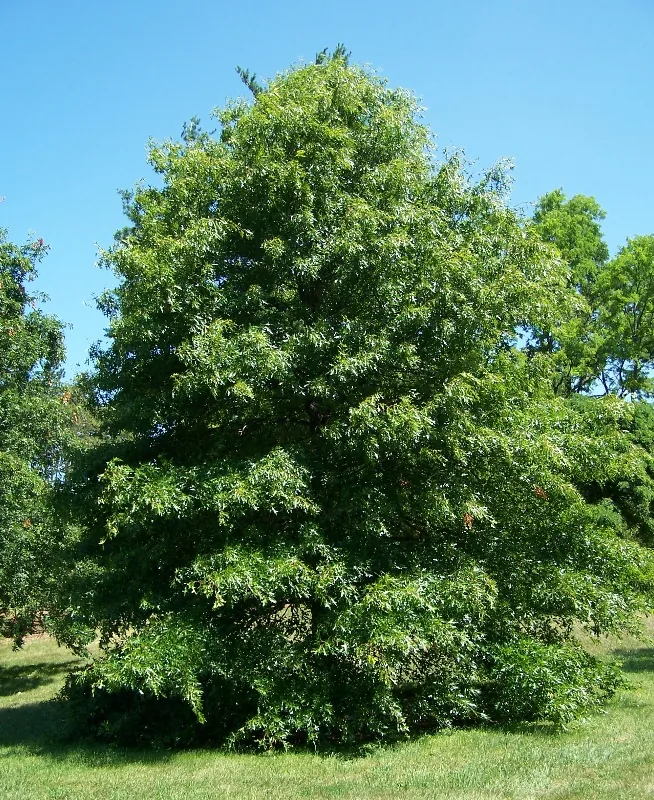
Pin oak ranks among the easiest and fastest oaks to establish, which accounts for its heavy use as a lawn and street tree throughout the eastern states. A member of the red oak group, it reaches 50 to 70 feet (15 to 21 m) on a strong central leader carrying a broadly pyramidal crown. Its branching is diagnostic: the lower limbs descend, the mid-canopy limbs are borne horizontally, and the upper limbs ascend, a three-tiered architecture that reads clearly even in the leafless season.
The autumn display is the principal ornamental asset. The deeply lobed leaves color deep red to bronze and persist well into cold weather, and young trees commonly retain dead foliage through winter, a phenomenon termed marcescence. As a bottomland native, the species tolerates saturated ground and brief flooding once established, which recommends it for a low, poorly drained corner of the landscape.
Soil reaction is the limiting factor. Pin oak demands acidic ground and develops iron chlorosis on alkaline sites, so a pH test should precede planting. Provided with suitable soil, full sun, and space for its wide crown, the tree grows rapidly and requires little subsequent intervention.
Care
The short version: full sun, moist acidic soil that drains, and room for a wide crown. Irrigate young trees through their establishment years, hold the pH on the acidic side, and confine pruning to the dormant season.
Light
Pin oak performs best in full sun, six hours or more daily, which supports its rapid growth and full autumn coloration. It endures partial shade, but a crowded or shaded specimen grows thin and drawn and never colors as it should.
Water
Young trees require consistent moisture through their first several seasons while the root system establishes, and again during pronounced drought. Once established, the tree accommodates persistently moist soil and even brief flooding, a legacy of its bottomland origin.
Soil
Soil reaction governs success here. Pin oak needs moist, acidic soil with a pH between 4.5 and 6.5 and adapts to clay or sand provided the ground is not limy. On alkaline soil the foliage yellows with iron chlorosis, so a soil test before planting is warranted.
Temperature
The species is broadly cold hardy, tolerating roughly -29°F to 100°F (-34°C to 38°C), which spans USDA zones 4 through 8. No special overwintering measures are needed once it is established.
Humidity
Ambient outdoor humidity is entirely adequate, so no target value applies. Soil moisture and pH are far more consequential to this tree than atmospheric conditions.
Feeding
An established pin oak seldom requires feeding. On alkaline ground the appropriate intervention is not a general fertilizer but iron chelate or elemental sulfur, applied in early spring to lower pH and correct chlorosis.
Pruning
Prune during late winter to early spring dormancy, removing dead, damaged, or crossing wood. The low, sweeping limbs may be raised for clearance, but wounding must be avoided from April through July in oak-wilt regions to reduce beetle-borne infection.
Repotting
Pin oak is a landscape tree, not a long-term container subject. Pot nursery seedlings up annually until they are planted out, after which the tree occupies its permanent site for life.
Size & spacing
Allow for a large tree, 50 to 70 feet (15 to 21 m) in height with a crown spreading 40 to 60 feet (12 to 18 m). Provide that space and keep it well clear of buildings, walks, and overhead lines.
When to plant
Pin oak is established by planting rather than scheduled sowing, and its shallow root system makes it readily transplanted. Set new trees in spring or fall, and expect inconspicuous catkins in April as the foliage emerges, with acorns maturing over their second autumn.
Northern hemisphere
Southern hemisphere
Typical months for a temperate climate: start earlier in warm zones, later where spring frosts linger.
- Sow: Not typically; sow stratified acorns outdoors or in deep pots in fall.
- Plant: Spring or fall; pin oak is shallow-rooted and easily transplanted.
- Harvest: Inconspicuous yellow-green catkins in April as leaves emerge; acorns mature the second autumn.
Hardiness
USDA hardiness zones: 4–8
Temperature: down to -34°C
Troubleshooting
Nearly all pin oak problems register in the foliage, and the color and distribution of the symptom generally identify the cause. Interveinal yellowing indicates a soil-chemistry issue, whereas marginal browning points toward infection or stress. Confirm the pattern below before selecting a treatment.
Marginal leaf scorch browning inward and intensifying annually
A marginal scorch that advances inward behind a narrow yellow band and intensifies season after season points to bacterial leaf scorch caused by Xylella fastidiosa, which colonizes the water-conducting xylem and starves the leaf margins. No cure exists once the pathogen is established, so management centers on sustaining vigor with consistent water and mulch while removing limbs in advanced decline. Because drought produces a similar marginal scorch, a laboratory assay for the bacterium is what separates the two.
Fix:
- No cure; manage by maintaining tree vigor with water and mulch
- Prune out severely affected limbs
- Remove and replace trees in steep decline
Abrupt wilting and foliar bronzing, often lethal in a single season
Abrupt crown dieback in summer within the red oak group is the signature of oak wilt, caused by Bretziella fagacearum, a vascular fungus that moves tree to tree through grafted roots and is carried to fresh wounds by sap beetles. Because spread relies on those two routes, control means severing the root grafts between adjacent oaks, removing infected trees quickly, and halting all pruning at the first sign. The strongest preventive is to keep from wounding oaks April through July, the window when beetle-borne spore mats and cut surfaces coincide.
Fix:
- Do not prune during the growing season once detected
- Sever root grafts between adjacent oaks
- Remove infected trees promptly to limit spread
Interveinal yellowing with green veins, most severe on recent growth
This interveinal yellowing is iron chlorosis, and on pin oak the trigger is soil chemistry rather than an actual deficiency in the ground. Above roughly pH 7 the iron shifts to a form the roots cannot take up, so the youngest expanding leaves, which draw hardest on iron, pale first. Correct the underlying pH with elemental sulfur for a durable result, and reserve iron chelate for cases that need a faster, if shorter-lived, recovery.
Fix:
- Lower soil pH by applying elemental sulfur
- Apply iron chelate as a soil drench or foliar spray for a quicker but temporary response
- Trunk-inject iron for established trees where soil treatment is impractical
Woody knob-like and horned galls on the twigs
The hardened twig swellings are oak galls, woody deformations that horned and gouty gall wasps induce as they develop within the shoot tissue. Despite their look, they seldom compromise a vigorous tree, so tolerance is the sound default. Prune out a few galled twigs where practical, and set chemicals aside, since spraying rarely alters the outcome for a gall this well defended.
Fix:
- Prune out and destroy galled twigs where practical
- Tolerate galls on otherwise healthy trees
Toxicity
Pin oak is valued as a shade tree, but the acorns, buds, and young leaves contain tannins that are toxic on ingestion. Horses and livestock are the most vulnerable, since a large acorn intake can damage the kidneys, and dogs that chew acorns risk gastrointestinal upset or obstruction. Rake up fallen acorns where animals graze, and keep inquisitive pets away from the drop.
Toxic to
Cats · Dogs · Horses · Rabbits · Livestock · Birds · People
Cats Mild
The gallotannins irritate the digestive tract, so a cat that chews an acorn or fallen leaf may drool, vomit, or refuse food for a day. Serious cases are uncommon because cats rarely consume a meaningful dose.
Dogs Mild
Dogs ingest acorns more readily than most pets, and the tannins provoke vomiting, diarrhea, and reduced appetite. A whole acorn also poses a mechanical obstruction risk, which warrants watching a small dog that has been foraging on the lawn.
Horses Severe
In horses, quantity is what turns exposure dangerous: grazed acorns or young leaves first cause colic and constipation that can progress to bloody diarrhea. The tannins are nephrotoxic in volume, so excluding horses from a dropping oak through autumn is the prudent measure.
Rabbits Caution
The tannin load that burdens other grazers makes oak an unsuitable and risky forage for rabbits, so leaves and acorns are best kept out of the hutch and run altogether.
Livestock Severe
Cattle, sheep, and goats are susceptible when acorns or buds make up a large share of intake, and the tannin dose drives kidney failure that can prove fatal. Hungry animals on depleted pasture consume the most, so clearing stock from oaks during a heavy drop targets the real risk.
Birds Caution
Many wild birds process whole acorns without ill effect, yet the raw tannins remain hard on the gut, which makes acorns an unwise offering for pet or backyard birds.
People Caution
Raw acorns are bitter and astringent from their tannin content and can upset the stomach if swallowed, which is why no one eats them uncooked. Traditional acorn flour becomes edible only after the tannins are leached out through repeated rinsing.
Acorns and leaves can cause stomach upset if chewed; rake up fallen acorns where pets graze. Livestock and horses eating large amounts can suffer serious kidney damage.
Helpline numbers

United States
ASPCA Animal Poison Control: (888) 426-4435 (fee applies)
Poison Control: (800) 222-1222



Canada
Poison Centres: 1-844-764-7669
Varieties
The straight species accounts for most nursery stock, but a few named selections exist for situations where the wide, pendulous habit is unworkable.
Green Pillar ('Pringreen')
A columnar selection with a narrow crown suited to confined sites and street plantings that cannot accommodate the wide-spreading species.
Crownright ('Crownright')
A cultivar selected for ascending lower branches, correcting the pendulous lower habit typical of the species.
How to propagate
The species is readily raised from its own acorns with modest patience, whereas the named selections must be grafted by a nursery to reproduce true.
SeedModerate
Collect ripe acorns in fall; sow outdoors immediately or cold-stratify before spring sowing. · Germinates the following spring; several years to a transplant-size sapling.
Seed is the standard route for the species, though the acorn carries dormancy that a moist chilling period of about 30 to 45 days is needed to break. Collect ripe acorns in fall and either sow them outdoors at once, letting winter supply the chill, or stratify them before a spring sowing. A float test culls nonviable seed, since acorns that rise or show weevil exit holes are hollow, after which germination follows the next spring and a transplant-size sapling takes several years to develop.
GraftingDemanding
Late winter under glass. · One growing season to unite.
Named cultivars are clonal and do not reproduce true from seed, so they are perpetuated by grafting or budding onto seedling rootstock. The operation is carried out under glass in late winter, and the graft union callouses and unites over a single growing season. The technical skill it demands is the reason these selections command a premium over an ordinary seedling oak.
Myths
The pin oak supposedly owes its common name to its slender, pin-like lower limbs.
The epithet more plausibly refers to the numerous short, slender dead twigs and spur-like stubs that remain after shaded lower branches die back. The species does retain drooping lower limbs, and juvenile trees exhibit marcescence, holding dead foliage through winter. The pins are the spur-like dead twigs, not the living branches.
Yellow foliage on pin oak indicates the tree is short on feed or water.
Interveinal yellowing is almost always iron chlorosis, a consequence of high soil pH rendering iron unavailable at the root rather than a shortfall of nutrients or moisture. General fertilizer or extra irrigation does not address the chemistry involved. The real fix is lowering the pH or adding iron, not feeding the tree harder.