Tree · Fagaceae
Bur Oak
Quercus macrocarpa
Bur oak is the white oak group's iron candidate, a slow, long-lived shade tree built to hold ground others cannot.
Full sun
Every 7–14 days
USDA 3–8
60–80 ft · 18.3–24.4 m
Overview
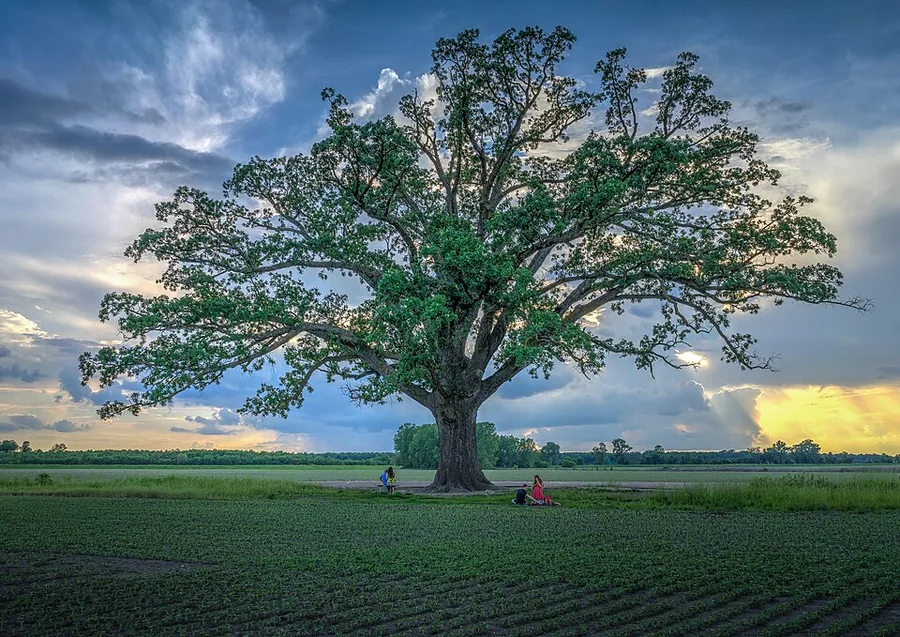
Quercus macrocarpa ranks among the most stress-tolerant trees in North America, a slow grower that compounds that slowness into centuries of standing and a mature frame of 60 to 80 feet (18 to 24 m) in both height and spread. Its place in the white oak group explains much of that resilience, letting it persist where softer species fail, from winter lows of -40°F (-40°C) to droughty uplands and the compacted, alkaline clay of urban sites.
The acorns rank as the largest of any native oak, occasionally 1.5 inches across, each seated in a deep, fringed cup whose mossy rim is the source of the name mossycup oak. Pollination runs through inconspicuous yellow-green catkins in April, and because this is a white oak, the acorn matures in a single season and drops that same fall.
Treat this as a long-horizon specimen that demands room. Sited in full sun and well clear of structures, foundations, and overhead lines, it draws on a broad root system and asks for little once established.
Care
The short version: full sun and generous spacing, almost any soil provided it drains, dependable water through establishment, and minimal intervention once the root system is in command.
Light
Bur oak performs best in full sun, six or more hours daily, which is what drives the broad, symmetrical crown the species is known for. Juveniles tolerate light shade, but a tree developed under heavy shade thins out and leans phototropically toward available light.
Water
Irrigate a young tree on a regular cycle through its first few years, the window in which it extends its root system, then withdraw support. A mature bur oak is very drought tolerant, drawing on deep roots to ride out extended dry periods, and warrants supplemental water only under severe drought.
Soil
Edaphic tolerance is exceptional here. The species favors moist, well-drained loam yet performs across clay, droughty ground, and even alkaline profiles, which accounts for its durability on difficult urban sites.
Temperature
Cold hardiness is fundamental to this tree, which functions across -40°F to 100°F (-40°C to 38°C) and is rated through USDA zones 3 to 8. Few thermal extremes within its native range register as stress.
Humidity
Atmospheric humidity is irrelevant to a bur oak in the landscape. The species occupies moist bottomlands and dry prairie margins with equal success, so there is no humidity parameter to regulate.
Feeding
An established bur oak rarely requires fertilization, mining nutrients across an extensive root run. On genuinely impoverished soil, a single balanced slow-release application in spring is sufficient.
Pruning
Confine pruning to late winter dormancy, removing dead, damaged, or crossing wood. Suspend all cutting from April through October, the period when sap-feeding beetles can introduce the oak wilt pathogen through a fresh wound.
Repotting
none
Size & spacing
Allow for an ultimate frame of 60 to 80 feet (18 to 24 m) in height and spread. Position it well clear of buildings, foundations, and utility lines so the broad crown and spreading root system have unconfined room to develop.
When to plant
A bur oak is established by transplant or direct seeding, not sown to a vegetable's calendar. Set container or balled-and-burlapped stock in spring while the soil works, or sow fresh acorns directly in fall. Flowering passes unremarked through April catkins, and the crop ripens and abscises that same autumn.
Northern hemisphere
Southern hemisphere
Typical months for a temperate climate: start earlier in warm zones, later where spring frosts linger.
- Plant: Plant balled-and-burlapped or container stock in spring; sow acorns outdoors in fall
- Harvest: Yellowish-green inconspicuous catkins in April; acorns mature in fall of the same year
Hardiness
USDA hardiness zones: 3–8
Temperature: down to -40°C
Troubleshooting
An established bur oak presents few problems, and most disorders that do appear are cosmetic. The exception that warrants real vigilance is oak wilt, so know its signature and the seasonal rules that suppress its transmission. Match the symptom below before intervening.
Crown foliage browning inward from the margins and dropping rapidly
The pattern points to oak wilt, a vascular fungus that occludes the xylem and progresses downward from the crown. As a white oak group member, bur oak typically declines over several seasons rather than collapsing in one, and both drought and root injury can reproduce the same appearance. Hold off on any pruning or wounding from April through October, when the sap-feeding vector beetles are active, and have a certified arborist confirm the diagnosis by laboratory culture of the sapwood.
Fix:
- Avoid wounding or pruning oaks April through October
- Contact a certified arborist or extension diagnostic lab for confirmation
- Sever root grafts between adjacent oaks where feasible
- Remove and properly dispose of severely infected trees to limit spread
Abnormal bumps, balls, or swellings on leaves and twigs
These structures are galls, formed when gall wasps or mites oviposit and the tree responds by enclosing the developing larva in protective tissue. They are conspicuous but rarely compromise a vigorous oak, so the standard recommendation is to tolerate them. Excise a few heavily galled twigs if their appearance is objectionable, and sustain tree vigor through proper watering rather than chemical control.
Fix:
- Tolerate galls in most cases as they rarely harm tree health
- Prune out and dispose of heavily galled twigs if desired
- Maintain tree vigor with proper watering
Toxicity
This is a valued shade species, but the acorns, buds, and young foliage are not fit for consumption. They concentrate tannins (gallotannin) that irritate the gastrointestinal tract in cats and dogs, present a choking and obstruction hazard when a whole acorn is swallowed, and drive serious nephrotoxic injury in horses and livestock that consume them in quantity. Clear the autumn drop from areas pets and stock can reach, and note that raw acorns are unsuitable for people as well.
Toxic to
Cats · Dogs · Horses · Rabbits · Livestock · Birds · People
Cats Mild
A cat that ingests foliage or a fallen acorn commonly responds with vomiting, anorexia, and loose stool. A whole acorn additionally constitutes a genuine choking and gastrointestinal obstruction hazard in an animal of that size.
Dogs Mild
Dogs are the species most prone to scavenging acorns from the ground, which provokes hypersalivation, gastric upset, and diarrhea. The graver concern is obstruction from a swallowed acorn lodged in the gut, so monitor for persistent vomiting or abdominal tenderness.
Horses Severe
Horses are affected severely. Substantial intake of acorns, buds, or young leaves can produce colic, constipation progressing to hemorrhagic diarrhea, depression, and dark urine, with the tannins capable of inflicting renal injury.
Rabbits Toxic
Rabbits should be excluded from oak entirely. The tannin load in leaves, buds, and acorns exceeds what their gut can process, and even a minor nibble can leave an individual inappetent and lethargic.
Livestock Severe
Cattle, sheep, and goats are at real risk from heavy intake of buds, leaves, or acorns, particularly when alternative forage is scarce in fall. The outcome ranges through renal damage and weakness to mortality in serious cases, so fencing stock away from mast-dropping oaks is warranted.
Birds Caution
Many wild birds dehusk and consume acorns without consequence, yet the same tannins can affect pet birds and poultry, and a whole acorn is too large and hard for most to manage safely. Withhold acorns from caged birds and supervise backyard flocks ranging beneath a tree.
People Caution
People do not consume raw acorns, and a mouthful is bitter and gastrically irritating owing to the tannins. Traditional acorn preparations are leached for hours beforehand, so regard anything taken straight from the tree as inedible and keep young children from mouthing them.
Rake up and dispose of fallen acorns and leaves where pets and livestock can access them.
Helpline numbers

United States
ASPCA Animal Poison Control: (888) 426-4435 (fee applies)
Poison Control: (800) 222-1222



Canada
Poison Centres: 1-844-764-7669
Varieties
Bur oak is planted overwhelmingly as the straight species, though it hybridizes where ranges overlap. The two forms below are the ones worth recognizing.
Quercus macrocarpa (species)
The straight species produces the largest acorns of any North American oak, reaching 1.5 inches across, each held in a deep cup whose fringed, mossy rim accounts for both common names, bur oak and mossycup oak.
Quercus × schuettei
Quercus x schuettei is a natural hybrid of bur oak and swamp white oak that arises in zones of sympatry, expressing foliage and acorn characters intermediate between the two parents.
How to propagate
The most reliable route to a bur oak is direct seeding of an acorn, and the white oak group obliges because the seed germinates quickly with little induced dormancy to overcome.
SeedModerate
Collect ripe acorns in fall and sow promptly outdoors or stratify before spring sowing · Acorns germinate within a few weeks; seedlings rapidly develop a deep taproot, making later transplanting difficult
Bur oak propagates readily from seed when fresh acorns are used. Collect the ripe mast as it abscises and sow it directly that autumn, since white oak acorns carry almost no dormancy and germinate within a few weeks. Provenance matters at the cold extreme: acorns from far northern sources respond to 30 to 60 days of cold, moist stratification at 32°F to 41°F (0°C to 5°C) ahead of spring sowing. Sow in situ at the intended planting position, because the seedling commits to a deep taproot almost immediately and tolerates transplanting poorly thereafter.
Myths
Acorns are safe for pets and livestock because wild animals eat them routinely.
Native browsers and granivores such as deer, squirrels, and jays are physiologically adapted to the tannins in acorns, buds, and foliage, whereas cats and dogs develop gastrointestinal upset and horses and livestock can sustain serious renal damage at high intake. Adaptation in wildlife does not extend to domestic animals, so clear the mast and exclude stock from it.