Tree · Fagaceae
Southern Live Oak
Quercus virginiana
A sprawling, long-lived shade tree that wants room to grow and little else once it settles in.
Full sun
Every 7–14 days
USDA 8–10
40–80 ft · 12.2–24.4 m
Overview
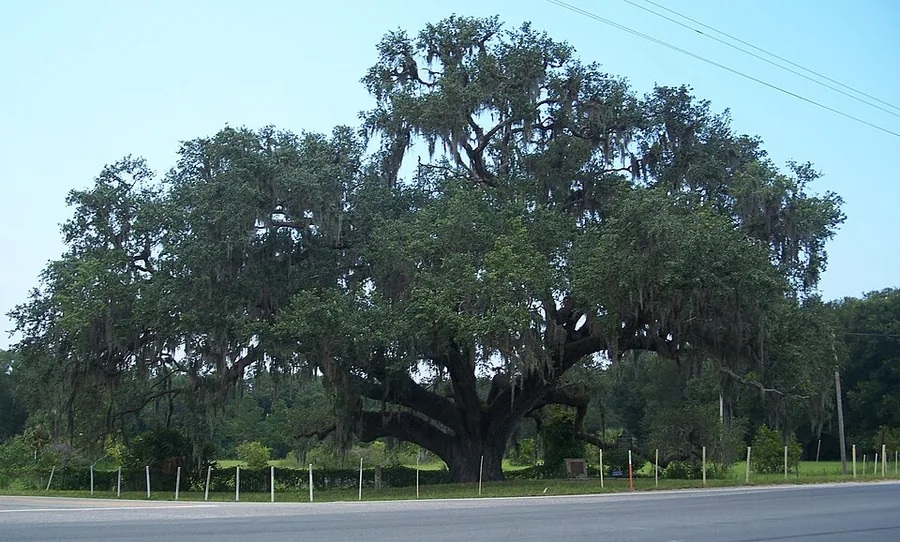
The Southern live oak is the wide, moss-hung shade tree of the coastal South, distinctive for a canopy that often spreads well beyond the tree's own height. It is functionally evergreen because it retains most of its foliage through winter and sheds the old leaves in spring precisely as the new flush expands, so the crown is never bare. Over decades a single specimen matures into a defining feature of its landscape.
Its horticultural value rests on a wide tolerance for site conditions. It roots in sand, loam, or clay, withstands the salt spray of coastal exposures, and endures drought once an established root system reaches deeper moisture. Rated for USDA zones 8 to 10, it grows at a moderate rate and persists for generations, which explains why it is so often planted as a legacy tree.
The governing constraint is dimension. A mature canopy can reach 40 to 80 feet (12 to 24 m) across and carries heavy, near-horizontal limbs that demand unobstructed ground. Placed at a proper distance from the house, paving, and overhead lines, it delivers a quality of shade few other trees can equal.
Care
The short version: full sun and nearly any soil, supplemental water only through establishment, and a disciplined summer prune to limit oak wilt, after which the tree is largely self-sufficient.
Light
Site a live oak in full sun for the densest, best-balanced crown, since maximum light supports uniform canopy development. It performs adequately in partial sun or light shade, but exposure in the open yields a fuller, more symmetrical structure.
Water
Irrigate a young tree on a regular cycle, about every 7 to 14 days, until its root system establishes and can draw its own moisture. Thereafter a mature live oak is highly drought tolerant and seldom requires supplemental water, having rooted deeply enough to sustain itself.
Soil
Its edaphic tolerance is unusually broad. It grows in sand, loam, or clay, accepts both acidic and alkaline conditions across pH 5.0 to 7.5, endures occasional saturation, and withstands coastal salt. Optimal growth still occurs in moist, well-drained, slightly acidic soil.
Temperature
Adapted to the warm South, it tolerates roughly 10°F to 100°F (-12°C to 38°C). That range spans intense summer heat at one extreme and the hard freezes that occur at the cold margin of its zones at the other.
Humidity
Ambient outdoor humidity is entirely sufficient, so no target level applies. The species is native to the humid coastal South, where atmospheric moisture is consistently high.
Feeding
An established tree in reasonable soil requires no fertilization, as its extensive roots meet its own nutrient demand. Apply a balanced slow-release tree fertilizer in spring only where growth is demonstrably poor.
Pruning
Confine pruning to mid to late summer, when the beetles that vector oak wilt are least active and the infection risk from fresh wounds is lowest. Remove dead, crossing, or weak branches and develop sound structure while the tree is young, since large cuts on a mature oak are best avoided.
Repotting
A live oak is unsuited to long-term container culture. Transplant it from the nursery pot into open ground before the roots begin to circle, and once planted, it remains in place for its full lifespan.
Size & spacing
This is a large tree that attains 40 to 80 feet (12 to 24 m) in height with a crown spreading 60 to 120 feet (18 to 37 m) across. Allot that full width of open ground and keep it well removed from buildings, paving, and utilities.
When to plant
A tree of this eventual size is not hurried, and it has no narrow planting window to meet. Establish a young live oak in fall or early spring, when the soil is workable and the roots can extend before summer heat or hard cold arrives. Flowering is limited to inconspicuous spring catkins, and the acorns ripen and fall in autumn.
Northern hemisphere
Southern hemisphere
Typical months for a temperate climate: start earlier in warm zones, later where spring frosts linger.
- Plant: Fall or early spring
- Harvest: Inconspicuous spring catkins; acorns mature in fall
Hardiness
USDA hardiness zones: 8–10
Temperature: down to -12°C
Troubleshooting
A vigorous live oak presents few problems, and the majority of what appears is cosmetic rather than threatening. The exception that merits real attention is oak wilt, which is the reason the pruning window is set where it is. Identify the symptom below before undertaking any cuts.
Progressive wilt, browning, and crown decline
These symptoms point to oak wilt, a vascular fungus that colonizes and occludes the water-conducting tissue, which starves the crown of moisture and produces the wilt and dieback that advance limb by limb. The dark vascular streaking in the wood reflects that internal blockage. No treatment reverses an established infection, so verify it through an extension office or diagnostic lab, confine pruning to mid to late summer, and sever root grafts between adjacent oaks where advised, since the fungus travels through those root connections.
Fix:
- Avoid pruning during active beetle season; prune only in mid-to-late summer
- Remove and properly dispose of infected trees per extension guidance
- Sever root grafts between adjacent oaks where recommended
Galls and blister lesions on foliage and twigs
Rounded swellings are insect galls, abnormal tissue the tree grows in response to gall wasps or mites, whereas raised blisters indicate infection by the leaf fungus Taphrina. Both are essentially cosmetic and draw on too little of the canopy to affect a vigorous tree. Raking and removing fallen foliage reduces the overwintering inoculum behind leaf blister, while galls warrant no intervention at all.
Fix:
- Tolerate galls, which rarely harm the tree
- Rake and remove fallen infected leaves to reduce leaf blister
- Maintain tree vigor with proper watering
Toxicity
This is a prized shade tree, but its acorns, buds, and young leaves contain tannins that are not safe to consume. Dogs and cats that ingest small amounts develop gastrointestinal upset, whereas horses and grazing livestock consuming large quantities risk serious, sometimes fatal kidney damage. Prevent animals from feeding on fallen acorns and clippings, particularly in autumn.
Toxic to
Cats · Dogs · Horses · Rabbits · Livestock · Birds · People
Cats Mild
In a cat, a nibbled leaf or acorn delivers enough tannin to irritate the gut, producing vomiting, loose stool, and a day or two of reduced appetite. The episode is usually self-limiting, though abdominal discomfort is typical while it resolves.
Dogs Mild
Chewed acorns or foliage bring vomiting, diarrhea, and a dulled appetite in dogs. Beyond the tannin effect, a whole swallowed acorn can obstruct the gut mechanically, so persistent straining or repeated retching warrants veterinary care.
Horses Severe
Horses are notably sensitive once intake climbs, presenting first with colic and gastric upset. A large ingestion of acorns or young leaves delivers a tannin dose high enough to cause nephrotoxic kidney injury that can prove fatal.
Rabbits Toxic
Oak is unsuitable forage for rabbits, whose hindgut fermentation depends on a steady supply of mild greens. The tannins in leaves and acorns disrupt that delicate gut balance, so exclude all clippings and fallen acorns from the hutch and run.
Livestock Severe
Cattle, goats, and sheep grazing acorns and buds in quantity absorb the largest tannin loads and suffer the gravest outcomes. Early constipation progresses to dark, bloody diarrhea, and in severe cases renal tubular failure ends fatally.
Birds Caution
Many wild birds process whole acorns without ill effect, but the raw tannins are comparatively harsh on the smaller digestive tract of a pet bird. As a precaution, withhold oak leaves and whole acorns from cage birds entirely.
People Caution
Raw acorns are unpalatably bitter because their tannin content is high, and eating them can upset the stomach. They become edible only after extended leaching removes the tannins, so keep small children from mouthing acorns off the ground.
Keep pets and livestock from grazing on fallen acorns, buds, and leaves, particularly in fall.
Helpline numbers

United States
ASPCA Animal Poison Control: (888) 426-4435 (fee applies)
Poison Control: (800) 222-1222



Canada
Poison Centres: 1-844-764-7669
Varieties
The species itself accounts for most nursery stock, though a few selected clones exist for growers who require a defined crown form.
Cathedral Oak
This is a selected cultivar valued for the even, symmetrical dome its canopy develops with maturity.
Highrise
Highrise departs from the broad, sprawling species habit by growing taller and narrower, which fits it to more confined sites.
How to propagate
Live oak propagates readily from its own acorns, and the single real constraint is timing, because the seed does not remain viable in storage.
SeedEasy
Sow fresh acorns in fall as soon as they mature · Germinates within weeks to a few months; several years to a sapling
Live oak propagates reliably from its own acorns, which are recalcitrant seed. Collect them ripe in fall and sow immediately, because a dried or stored acorn loses viability and will not germinate. A fresh acorn strikes root within weeks to a few months, after which the seedling needs several years of steady growth to reach sapling size.
Myths
Spanish moss growing in a live oak is a parasite that slowly kills the tree.
Spanish moss is an epiphyte, meaning it uses the branches only as a physical perch and derives its moisture and nutrients from the air rather than from host tissue. It draws nothing from the tree and causes it no harm, so removal serves no horticultural purpose.