Tree · Fagaceae
White Oak
Quercus alba
A slow, structural native that repays the patient grower with a century of shade and a heavy acorn crop for wildlife.
Full sun
Every 7–14 days
7300–9125 days
USDA 3–9
Overview
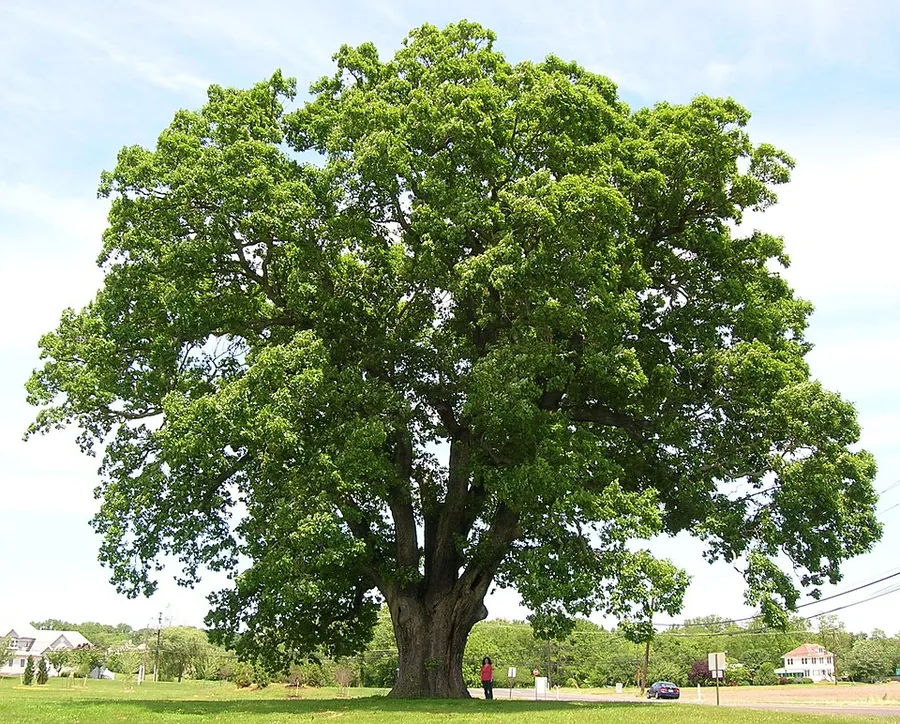
Quercus alba ranks among the defining hardwoods of the eastern North American forest, a slow-growing, exceptionally long-lived shade tree that develops a broad, rounded crown over many decades. The foliage is diagnostic: deep, rounded lobes without bristle tips, which separates the white oak group from the bristle-tipped red oaks. Its bark matures to a pale, scaly gray, the trait behind the common name.
Mature dimensions govern siting more than any other factor. The tree attains 50 to 100 feet (15 to 30 m) in height and nearly the same in spread, so it belongs on open ground clear of structures, foundations, and overhead lines. A pronounced taproot develops early, which anchors the mature tree but also makes established specimens effectively immovable, hence the emphasis on transplanting only while young.
The autumn acorn crop feeds jays, squirrels, turkeys, and deer, and white oak acorns are comparatively low in tannin among the oaks. Even so, the leaves, buds, and acorns carry tannins that are toxic to pets and dangerous to grazing horses and cattle, so placement relative to livestock and animals is a genuine horticultural consideration.
Care
The short version: site it in full sun on deep, moist, slightly acidic, well-drained soil. Irrigate through establishment across the first year or two to build the root system, then treat a mature tree as largely self-sufficient, and confine pruning to full dormancy.
Light
Site white oak in full sun to develop the strongest, most complete crown; juveniles will tolerate partial shade. Open exposure drives the broad, symmetrical canopy characteristic of the species, since unshaded lateral branches extend evenly.
Water
Deep, regular irrigation through the first 1 to 2 years builds the root system that later confers drought tolerance, after which supplemental water can be reduced. The species resents saturation, so avoid wet sites and provide moist, well-drained soil to keep the roots aerated.
Soil
Optimal growth occurs on deep, moist, well-drained loam that is mildly acidic, at a pH of 5.0 to 6.5. The tree adapts to clay, loam, or sand, but rich acidic loam yields the best performance, and alkaline soil restricts iron availability, producing iron-deficiency chlorosis in the foliage.
Temperature
Cold hardiness spans USDA zones 3 to 9, with tolerance of winter minima near -40°F (-40°C) and summer maxima around 95°F (35°C). That amplitude accounts for the species' range across most of the eastern half of the continent.
Humidity
Ambient outdoor humidity is sufficient, so there is no target to maintain. Canopy air movement is the more relevant factor, because still, humid conditions within crowded foliage favor the leaf-infecting fungi.
Feeding
A white oak on reasonable soil rarely requires fertilization. Where the soil is poor or growth is weak, apply a balanced slow-release tree fertilizer in early spring, and monitor for the interveinal yellowing that elevated soil pH induces through restricted iron uptake.
Pruning
Confine pruning to late fall or winter dormancy, because growing-season wounds release volatiles and sap that attract the beetles vectoring oak wilt. Remove dead, damaged, or crossing branches, and establish a single strong central leader during the juvenile years to build sound structure.
Repotting
Repotting does not apply to a landscape tree. Container saplings should be planted out while young, before the deep taproot circles or girdles within the container, as older specimens transplant poorly once that root has extended.
Size & spacing
Allocate generous space: mature height reaches 50 to 100 feet (15 to 30 m) with a spread of 50 to 80 feet (15 to 24 m). Position it well away from buildings and utilities so the crown can develop its full architecture unimpeded.
When to plant
White oak phenology is driven by the acorn, which matures in a single season and carries little dormancy, so it germinates almost immediately at seed fall in autumn. The inconspicuous catkins responsible for that crop open earlier, in April and May. In practice this means sowing in fall as the acorns drop and shifting any seedling in early spring, before the taproot descends beyond easy transplanting.
Northern hemisphere
Southern hemisphere
Typical months for a temperate climate: start earlier in warm zones, later where spring frosts linger.
- Sow: Not typically; acorns are best sown outdoors. If started in deep containers, sow fresh acorns in fall before the radicle emerges.
- Plant: Sow fresh acorns outdoors in fall as soon as they drop; transplant young seedlings in early spring while the taproot is still small.
- Harvest: Inconspicuous yellowish-green catkins in April-May; acorns mature in one season and ripen in fall (September-October).
Hardiness
USDA hardiness zones: 3–9
Temperature: down to -40°C
Troubleshooting
A vigorous white oak tolerates most foliar and insect pressure, and the leaf spotting and defoliation you will encounter seldom affects long-term health. The exception that warrants attention is oak wilt, a vascular disease, so the key diagnostic skill is separating rapid crown dieback from cosmetic damage. Identify the symptom below before intervening.
Rapid top-down crown dieback and leaf loss
This pattern indicates oak wilt, a vascular fungus vectored by sap beetles and transmitted below ground through root grafts between adjacent oaks. White oaks are more resistant than red oaks yet remain susceptible, and once established the disease can kill a tree within a single season. Engage a certified arborist or extension office, secure a laboratory culture for confirmation, and disrupt the root grafts between neighboring oaks where site conditions allow.
Fix:
- Contact a certified arborist or extension office promptly
- Remove and properly dispose of severely infected trees
- Sever root grafts between adjacent oaks where feasible
- Avoid pruning during the growing season
Vein-associated tan lesions following a cool, wet spring
Cool, wet spring conditions favor anthracnose, a foliar fungus that produces tan necrotic patches and some premature leaf drop; raised yellow-green distortions instead indicate oak leaf blister. Neither materially compromises an established tree, so the appropriate response is sanitation, raking and removing fallen leaves and thinning crowded branches to improve airflow, with fungicide rarely justified.
Fix:
- Rake and dispose of fallen infected leaves
- Improve air circulation by thinning overcrowded branches
- Fungicides are rarely warranted on established shade trees
Defoliation from chewing insects and firm growths on twigs
The chewing damage is typically caterpillar feeding, from spongy moth, orangestriped oakworm, or oak skeletonizer, while the firm growths on leaves and twigs are galls induced by cynipid wasps and mites. A healthy tree compensates for light defoliation, so tolerate minor feeding, hand-pick or prune localized infestations and galls, and reserve chemical control for a heavy spongy moth outbreak.
Fix:
- Tolerate minor feeding on otherwise healthy trees
- Hand-pick or prune out localized infestations and galls
- For heavy spongy moth outbreaks consult extension for recommended controls
Toxicity
The toxicological profile here is significant around animals. Leaves, buds, and particularly acorns contain tannins, which are hydrolyzed in the gut to gallic acid and related compounds, producing effects that range from mild gastrointestinal upset in pets to fatal nephrotoxicity in horses and grazing livestock. Remove fallen acorns where animals have access, exclude stock from oak pasture during heavy drop, and note that acorns intended for human use require tannin leaching first.
Toxic to
Cats · Dogs · Horses · Rabbits · Livestock · Birds · People
Cats Caution
Ingestion of acorns or leaves can produce vomiting, diarrhea, inappetence, and abdominal tenderness in cats, driven by the tannins. Removing fallen acorns from areas the cat frequents is the practical control.
Dogs Caution
Dogs that gnaw acorns or leaves may show vomiting, diarrhea, and reduced appetite, and a swallowed whole acorn adds a mechanical risk of gastrointestinal obstruction, which is the more serious concern in a persistent chewer.
Horses Severe
Horses represent the highest-risk species. Browsing young spring leaves, buds, or green acorns can cause colic and abdominal pain, constipation progressing to bloody diarrhea, depression, frequent urination with darkened urine, jaundice, and potentially fatal renal damage.
Rabbits Caution
Oak is not suitable forage for rabbits, whose sensitive gastrointestinal tract is readily disturbed by the tannins present in the leaves and acorns, so both should be kept entirely inaccessible.
Livestock Severe
In cattle, sheep, and other grazers, consumption of substantial quantities of oak leaves, buds, or acorns causes inappetence, depression, and dark or bloody feces. The tannins are converted to gallic acid in the gut, producing severe and often fatal kidney damage, with incidence highest during drought when alternative forage is limited.
Birds Caution
Wild corvids and turkeys use acorns as a staple, but the same tannins pose a quantitative risk to pet and backyard birds, so oak parts should not be regarded as safe feed for them.
People Caution
Raw acorns are bitter and gastrointestinally irritating owing to their tannin content, becoming edible only after the tannins are leached or boiled out. Treat any unprocessed acorn as a caution and prevent children from ingesting them off the ground.
Rake up and dispose of fallen acorns and leaf litter where pets, horses, or cattle have access, especially in fall and after storms; keep livestock off oak-heavy pasture during heavy acorn drop or in drought years when other forage is scarce.
Helpline numbers

United States
ASPCA Animal Poison Control: (888) 426-4435 (fee applies)
Poison Control: (800) 222-1222



Canada
Poison Centres: 1-844-764-7669
Varieties
White oak is cultivated almost exclusively as the wild species; only one naturally occurring leaf-form variant is worth distinguishing.
Quercus alba (species)
The species is recognized by leaves 4 to 9 inches long bearing 5 to 9 deep, rounded, bristleless lobes, light ashy-gray scaly bark, and sweet edible acorns up to about 1 inch long that are heavily used by wildlife.
Forked-leaf white oak (forma)
The distinction of this natural leaf-form lies in its narrower lobes, which are more deeply and irregularly forked than the foliage of the typical white oak.
How to propagate
Propagation is by seed, and the operative constraint is the acorn's near-absence of dormancy. Because it germinates on falling, fresh sowing outperforms any stored-seed approach.
SeedModerate
Collect and sow fresh acorns in fall as soon as they drop · Acorns germinate within a few weeks of falling; a sturdy taproot forms the first autumn, with above-ground seedling growth the following spring
White oak establishes readily from seed, but the acorn's near-lack of dormancy sets the schedule. Because the seed germinates almost as soon as it drops, collect acorns fresh in autumn and sow them before the radicle emerges. A robust taproot forms in that first autumn while shoot growth is deferred to spring, which is precisely why transplanting should occur only in the seedling stage. Protecting the sown acorns from rodents is essential, since predation can eliminate a crop before germination.
Myths
White oak acorns are safe for people to eat raw because squirrels and deer consume them.
Wildlife tolerance of tannins far exceeds that of humans, so the comparison does not hold. Raw acorns are bitter and irritate the digestive tract, and the tannins must be leached or boiled out before human consumption. In quantity, raw oak is toxic to pets and genuinely dangerous to horses and livestock.
Oaks can be pruned at any time of year without consequence.
Timing is more consequential for oaks than for most trees. Restrict pruning to the dormant season, because spring and summer wounds attract the sap beetles that transmit oak wilt. If a wound must be made during active growth, seal it immediately.