Tree · Fagaceae
Northern Red Oak
Quercus rubra
A fast native oak that delivers deep shade and brilliant red fall color across a long lifespan.
Full sun
Every 7–14 days
USDA 3–8
50–75 ft · 15.2–22.9 m
Overview
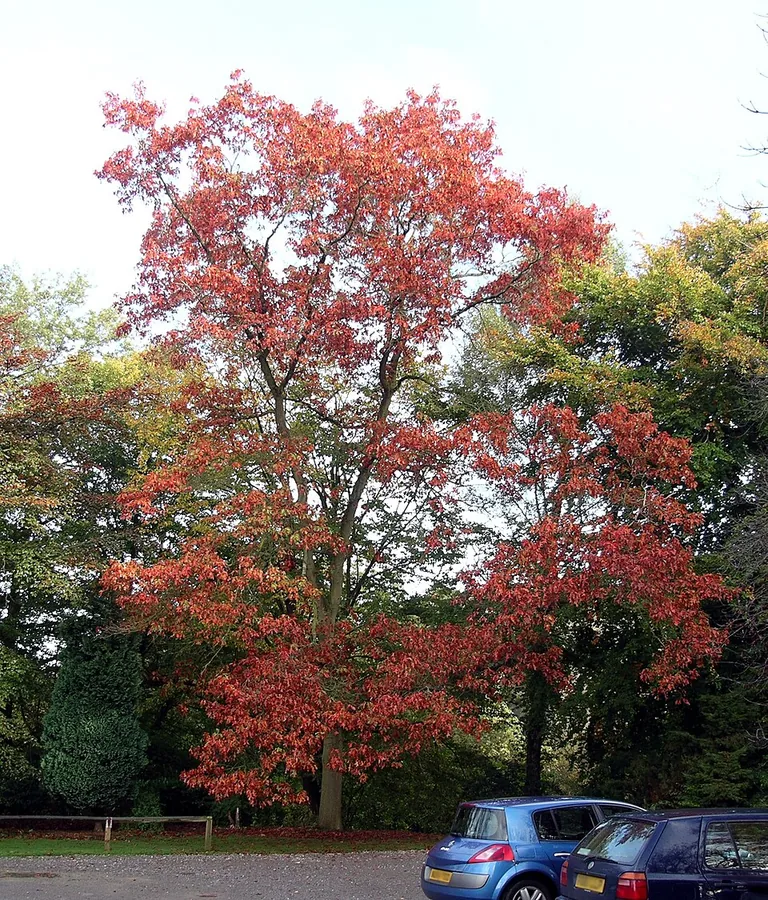
Northern red oak, Quercus rubra, is the archetypal shade oak of eastern North America and a member of the beech family. Left to mature, it reaches 50 to 75 feet (15 to 23 m) and forms a broad, rounded crown. Its long pale bark ridges and pointed, bristle-tipped leaf lobes place it squarely in the red oak group rather than among the white oaks.
The defining trait is growth rate. Red oak lays down height faster than most oaks, which is why municipalities favor it where usable shade is wanted within a single generation. Its tolerance of compacted city soil and road grit suits it to streets, and cool autumn nights trigger the shift to russet and brilliant red.
Once past establishment, the tree is largely self-sufficient given adequate room and suitable ground. The horticultural caution is chemical: tannins concentrated in the acorns and young leaves make the tree hazardous to grazing animals, which is why it belongs in landscape settings rather than pasture.
Care
The short version: site it in full sun on deep, acidic, well-drained soil, irrigate through the first few years while the taproot develops, after which the root system supports the tree on its own.
Light
Red oak demands full sun to develop straight, dense growth, though juveniles tolerate partial shade. Sufficient light drives the broad, symmetrical crown that gives the species its value as a shade tree.
Water
Irrigate young trees through the first few years while the root system extends downward, allowing the top half of the soil to dry between waterings to keep the roots aerated. After establishment the species is drought tolerant, drawing on its deep roots to persist on rainfall through all but extreme drought.
Soil
Provide deep, fertile, well-drained soil in the acidic range, a pH of 4.5 to 7.0. On alkaline ground the roots cannot mobilize iron, producing the interveinal chlorosis this species is prone to, so a moist loam or sandy loam is ideal.
Temperature
Cold hardiness is exceptional, with tolerance to -40°F (-40°C), and the species withstands summer maxima near 100°F (38°C). That amplitude spans much of the temperate zone.
Humidity
Ambient outdoor humidity is sufficient, so no target level applies. Canopy air movement carries more weight, because still, humid air within a dense crown favors infection by foliar fungi.
Feeding
An established landscape oak seldom requires supplemental nutrition. Only on genuinely poor soil is a balanced slow-release tree fertilizer in early spring warranted, and no further feeding is needed.
Pruning
Prune strictly within winter dormancy and never from April through June, the period when fresh cuts attract the beetles that transmit oak wilt. Limit cuts to dead, damaged, or crossing branches.
Repotting
Container culture is temporary; this species matures into a forest-scale tree. Transplant only while young, before the deep taproot commits, and site it permanently, because the deep taproot makes an older tree difficult to move.
Size & spacing
At maturity the tree occupies 50 to 75 feet (15 to 23 m) in height and 40 to 65 feet (12 to 20 m) in spread. Allow generous clearance from structures and overhead power lines.
When to plant
Red oak follows a strict phenological cycle. Acorns ripen and drop in fall and require a cold winter to break dormancy before germination, so sow in autumn or transplant young saplings in early spring. Confine pruning to midwinter dormancy to avoid the spring window when fresh wounds attract the beetles that vector oak wilt.
Northern hemisphere
Southern hemisphere
Typical months for a temperate climate: start earlier in warm zones, later where spring frosts linger.
- Sow: Stratify acorns over winter (60-90 days cold-moist) and sow in deep containers in late winter to early spring
- Plant: Plant acorns in fall or transplant young saplings in early spring
- Harvest: Inconspicuous yellow-green catkins in spring; acorns mature over two growing seasons and drop in fall
Hardiness
USDA hardiness zones: 3–8
Temperature: down to -40°C
Troubleshooting
An established red oak is resilient, and most disorders present first in the foliage. Oak wilt is the one lethal threat; the remainder are cosmetic or self-limiting. Identify the symptom below, then respond according to its severity.
Rapid crown bronzing and vascular collapse in summer
This is oak wilt, caused by a fungus that colonizes and occludes the xylem, cutting off water transport, and red oaks are highly susceptible. Foliage dulls, bronzes inward from the margins, and abscises as the upper crown fails, occasionally killing a mature tree within a single season. Secure a laboratory diagnosis, remove the tree promptly, and disrupt the root grafts connecting adjacent oaks to arrest underground transmission.
Fix:
- Remove and properly dispose of infected trees promptly
- Sever root grafts between adjacent oaks to limit underground spread
- Avoid wounding or pruning healthy oaks April-June
Vein-delimited leaf necrosis following a cold, wet spring
Oak anthracnose is a foliar fungus favored by prolonged cool, wet spring weather, when free moisture allows infection. It produces brown lesions along the veins, distorts expanding leaves, and kills scattered twigs, but rarely compromises an established tree. Rake and destroy infected litter to remove overwintering inoculum, prune out dead twigs, and improve canopy air movement.
Fix:
- Rake and destroy fallen infected leaves
- Prune out dead twigs
- Apply labeled fungicide early in the season before bud break only in severe cases
Progressive canopy defoliation by hairy caterpillars
Spongy moth larvae, formerly the gypsy moth, can defoliate a crown in late spring to early summer. A vigorous oak withstands a season of this and refoliates from reserves with a second flush, so isolated outbreaks seldom prove serious. Scrape overwintering egg masses from the bark, apply sticky bands or hand-pick light infestations, and irrigate to support the tree through defoliation.
Fix:
- Hand-pick or use sticky bands on trunks for small infestations
- Apply Bacillus thuringiensis (Bt) to young larvae
- Support tree vigor with water during defoliation years
Interveinal chlorosis concentrated on the newest foliage
Iron chlorosis develops where soil pH is too high for the roots to take up iron, so the leaf yellows between the veins while the veins retain chlorophyll, most acutely on new growth with the highest demand. Acidify the soil gradually with elemental sulfur and treat an affected tree with chelated iron, but the durable correction is establishing the tree on acidic soil at planting.
Fix:
- Lower soil pH with elemental sulfur over time
- Apply chelated iron as a soil drench or foliar spray
- Improve soil drainage and aeration
Toxicity
For any operation keeping animals, treat this as a hazard tree. The leaves, buds, and green acorns hold tannins that irritate the digestive tract and, in horses and livestock, cause renal damage severe enough to be fatal. Raw acorns are unpalatable and astringent until leached, so keep grazing stock, pets, and small children away from fallen material.
Toxic to
Cats · Dogs · Horses · Rabbits · Livestock · Birds · People
Cats Mild
A cat ingesting a leaf or acorn typically shows mild gastrointestinal upset, with vomiting, loose stools, and anorexia. Cats rarely consume a toxic quantity, but fallen acorns should still be cleared from areas a cat frequents.
Dogs Mild
Dogs are the pet most inclined to chew acorns, producing vomiting, diarrhea, and reduced appetite. A quantity of whole acorns can also cause gastrointestinal obstruction, so clearing them from a dog's foraging area is advisable.
Horses Severe
Horses are highly sensitive to oak. Consumption of young leaves, buds, or green acorns causes colic, constipation progressing to bloody diarrhea, lethargy, frequent urination, dark urine, jaundice, and potentially fatal renal damage.
Rabbits Toxic
The tannin concentration in oak foliage and acorns exceeds what a rabbit's digestive tract can handle, so no part of the tree should reach a hutch. Even minor ingestion can cause anorexia and distress.
Livestock Severe
Cattle, sheep, and goats grazing young leaves, buds, or green acorns can develop gastrointestinal ulceration and renal failure as tannins accumulate. A sufficient intake is fatal, and stock will actively seek fallen acorns after storms, so exclusion is essential.
Birds Caution
Native jays and woodpeckers process acorns as dietary staples, but raw tannins are harsh on backyard poultry and cage birds. Pet birds should be kept away from foliage and green acorns.
People Caution
Raw acorns are bitter and astringent from their tannin content and are unfit to eat straight from the tree. Traditional preparation relies on prolonged leaching in water, and small children should be prevented from mouthing acorns or leaves.
Keep livestock and horses away from oak leaves, buds, and fallen green acorns; pick up acorns where pets forage. Most poisoning occurs when animals eat large amounts.
Helpline numbers

United States
ASPCA Animal Poison Control: (888) 426-4435 (fee applies)
Poison Control: (800) 222-1222



Canada
Poison Centres: 1-844-764-7669
Varieties
The nursery trade offers the straight species almost exclusively, but two named selections are documented.
Aurea
Aurea flushes bright golden yellow foliage that matures to green, a selection seldom encountered in commerce.
Splendens
Splendens was selected for a notably clean, brilliant red autumn color.
How to propagate
Red oak propagates readily from its own seed, provided the acorn receives the cold, moist period its embryo requires to break dormancy.
SeedModerate
Collect ripe acorns in fall; sow outdoors immediately or stratify over winter and sow in spring · Germinates the spring after cold stratification; several years to establish a sapling
Red oak germinates freely from acorns once the seed has satisfied its chilling requirement. Collect ripe acorns in fall and either sow them outdoors immediately or provide 60 to 90 days of cold, moist stratification near 32°F to 40°F (0°C to 4°C) before spring sowing, which substitutes for a natural winter. Seedlings emerge the following spring and take several years to develop into a sapling, and because the species forms a deep taproot, sow in the final position or transplant only while young from a deep container.
Myths
Fallen oak leaves and brown acorns pose the same poisoning risk to livestock throughout the year.
Toxicity tracks the tannin load, which is highest in spring's young leaves and buds and in immature green acorns. Senescent brown leaves in autumn contain far less, and clinical poisoning requires a substantial intake rather than incidental browsing. Risk is a function of timing and dose, not the simple presence of oak.
Red oak grows too slowly to justify planting for shade.
Northern red oak is among the faster oaks, adding height at a moderate to fast rate. As a long-lived native, it is well justified as a shade and street tree, and the establishment period is shorter than its reputation implies.